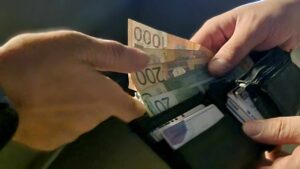
The Central Bank of Kosovo’s decree banning the use of the Serbian dinar is an attempt to create a new reality on the ground that will limit the functioning of institutions financed by the Republic of Serbia, and before the formation of the ASM, to make financing from Serbia in Kosovo transparent. The implementation of that regulation will increase poverty in Serb-majority towns and their distrust of the government, said Dragiša Mijačić, from the Institute for Territorial Economic Development.
He shared precise data, that is, the exact number of beneficiaries of funds from the Serbian budget for citizens in Kosovo. There are 87,000 beneficiaries in total, citizens who receive salaries, pensions, social welfare beneficiaries, and agricultural households.
„Facts and Figures: About 40,000 (est.+/-5%) salaries and 32,000 pensions are paid in dinars by the Republic of Serbia in Kosovo. On top of that: >10000 social welfare beneficiaries and >5000 agricultural households. In total, 87000 beneficiaries from Kosovo are dependent on the Serbian budget.”
Most of the above-mentioned funds are transferred from the Kosovo Office, whose budget for 2024 is 104.4 million euros, Mijačić added, noting that these are regular transfers.
Capital investments present additional funds, he says, mentioning the statement of Serbian President Aleksandar Vučić from 2022, in which he says that the development projects and capital investments financed by Serbia in majority Serbian areas in Kosovo amount to 800 million euros.
He also pointed out that the Kosovo government also benefits from these funds:
„A significant part of these investment funds ends up in Albanian construction companies, service industries, shops, retail, as well as in the Kosovo budget, which also contributes to inter-community cooperation and social cohesion between Albanians and Serbs in Kosovo.“
On the other hand, he points out, that the allocation funds of the Government of Kosovo for Serb-majority communities amount to 41.6 million euros in total, or only 40% of the amount the Serbian government allocates for its citizens in Kosovo.
At the same time, on January 1, 2024, Kurti announced over 12 million capital investments in ten Serb-majority municipalities in Kosovo.
Comparing these figures to those allocated for the Kosovo Serb community by the Kosovo government, Mijačić warns that it is obvious that the financial capabilities of the Kosovo government are far beneath those of the Serbian one.
„Kosovo does not have the financial means to cover the costs of education, health and social assistance schemes for the Serbian community paid by Serbia, especially not as per the existing scale.“
But the Kosovo government has the security power „to turn the lives of Serbs in Kosovo into hell, despite the fact that there are legal provisions in Kosovo that allow the Serbian government to finance the undertakings of the Serbian community.“
This is outlined in Article 143.2 of the Constitution of Kosovo. The provisions of the comprehensive proposal for the Kosovo status settlement from March 26, 2007, will take precedence over all other provisions in Kosovo:
„Let’s see what that proposal says: Article 11.1 of the comprehensive proposal for the solution of the status of Kosovo says: Municipalities shall be entitled to receive financial donations from the Republic of Serbia. This article is further operationalized in the law on self-governance in Kosovo. Article 30.2 (majority Serbian municipalities) shall be entitled to cooperate, within the areas of their own competencies, with municipalities and institutions, including government agencies, in the Republic of Serbia.“
Mijačić says that such cooperation can be in the form of Provisions of Serbian institutions for financial and technical assistance, including staff and equipment, in the application of municipal competencies.
„In other words: There are existing instruments in the legal system of Kosovo that allow financing of the Serbian community in Kosovo by Serbia,“ he points out.
According to him, it is particularly symptomatic that this regulation is being passed while, with the mediation of Miroslav Lajčak, Vučić and Kurti are negotiating provisions for the creation of the Association of Serb-majority Municipalities, which should provide a legal framework for the functioning of educational and health institutions in Serb-majority municipalities in Kosovo.
Therefore, Mijačić believes that the regulation of the Central Bank of Kosovo to ban the use of the Serbian dinar is an attempt to create a new reality on the ground that would “limit the functioning of institutions financed by the Republic of Serbia, before the creation of the ASM, and to make the financing from Serbia in Kosovo transparent“.
Mijačić warned that this, as well as all the other „unilateral decisions of the Kosovo government in the past“ will create political instability and disrupt the security in Serb-majority areas across Kosovo.
In addition, the implementation of this regulation will also increase poverty in Serbian areas and their distrust of the government, he further alerted, noting that he sent this elaboration of the consequence of the regulation to international officials, diplomats, and media outlets.
Preuzimanje i objavljivanje tekstova sa portala KoSSev nije dozvoljeno bez navođenja izvora. Hvala na poštovanju etike novinarske profesije.