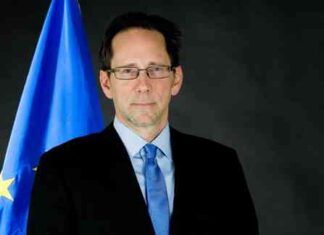
Serbian President Aleksandar Vučić said on Sunday, during an address in Belgrade and a day after meeting Ukrainian President Volodymyr Zelenskyy, that Serbia had already called in engineers and other experts to examine the possibility of diverting the Ibar River.
The statement quickly drew attention in Kosovo and prompted strong reactions in Albanian-language media, particularly over its potential implications for the Gazivode/Ujman reservoir and Kosovo’s water supply.
Vučić’s remarks came as he reflected on Zelenskyy’s visit to Belgrade and Ukraine’s continued policy of non-recognition of Kosovo, while also speaking at length about the position of Kosovo Serbs and Belgrade’s options for responding to developments in Kosovo.
Vučić did not say where such an intervention could take place, how the river might be diverted, or whether there is an actual government project to do so. He also did not identify the experts he said had already been contacted.
His remarks nevertheless carry particular weight because the Ibar feeds the Gazivode/Ujman reservoir, which plays an important role in Kosovo’s water and energy system, and because they come amid nearly two months of controversial demolitions around the lake.
“We have already called in experts”
Vučić made the announcement while discussing the position of Kosovo Serbs and what options Belgrade has to assist them.
He first ruled out military confrontation with NATO.
“Is going to war with NATO an option for us at this moment? Is that an option? I don’t think it is. We are doing everything we can to make life easier for our people, whose lives are terribly difficult,” Vučić said.
He then turned to the Ibar:
“And soon, I have to announce this to you, we have already called in experts who deal with this — people from the construction sector, engineers and everyone else… Since they are mistreating our people so much, let us see. We have various reasons for changing the course of the Ibar, and then we will see what the Albanians will do and how they will behave.”
“We are a sovereign country. Sometimes we have one set of interests, sometimes another, and we will act accordingly,” he added.
Why Gazivode/Ujman matters
The announcement comes at an especially sensitive moment around the Gazivode/Ujman reservoir.
For almost two months, demolitions have been underway at several locations around the lake.
The operation began in Čečevo/Çeçevë in late June and subsequently expanded to other locations. Holiday homes and other structures have been demolished, including the Jezero Hotel, while property owners at several locations have been instructed to submit documentation, vacate their properties or remove structures.
The Ibar-Lepenac/Ibër-Lepenc water company and Kosovo authorities maintain that the operation concerns structures built without the necessary permits or on land belonging to the company.
Some property owners, their legal representatives and Kosovo Serb representatives have challenged both the legal basis for the demolitions and the manner in which they have been carried out.
The EU called for an immediate halt to the demolitions in July and recently reiterated that request.
Vučić has commented only a handful of times on developments around Gazivode/Ujman during this period.
Following the demolition of the Jezero Hotel, he accused the Kosovo authorities of “imposing force” and demolishing the properties of people who had remained loyal to Serbia.
A day after an open letter accusing Vučić of “betrayal”
The Ibar announcement also came just one day after an open letter by Kosovo Serb politician Dr Marko Jakšić circulated widely on social media.
The immediate trigger for Jakšić’s letter was the demolition of the Jezero Hotel, owned by his relative Jordan Jakšić, as well as the broader demolition campaign around Gazivode/Ujman.
Jakšić reminded Vučić of his previous pledges concerning both the Gazivode/Ujman reservoir and the Valač/Vallaq power substation.
“At one of those rallies, you swore that under no circumstances would you give up either Valač or Gazivode. Your word proved weak, because you gave everything away,” Jakšić wrote.
He concluded by endorsing a message previously published by protesting students, telling Vučić:
“And that is why the students are right when they call you a traitor for all generations.”
There is, however, no evidence that Vučić’s announcement concerning the Ibar was made in response to Jakšić’s letter.
Vučić raised the same possibility in 2024
This is not the first time the Serbian president has publicly discussed changing the course of the Ibar.
Following the explosion that damaged the Ibar-Lepenac/Ibër-Lepenc canal in November 2024, Vučić said on December 1 that the idea had existed since 1985.
“They would be left without the entire lake. There would be no Gazivode, nothing for them. We don’t need terrorism — by a decision of the Serbian government, we change the course of the Ibar River,” Vučić said at the time.
“People, Muslims, Bosniaks from the area around Ribariće, had asked for that. We do it, and they have no lake.”
At the time, however, Vučić distanced himself from actually pursuing such a course of action, saying he did not want “nature to be used for political purposes” and that this had “never been our policy.”
The Kosovo Serb opposition movement Otadžbina reacted to his 2024 remarks by calling the idea a “nearly impossible mission.”
According to the movement, the terrain would pose enormous engineering obstacles. It claimed that one option would effectively require raising the Ibar by some 500 metres, while another could involve constructing a tunnel roughly 30 kilometres long, with potential risks for Novi Pazar.
Otadžbina also argued that such a move would raise serious questions under international law.
Albanian-language media: “Crazy idea” and “Kosovo without water”
Vučić’s latest remarks quickly made headlines in Kosovo’s Albanian-language media.
Koha took a relatively restrained approach, reporting under the headline: “Vučić says he has engaged experts to change the course of the Ibar.”
Other outlets used considerably stronger language.
KosovaPress described it as Vučić’s “crazy idea about Ujman”, while Sinjali also referred to a “crazy idea” and linked a possible diversion of the Ibar to water levels in the Gazivode/Ujman reservoir.
Gazeta Express and Zeri used similar framing, with Zeri reporting that Vučić had revived the “crazy idea” because of what he described as the “mistreatment” of Serbs.
A2 CNN went considerably further:
“Serbia will leave Kosovo without water, Vučić goes crazy and threatens: We are changing the course of the Ibar.”
That headline, however, goes beyond what Vučić actually announced.
He did not say that Serbia had decided to divert the Ibar, nor did he announce that work was about to begin. He said that experts had already been called in to examine the issue and that Serbia had “various reasons” for considering a change to the river’s course.
As of Sunday early afternoon, there had been no publicly available reaction from Kosovo institutions or leading political figures to the announcement. The first reactions came primarily from Albanian-language media.
Can the Ibar simply be diverted?
Vučić’s statement also raises a broader question: could Serbia legally and technically change the course of the Ibar?
On the basis of the information he provided on Sunday, there is no simple answer.
The Ibar is a transboundary river. It rises in Montenegro, flows through Kosovo and into the Gazivode/Ujman reservoir, before continuing north into Serbia.
Serbia and Montenegro are parties to the UNECE Convention on the Protection and Use of Transboundary Watercourses and International Lakes, which requires parties to prevent significant adverse transboundary impacts, use shared waters in an equitable and reasonable manner, and cooperate over transboundary waters.
Kosovo’s disputed international status complicates the formal interstate dimension. Serbia does not recognise Kosovo’s independence, while Montenegro does.
That political dispute, however, does not alter the geographical reality that the Ibar crosses several territories.
Any legal assessment of a possible diversion would therefore depend primarily on where the intervention took place, the scale of the works, how significantly they altered the river’s flow, and what consequences they produced downstream.
Vučić provided none of those details on Sunday.
For now, therefore, Serbia has not announced a decision to divert the Ibar.
What its president has announced is that experts have already been called in to examine the possibility.
Coming amid the ongoing dispute over demolitions around Gazivode/Ujman, however, that possibility alone was enough to place one of the region’s most politically sensitive water resources back at the centre of tensions between Belgrade and Pristina.
Preuzimanje i objavljivanje tekstova sa portala KoSSev nije dozvoljeno bez navođenja izvora. Hvala na poštovanju etike novinarske profesije.