As political discourse in Serbia continues to focus on potential “major compromises” in the ongoing dialogue with Pristina—an issue recently addressed by Serbia’s Minister for European Integration, Nemanja Starović, in an interview with Austria’s APA news agency—Belgrade-based daily Danas has published a report alleging that senior figures within the Serbian Orthodox Church (SOC) are in talks to sign a “fundamental agreement” with the Kosovo authorities. The SOC has firmly denied the claims.
The report, citing unnamed but “well-informed” church and political sources, suggests that SOC Patriarch Porfirije and Bishop Irinej of Bačka have discussed a document formalizing relations between the Church and Kosovo’s institutions. However, the SOC issued a sharp denial on the same day, accusing certain media of spreading slander and seeking to destabilize Serbs in Kosovo.
Danas: Secret Meeting and a Draft Agreement
According to Danas journalist Jelena Tasić, who has long covered both the Kosovo issue and the Church, the alleged meeting took place early yesterday morning in Belgrade. The draft agreement—leaked online and shared by some portals—reportedly states that the “SOC and Kosovo are, in their respective spheres of activity, independent and autonomous.”
The article further claims that after Serbian President Aleksandar Vučić allegedly gave consent to the Franco-German plan—now referred to as the European agreement on the path to normalization—Patriarch Porfirije issued an internal ban on public comment by clergy and bishops regarding Kosovo and related documents. Communication within the Church is reportedly being strictly monitored.
The report also claims that during the SOC’s most recent May assembly, Kosovo was not discussed beyond the regular report delivered by Bishop Teodosije of Raška-Prizren.
POKS: “Treasonous Agreement”
The right-wing political movement POKS (Movement for the Restoration of the Kingdom of Serbia) publicly called on the SOC leadership to reject what it described as a “so-called fundamental agreement” offered by the “false state of Kosovo,” claiming it aligns with the “anti-constitutional and treasonous Franco-German plan.”
“Any formal agreement between the SOC and the so-called Republic of Kosovo, as two independent contracting parties, would amount to de facto and de jure recognition of the fake state,” the statement reads.
“This paves the way for another betrayal without any real protection for the Church from Kosovo’s institutions.”
POKS leader Vladimir Jelić warned that the proposed agreement could also open the door to the creation of a “Kosovo Orthodox Church,” leading to potential long-term challenges for SOC’s control over its holy sites.
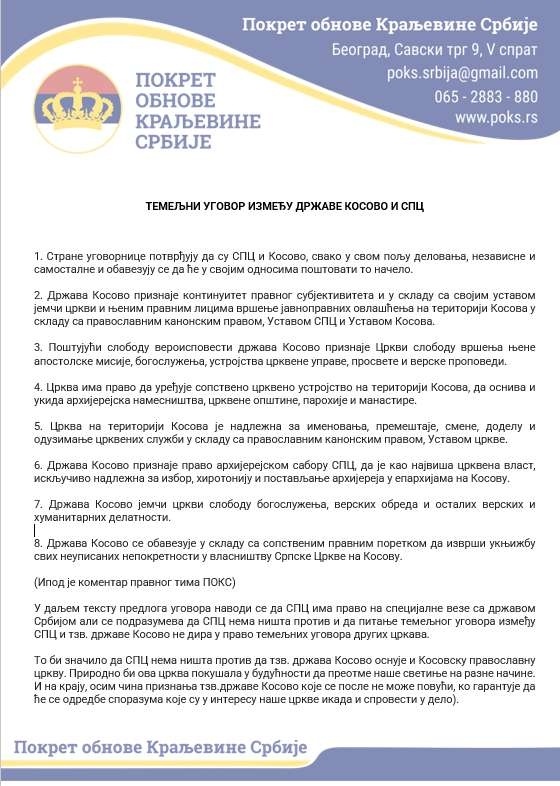
According to the draft published by POKS, the agreement includes the following provisions:
• „The contracting parties confirm that the Serbian Orthodox Church (SOC) and Kosovo, each within its own field of activity, are independent and autonomous, and commit to respecting this principle in their mutual relations.“
• „The State of Kosovo recognizes the continuity of the Church’s legal personality and, in accordance with its Constitution, guarantees the Church and its legal entities the exercise of public-law powers on the territory of Kosovo in accordance with Orthodox canonical law, the Constitution of the SOC, and the Constitution of Kosovo.“
• „Respecting freedom of religion, the State of Kosovo recognizes the Church’s freedom to carry out its apostolic mission, worship, organization of church governance, education, and religious preaching.“
• „The Church has the right to regulate its own ecclesiastical organization within the territory of Kosovo, including the establishment and dissolution of episcopal deaneries, church municipalities, parishes, and monasteries.“
• „The Church on the territory of Kosovo is competent for appointments, transfers, dismissals, the granting and revocation of church duties in accordance with Orthodox canonical law and the Church’s Constitution.“
• „The State of Kosovo recognizes the right of the Holy Assembly of Bishops of the SOC, as the highest ecclesiastical authority, to have exclusive competence over the election, consecration, and appointment of bishops in dioceses in Kosovo.“
• „The State of Kosovo guarantees the Church freedom of worship, religious rites, and other religious and humanitarian activities.“
• „The State of Kosovo commits, in accordance with its legal order, to register all unregistered real estate owned by the Serbian Church in Kosovo.“
However, the version shared by POKS does not include specific clauses on property ownership.
SOC Denial: “Malicious Fabrications”
In a statement titled “Regarding Fabrications in Certain Media,” the SOC dismissed the claims without naming Danas directly. The Church stated:
“It’s not difficult to understand that the false report about alleged talks between His Holiness Patriarch Porfirije and Metropolitan Irinej concerning the status of the Church in Kosovo and Metohija has been deliberately released to destabilize the Serbian people in Kosovo, acting in the interest of Kurti’s clique.”
The SOC reiterated its long-standing position, as previously articulated by Patriarch Porfirije during a scholarly conference in March 2024:
“After eight centuries of uninterrupted presence in Kosovo and Metohija, the Serbian Orthodox Church cannot be part of any political negotiations or agreements concerning the region’s status.”
The Church emphasized that respect for human and religious rights must be guaranteed for all—including the SOC and its faithful—and firmly rejected any political or legal model that contradicts the Gospel or the Church’s historical mission in Kosovo.
No Confirmation from Pristina, Talks of External Pressure
Danas also reports that no confirmation has come from the office of Kosovo’s outgoing Prime Minister Albin Kurti regarding the alleged agreement or potential signatories.
However, within church and political circles, speculation persists that such a deal could be part of a broader arrangement involving the United States taking a leading role in the dialogue process—potentially including the SOC.
The same sources told Danas that the SOC never authorized President Vučić to negotiate on its behalf concerning Church matters in Kosovo. Nevertheless, two internal drafts concerning the Church’s status in the region reportedly circulated within the Holy Synod in 2023, but were never formally discussed by the Assembly.
Two years ago, both Belgrade and Pristina officially accepted the EU’s “European Path to Normalization” agreement. Article 7 of the agreement stipulates that:
“Both Parties commit to establish specific arrangements and guarantees, in accordance with relevant Council of Europe instruments and by drawing on existing European experiences, to ensure an appropriate level of self-management for the Serbian community in Kosovo and ability for service provision in specific areas, including the possibility for financial support by Serbia and a direct communication channel for the Serbian community to the Government of Kosovo. The Parties shall formalise the status of the Serbian Orthodox Church in Kosovo and afford strong level of protection to the Serbian religious and cultural heritage sites, in line with existing European models.“
Preuzimanje i objavljivanje tekstova sa portala KoSSev nije dozvoljeno bez navođenja izvora. Hvala na poštovanju etike novinarske profesije.