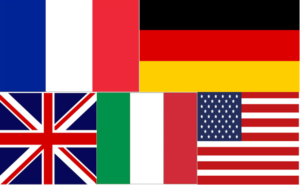
Quint countries issued a joint statement today on the recent regulation of the Central Bank of Kosovo on cash operations, expressing concern with regard to its impact on the Kosovo Serb community. They also call for the decision to be suspended in order to allow a „sufficiently long period of transition“.
“The Embassies of France, Germany, Italy, the United Kingdom, and the United States note that the recent regulation of the Kosovo Central Bank (KCB) on cash operations, which aims to reduce counterfeit cash, safeguard financial stability, as well as increase the transparency of cash flows in Kosovo, nevertheless raises concerns with regard to the impact on the Serb-majority communities in particular.”
They added that they are concerned about the impact of the regulation in particular on schools and hospitals, for which “no alternative process seems viable at the moment.”
“The regulation will also have a direct impact on the everyday lives of the overwhelming majority of Kosovo Serbs who receive payments/ financial assistance from Serbia.”
Quint ambassadors pointed out that they met with the Prime Minister on Friday to discuss the issue. They once again called for the suspension of this regulation.
“Having had an exchange on this issue with the Prime Minister on Friday, the Quint calls for the suspension of the enforcement of the regulation to allow a sufficiently long period of transition, and for clear and effective public communication,” they underlined.
Moreover, they emphasized that the issue should be discussed further in the framework of the EU-Facilitated Dialogue.
On the other hand, after their meeting on Friday, Kurti sent a call to all to „respect the constitutionality and legality of the country and the independence of the Central Bank“. He underlined that the euro is the only allowed currency for cash operations.
At the end of last year, the Central Bank of Kosovo passed a regulation on the use of currencies in Kosovo. This regulation, which foresees that the only allowed currency in Kosovo is the euro, is set to enter into force on February 1.
Although it is not specified in the text of the regulation itself, it is interpreted to mean that the Serbian dinar will not be able to be used for payment from the beginning of next month, that is, those who use it will be treated as violators of the law.
Just a day before the media reported on the new regulation of the Central Bank, Serbian President Aleksandar Vučić announced that Pristina was „considering canceling payment transactions with Serbia proper“, but also allegedly „invading Poštanska Štedionica banks“.
The news was met by an avalanche of criticism from Belgrade, but also from the international community, primarily over the manner and the short period foreseen for the implementation of the regulation.
The US Embassy in Pristina also called on the Kosovo government at the time to reconsider the decision, consult with affected communities, respond to concerns expressed by the international community, and ensure sufficient time to implement the decisions, in order to mitigate the impact of the regulation.
The head of the European Union Office in Kosovo, Tomas Szunyog, also expressed concern about the short period for adjustment before the implementation of the CBK regulation on payment transactions, stressing that it will especially affect citizens in Serb-majority areas.
The governor of the Central Bank of Kosovo, Ahmet Ismaili, also reacted regarding the issue.
He confirmed earlier this week for RTK2 that the regulation defines the euro as the only official currency for all banking transactions in Kosovo, but he also said that „no one can prohibit wages or payments from Serbia if they are in euros.“
Ismaili stressed that this regulation restricts the use of cash from „illegal financial institutions that are not licensed by the Central Bank“.
He specified that the solution can be found in the licensing of a Serbian financial institution in Kosovo by the CBK, which would use the dinar, but also „recognize“ that the euro is the official currency.
Read more:
Mijačić: 87,000 in Kosovo rely on the Serbian budget, the ban on dinar will increase poverty
Preuzimanje i objavljivanje tekstova sa portala KoSSev nije dozvoljeno bez navođenja izvora. Hvala na poštovanju etike novinarske profesije.