We will continue the renovation work even if our international partners withdraw, stated Kosovo’s Minister of Culture, Hajrulla Çeku, two years ago following a controversy over a joint project between the Kosovo government, the EU, and the UNDP to renovate the house of Xhafer Deva. The announcement came after a media outcry drew attention to Deva’s past as a Nazi collaborator and an SS Skanderbeg Division leader, which ultimately led the EU and UNDP to halt the planned restoration work.
Fast forward two years, and Kosovo’s Ministry of Culture has now confirmed an allocation of €500,000 for the complete restoration. Without clarifying the building’s specific purpose, the Ministry announced this summer that it would be used “for community service.”
Recently, photos of the nearly completed exterior of the building sparked excitement and promotion on Albanian social media, followed by harsh criticism from Belgrade. Serbia condemned the restoration as an attempt to “whitewash Deva’s criminal legacy.”
While Pristina officials have remained silent on the matter, the German Embassy reiterated its position: “Deva was a well-known Nazi collaborator and Skanderbeg Division leader—facts that cannot be separated from the building’s history.”
Efforts to restore Xhafer Deva’s house have been ongoing for years. Various contracts were signed, emergency interventions were carried out, yet the building has never been fully renovated.
The NGO “Cultural Heritage Without Borders,” involved in several such projects, reported that emergency repairs on the building were completed in 2014 as part of a broader program targeting 50 heritage sites across Kosovo. This program, co-funded by the Swedish government and the Kosovo Ministry of Culture, was aimed at preserving these sites.
In 2015, however, a fire damaged the house, and in 2016, it faced a demolition threat by the South Mitrovica Inspection Authority, which was later reversed after the Ministry of Culture earmarked funds for restoration.
Partial restorations were again conducted in 2018.
Expressing dissatisfaction with the lack of investments and delays, “Cultural Heritage Without Borders,” along with 50 other organizations, petitioned the Ministry in 2019, calling for a full restoration of this cultural heritage site, which has now gained permanent protection status as of 2023 under the name “Xhafer Deva’s Residential House – Former Old Clinic Building.”
From Announcement to Suspension
While previous restorations went mostly unnoticed by the public, this changed in 2022. In February, the Ministry of Culture announced the start of a restoration project, stating that the building holds “significant social, cultural, historical, and architectural value for the entire region.”
The restoration plans, developed by “Cultural Heritage Without Borders” and approved by the Kosovo Institute for the Protection of Monuments in October 2021, included window and door replacements, carpentry work, and facade repairs.
The Ministry also disclosed the building’s intended purpose: the ground floor would serve as a community space for cultural activities, while the upper floors would house offices for the Regional Cultural Heritage Center in Mitrovica.
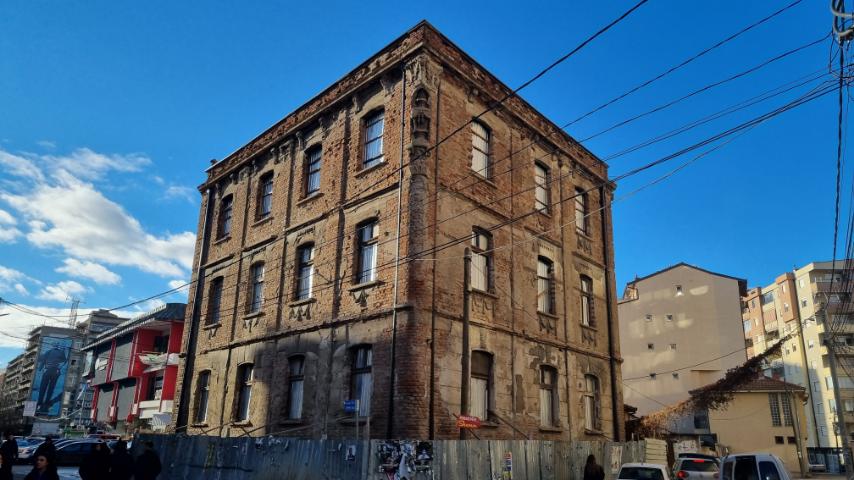
However, despite being poised to start, the project was suspended just days later, with both the UNDP and the EU withdrawing their support after a public outcry, particularly from Serbian historians, who highlighted Deva’s role as a prominent Wehrmacht figure and Nazi collaborator.
The UNDP claimed they were unaware of Deva’s background, while the Kosovo government offered a compromise, suggesting that the house need not bear Deva’s name and emphasizing its architectural value.
German Ambassador Jörn Rohde openly condemned the project, stressing that there should be “no history whitewashing.”
He reminded that while Germany supports the preservation of historic buildings, it does not overlook the crimes of their past occupants. Rohde faced backlash from Albanian social media users and some Kosovo officials, although his stance garnered international attention.
“We cannot rewrite history. Don’t distort the truth about the Holocaust or the war crimes committed by the Nazis and local collaborators,” he warned.
“We Are Not Rehabilitating Deva’s History”
Minister Çeku later criticized Rohde’s remarks, calling them premature but maintained his commitment to restoring the building, even if it would only be government-funded. Çeku emphasized that the house could be used as a cultural space without associating it explicitly with Deva.
He further argued that Albanian society has a proud anti-fascist history, helping Jews during World War II, and accused some narratives of trying to paint Kosovo as Holocaust deniers.
While announcing the restoration plans, Deva’s family called on the Kosovo Assembly to return the property to them. Valdet Deva, Xhafer Deva’s grandson, sent a request to the Assembly in 2022, claiming the property had been confiscated by Yugoslavia in the 1940s.
Funding and Future Plans
Despite the backlash, Kosovo’s Ministry of Culture confirmed in June 2023 that it had allocated a budget of €500,000 for the full restoration of the building.
Kosovo’s 2024 budget earmarks €642,966 in total for the project, with €200,000 planned for 2024 and €300,000 for 2025.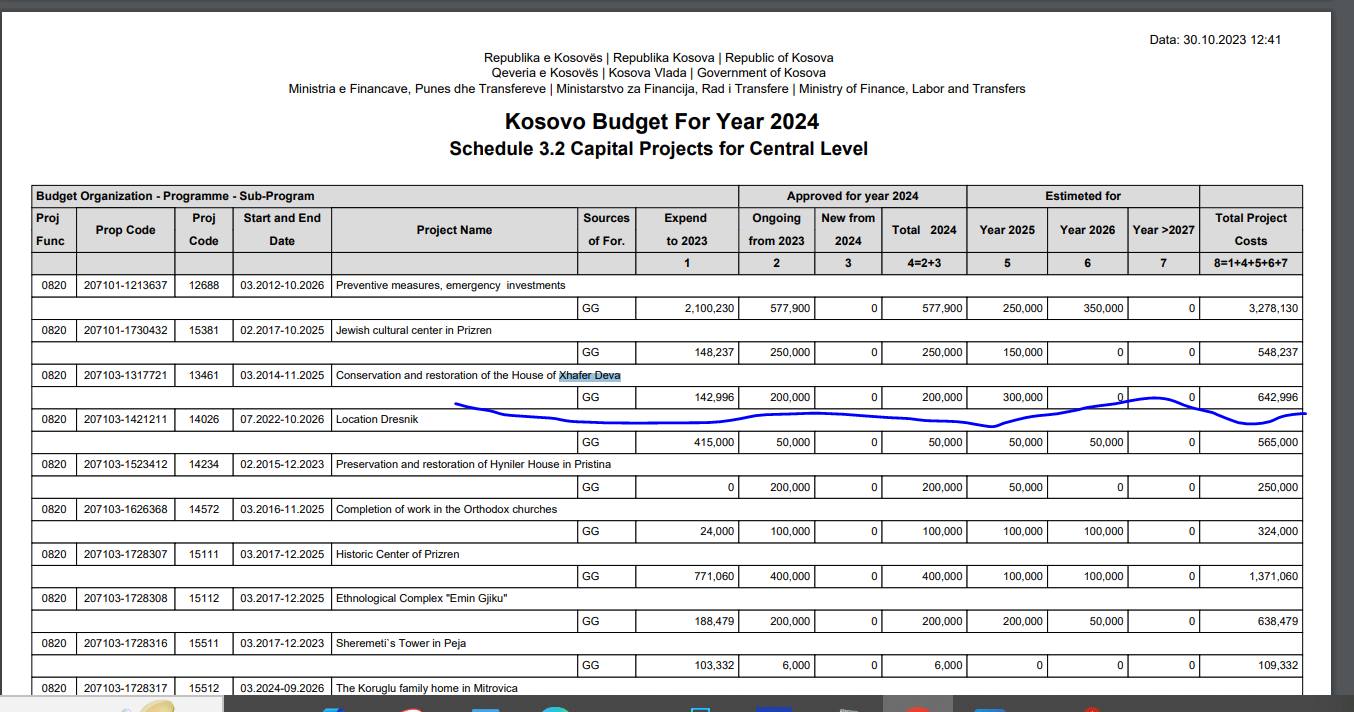
Unlike the original 2022 statement specifying the building’s use for community and heritage center purposes, recent announcements have only stated a general goal for it to serve as “a community space.”
As part of the project, “Cultural Heritage Without Borders” will again contribute to the restoration, though it remains unclear if international partners are still involved. Notably, funding details now exclusively mention Kosovo’s Ministry of Culture.
Silence from Pristina
The KoSSev portal has repeatedly requested comments from the Kosovo government over the past months regarding the project’s specifics and future use of the house, but received no response.
Despite multiple inquiries, including questions about the renovation plans, Deva’s role in the narrative, and the presence of any consulting experts for such a sensitive restoration, only the spokesperson, Perparim Kryeziu, has acknowledged receipt of the inquiries, stating he would seek answers.
Public Reactions and Further Controversy
Photos of the renovated Xhafer Deva house with illuminated interiors circulated on social media recently, drawing mixed reactions. The building’s exterior was lit in the colors of the Kosovo and Albanian flags, with social media posts suggesting it would be lit in various colors for different holidays. In contrast, German Embassy officials reiterated that Deva’s legacy is inseparable from the building’s historical context.
Meanwhile, Serbian officials have condemned the project, with Foreign Minister Marko Đurić saying that the house was illuminated in the colors of the flag of the Third Reich, labeling it as “glorification of Nazi collaborators,” which he deemed “socially unacceptable anywhere, including in Kosovo.”
Serbia’s Director of Public and Cultural Diplomacy, Arno Gujon, called on international officials to boycott any potential opening ceremony, stressing that “this whitewashing of Deva’s legacy is no path toward reconciliation or EU integration.”
While Pristina has largely stayed silent, some in the Albanian community have praised the renovation, framing it as a commendable preservation effort.
Preuzimanje i objavljivanje tekstova sa portala KoSSev nije dozvoljeno bez navođenja izvora. Hvala na poštovanju etike novinarske profesije.