This year’s Belgrade Security Forum high profile panels that included Serbian government officials were all dominated by questions and statements related to Belgrade – Prishtina relations. President of Serbia, Aleksandar Vucic, Prime Minister of Serbia, Ana Brnabic and the Director of the Office for Kosovo and Metohija, Marko Djuric all sent a coordinated message, that the final agreement must be based on a compromise. Similarly, the President of Austria, Alexander Van Der Bellen, the Ambassador of the Federal Republic of Germany to the Republic of Serbia, Thomas Schieb and the Ambassador of the United States to the Republic of Serbia Kyle Scott all called for “courageous leaders and courageous decisions”.
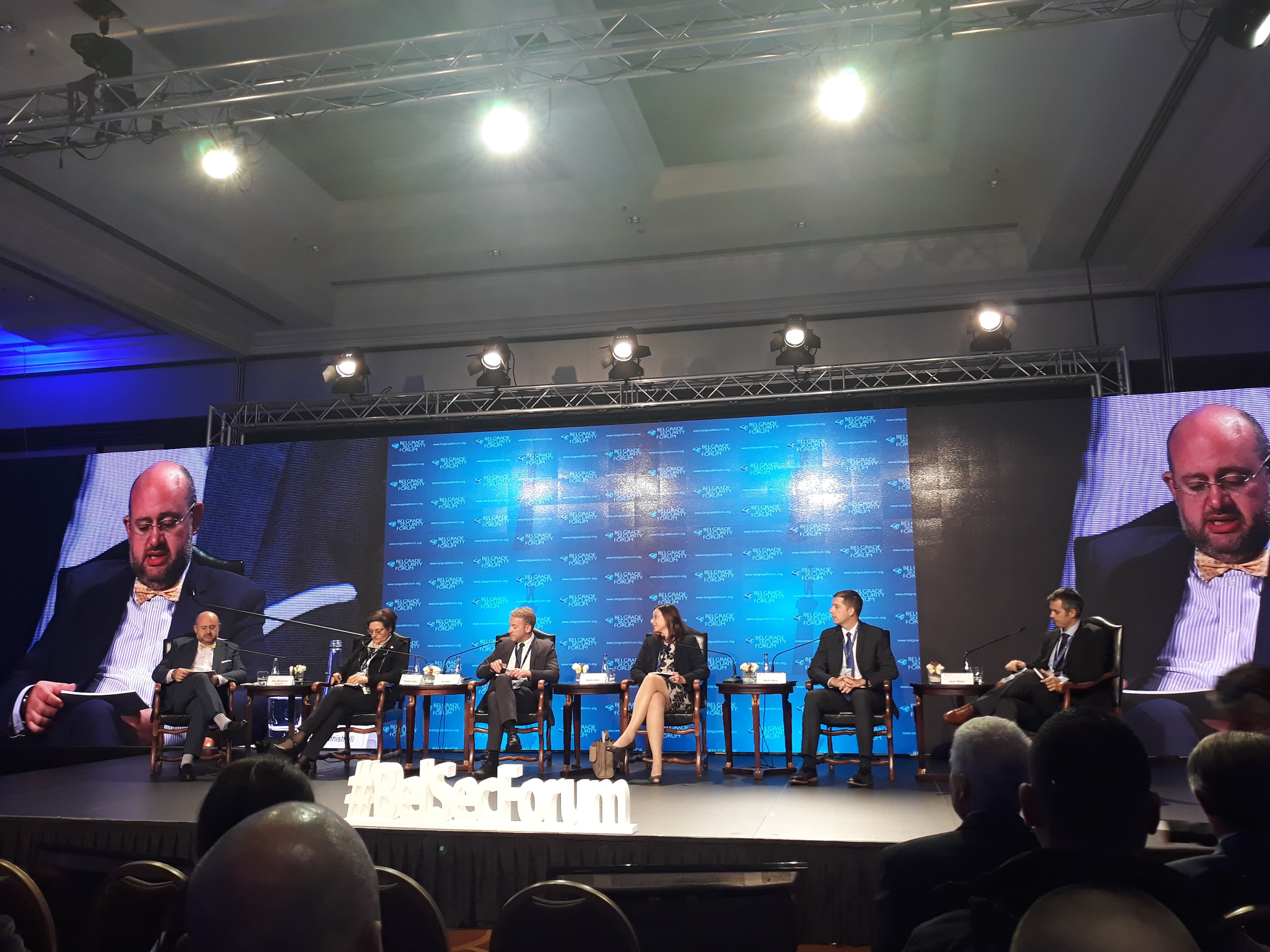
The day two panel “Where Is the New Phase of the Belgrade-Pristina Dialogue Taking Us?” was dedicated only to the negotiation process between Belgrade and Pristina. The speakers at the panel were Gordana Comic, Deputy Speaker of the Parliament of Serbia, Ilir Deda, Member of the Parliament of Kosovo, Sabine Stöhr, Head of Department for SEE, Federal Ministry for Foreign Affairs of the Federal Republic of Germany Mako Djuric, Director of the Government of Serbia Office for Kosovo and Metohija and Agon Maliqi, Policy Analyst, and Co-founding editor of Sbunker.net.
Panellists had opposing views as to how the process of the dialogue should develop further. While the representative of the German government conveyed a message that there is still a lot of open issues to discuss and find solutions to, Maliqi expressed concern that further procrastination of the process might lead to more autocratic governments and serious impairment of the EU integration process. Djuric agreed that the status quo is a dangerous scenario, but unlike Maliqi, he expects Kosovo to offer something in return for “materializing their dreams on membership of international organizations”.
Geopolitical changes made it possible for Serbia to request additional compromise
“I do believe that it is the time to cut the Gordian knot. But cutting the Gordian knot by finding a compromise. A solution that will satisfy at least some of the wishes of both Serbs and Albanians,” Djuric started by repeating the well-known position of the Serbian government.
The Director of the Government of Serbia Office for Kosovo and Metohija did not, however, clarify as to what the agreement might be, adding that he himself does not know details of the agreement that has not been made yet due to “many factors that are bringing us further away from the agreement”. He did, regardless to this, claim that the solution the two sides are aiming for is not a division along ethnic lines.
“No one here wants division along ethnic lines. But, what happened in 2008 was exactly a division on ethnic basis and along ethnic lines. When the unilateral declaration of independence was done in 2008 it was done based on aspirations of the majority Albanian people in Kosovo and Metohija. And in a territory in which, unfortunately, after all of the ethnic cleansing more than 90% of the population were ethnic Albanians. In that sense, I want to say that any kind of a solution, if we achieve it, it will definitely not mean that Belgrade or Pristina will remain without Serbs or Albanians respectively and no such solution is something we are aiming for,” said Djuric.
What he did say about the final solution was that it aims to set a precedent, a new paradigm of addressing issues in the Balkans with dialogues and agreements.
“We are aiming for a solution that would create a new paradigm in relations between Serbs and Albanians. If we reach an agreement on two core issues – the question of status and the question of territory and we Serbs and Albanians manage to shake hands on these two issues, I do believe that the overall relations between, not just Belgrade and Pristina, but Serb and Albanian people in the Balkans would change forever. It would set another important precedent in our region – that important disputes are settled, not through conflict, but through peaceful means, through dialogue and through agreement between the parties” argued the Acting Director of the Government of Serbia Office for Kosovo and Metohija.
The representative of the German Foreign Affairs Ministry, Sabine Stöhr was critical of any solution that included territory as a bargaining chip.
“We are concerned how the aim of the dialogue is being framed – that the territory is the solution to anything. And also, that it is the only solution. You said that status and territory are the issues being discussed and that status and territory are in some way cradled against each other, then the solution is there. We do not believe that this will lead to a sustainable solution as none of the existing problems will be resolved.”
To this, Djuric replied by criticizing the context in which support for Kosovo’s unilateral declaration of independence was given.
“If these (territory and status) are not core to unresolved issues, why then, did, in 2008, such a huge part of the international community stand exactly behind the idea of changing the borders and taking a certain part of territory from Serbia. In 2008 it was all about territory, it was all about our territory. And, in 2008, it was just 10 years ago, we were member of UN, recognized in our borders that included Kosovo and Metohija, we were not an undemocratic government, undemocratic regime, it was almost 10 years after the end of the conflict, we were a member of the Council of Europe, a member of the OSCE, and had a pro-Western democratic government in power following a series of democratic elections at the moment it was decided in Pristina, with the support of some to take a part of our territory. And it was all about ethnic questions and all about territorial issues,” said Djuric.
Agon Maliqi from Pristina argued that Serbia came into the position to request a compromise due to geopolitical changes but added that extensive minority rights were already a compromise and that “Kosovo has no more to give”.
“From Kosovo’s perspective, 2008 is a compromise, it’s not a unilateral declaration of independence, it’s multilateral it was done with considerable support of the West, it was part of Kosovo’s contract with the West. The agreement was, this is a territory that will be based on values and these values provide strong safeguards for minorities. Serbia does not see that as a compromise and throughout the last years as more dialogue continued, the more the geopolitical situation changed, and Serbia’s leverage has increased into neglecting the first compromise and saying that there is need for more compromise. The problem is that Kosovo has no more to give.”
Replying to this remark, Djuric said:
“I took note that Kosovo Albanians do not want pieces of territory chopped off, sorry neither do Serbs. What you see not fit for you, we do not see fit for us as well. But this means we need to look for a solution, look for a compromise that will leave us both with achieving something, getting something in a civilized, peaceful way, not through a dispute.”
Ms Stöhr weighed in by pointing out that initiatives such as the one for the transformation of the KSF are a reflection of Kosovo’s irritation at constant denial of its statehood.
“Reactions like the strive of Kosovo to secure even more of their independence and their statehood through the KSF transformation is a direct result of questioning something which Kosovo authorities and Kosovo thinks they have achieved, and that is statehood.”
Comic: We can not shake hands with fists
Gordana Comic, Member of the Parliament of Serbia in her closing remark described the process of the dialogue as an act of trying to shake hands while holding fists and argued that the Serbian and Albanian societies are ready for the deal, but that they do not have a voice.
Germany’s offer to discuss outstanding issues refused
Sabine Stöhr repeated the position of Germany on the final agreement on normalization. Germany is against the status quo and urges the agreement respect the principle of multiethnicity.
“We would like to see an agreement, because it is very obvious that the lack of the agreement is detrimental for both Kosovo and Serbia. We would say that any agreement that should be comprehensive, should contribute to regional stability and should follow the principle of multiethnicity.”
However, Stöhr also pointed out the necessity “bringing back to the table” the still unresolved issues between Belgrade and Pristina without stressing the urgency of reaching the final agreement.
“We do not see so much work being done on all the issues that had not been resolved between Belgrade and Pristina. So, first and foremost, we would give our support for a lot of work that has to be done to solve a lot of issues that are still open. They are issues of reconciliation, but there are also very concrete issues that are open. We believe that it is necessary to sit together in good spirit and with the aim to solve the problems and really tackle them.”
Replying to Mr Djuric’s complaints about Pristina’s refusal to form the Association of Serb majority municipalities while, on the other hand, Belgrade fulfilled all its duties, Ms Stöhr was categorical in stating that Germany did offer to discuss the outstanding issues of Kosovo Serbs, but that this offer was not taken. She reminded Mr Djuric that Serbia did not fulfil its agreements in relation to the energy agreement.
“We didn’t discuss the ASM, because we were told territory and status are the solution,” said Stöhr.
Commenting on Ms Stöhr’s message that the final agreement can be reached with an easier pace, Maliqi stated fear that the lack of the agreement will bring a political deadlock and affirm the positions of stabilocrats “who are able to rule because they are able to secure the problem”.
Status quo can lead to one party force the hand of the other
Agon Maliqi, an analyst from Pristina expressed fear that the lack of the solution “will contribute to the democratic backsliding” that will “increase the political risk in Kosovo, taking the frozen conflict and throwing it into a much more dangerous external environment.”
As Maliqi sees it, the political stalemate, in the short term can lead to one party forcing the hand of the other by violent means.
One thinks what historical memory teaches us about Kosovo is that very often, status quo in Kosovo is not sustainable. Remember in the 90s, peaceful protest for 10 years until in 1998 there had to be a violent eruption for that to change, in 2004 it was March riots.”
He finds that similar societal dynamics are visible now as well.
“We are approaching soon a moment where Kosovo needs to consolidate its statehood and neglection of this internal dynamic in Kosovo, the unsustainability, I fear that we are coming to a point where we will see more escalations,” warned Maliqi.
While violence is a short-term risk of the frozen conflict, political instability might be the mid-term consequence of this state, argues Maliqi. He finds that the opposition in Kosovo is not constructive when it comes to the dialogues and sabotaging, it might leave Kosovo without an EU perspective.
“Although independence is irreversible, it has come to a point that no one can take back what we already have, but with no accession future and we can have a tremendous impact on the momentum for rule of law reforms, lack of focus on education, healthcare and other real challenges.”
Although Maliqi clams the Brussels dialogue has improved interethnic relations in Kosovo, he still finds that it is the Kosovo Serb community that might fall victim to this process.
“As long as Serbs in Kosovo are seen by the majority as an instrument of Serbia, this is not a conducive environment for peace. I fear Serbian and Kosovo politicians and the international community by its lack of consensus on this issue is leading us to a very dangerous situation.”
Deda: 80% of people in Kosovo do not want division along ethnic lines
Ilir Deda, Kosovo MP, is also firmly against any territorial change. He found fault with both the Serbian and Albanian society and with those monitoring progress in the relations of the two.
“We have been stuck in the parameters of the 90s that led to the conflict. People in the West are desperate to see progress here and sometimes superficially evaluate the progress“, argued Deda.
“We cannot even start a debate why is this good or why is that bad. It’s bad, period, that’s why Yugoslavia collapsed. The quest for an ethnic redrawing of borders led to millions been displaced and hundreds of thousands of dead,” said Deda. Ha also added that 80% of population in Kosovo agree with his position.
Serbia will not deliver anything on a silver plate
Answering the question how would you persuade 80% of Kosovo Albanians who are against border change to rethink their position, Djuric stressed “we do not expect presents, we expect a fair deal, but we will not give anything on a silver plate”.
He pointed out that many in Kosovo as well as Serbia are not realistic about the situation they are currently in, one side clinging to the claims that it is independent, the other clinging to its legal acts.
“Part of our society likes to dream and live in a world is which everything on the ground is just as it is defined in our legal acts and in our political programme, the reality is that we need to achieve a compromise, a solution that will resolve the core issues that we have a dispute on. No one will bring to Pristina on a silver plate what they expect to achieve or receive when it comes to materializing their dreams about membership of international organizations or reaffirming their position in the international community without compromising with Belgrade. Equally no one will with a magic wand fulfil our view or our vision of how resolution 1244 should be implemented.”
Related articles:
Vucic: I knew that the ASM will not be formed, that is why we are discussing a compromise solution
Vucic at BSF: We need to offer something substantive to the people of WB
From BSF day one: 2025 was never serious, Unrealistic EU accession date for Western Balkans
Brnabic: Germany’s red lines are burdening the negotiation process
Preuzimanje i objavljivanje tekstova sa portala KoSSev nije dozvoljeno bez navođenja izvora. Hvala na poštovanju etike novinarske profesije.