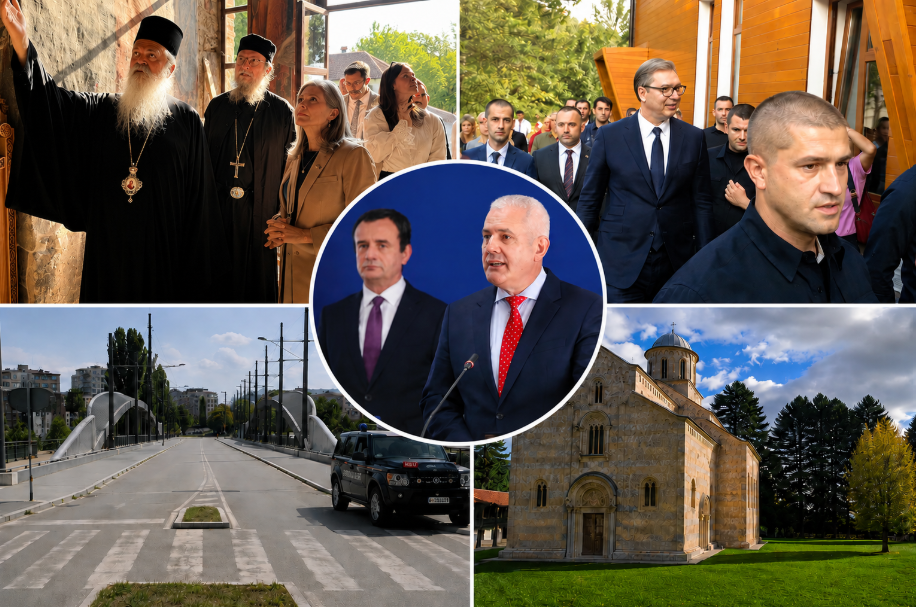
 August 10 brought parallel changes to two long-standing KFOR security arrangements in Kosovo. At the main bridge over the Ibar/Ibër in Mitrovica, the static KFOR post on the northern half was removed after years of continuous presence. At Visoki Decani Monastery, KFOR began gradually integrating Kosovo Police personnel into its security architecture after 27 years.
By the evening, Serbian President Aleksandar Vučić claimed that Belgrade had intervened after an attempt to “open the bridge” in Mitrovica, while describing the developments at the monastery as “nothing unexpected.” He also returned for the third time in less than two days to the possibility of altering the course of the Ibar/Ibër River – after first announcing that experts had already been called in and then directly mentioning Gazivode/Ujman, he now referred to the Ribariće area and called the issue Serbia’s “internal matter.”
Meanwhile, KFOR confirmed that Serbian Armed Forces Chief of General Staff Milan Mojsilović had been regularly informed about the transition process at the bridge, while Metropolitan Teodosije of Raška and Prizren said the Diocese was following the changes in Dečani/Deçan “with particular concern.”
A visible change at the main Mitrovica bridge
The first change was visible on the ground in Mitrovica.
The tent and static position used for years by Italian Carabinieri serving with KFOR were removed from the northern half of the main bridge over the Ibar/Ibër.
The Carabinieri remained present on the southern side, where their previous position was also moved. During the day, they were seen circulating toward the northern side of the bridge as well.
KFOR confirmed that a change in its own posture was underway.
The NATO-led mission said it had begun a “gradual transition of KFOR’s permanent presence” from the main bridge.
According to KFOR, the process will be gradual and conditions-based, while the mission will maintain a visible presence in North Mitrovica, South Mitrovica and elsewhere in northern Kosovo.
KFOR also confirmed another important detail: Serbian Armed Forces Chief of General Staff Milan Mojsilović was being “regularly informed about this process.”
Several hours later, Vučić offered his own account of why communication with KFOR had taken place.
Vučić: “Our intervention followed”
Speaking to Serbian public broadcaster RTS on Monday evening, Vučić first said he was about to speak with Mojsilović and assumed that the Serbian chief of staff had spoken with the KFOR commander earlier in the day.
“I am now going to speak with the Chief of General Staff. I assume he spoke with the KFOR commander today,” Vučić said.
He then connected those contacts directly to the main bridge in Mitrovica.
“Because they wanted to open the bridge on the Ibar in Mitrovica, and that is why our intervention followed – that such a thing must not be allowed,” Vučić said.
He did not specify who he meant by “they,” what exactly he meant by “opening” the bridge, whom Belgrade had approached, or what form the alleged intervention had taken.
KFOR’s statement confirms communication with Mojsilović and that he was being kept informed about the transition process at the bridge.
It does not, however, confirm Vučić’s claim that an intervention by Belgrade prevented the bridge from being opened.
The main bridge remains open to pedestrians but closed to regular vehicle traffic. Its reopening to vehicles has long been part of the EU-facilitated Brussels dialogue between Belgrade and Pristina. Under the 2015 agreement on the bridge and freedom of movement, the parties agreed on its revitalisation and reopening to traffic, alongside the transformation of King Petar Street on the northern side into a pedestrian zone. The process was never fully completed as envisaged, and subsequent attempts by the Kosovo authorities to reopen the bridge to vehicles have repeatedly become a politically and security-sensitive issue, particularly for the Serb community in North Mitrovica.
Sveçla: The process will lead to the bridge opening
Later in the day, acting Interior Minister Xhelal Sveçla spoke from the main bridge itself, offering a more explicit interpretation of the changes underway.
“Today, we are all witnessing the beginning of a process through which responsibility for security at the bridge in Mitrovica will be transferred to the Kosovo Police,” Sveçla said.
He said the process was being closely coordinated with KFOR and the Kosovo Police and described it as a short-term process that would ultimately lead to the bridge being opened.
According to Sveçla, the goal is to ensure that the opening is “good for everyone,” while a bridge that has symbolised division for 27 years would become a thing of the past.
His remarks went further than KFOR’s own statement. While KFOR confirmed the gradual transition of its permanent presence from the bridge, it did not say in its response to KoSSev that the Kosovo Police had already assumed primary responsibility for securing it.
Sveçla, however, explicitly presented the process as one in which security responsibility would pass to the Kosovo Police and linked it to the eventual opening of the bridge.
On the same day, a change at Visoki Decani Monastery
While KFOR was changing its long-standing posture at the bridge, another transition began at Visoki Decani Monastery.
KFOR announced on Monday that it had begun the gradual integration of Kosovo Police personnel into its security architecture at the Serbian Orthodox monastery.
The process, KFOR said, is part of an effort to optimise its posture in line with what it described as an improved security situation in Kosovo.
It will be gradual and conditions-based and is being coordinated with several actors, including representatives of the Serbian Orthodox Church, Kosovo institutions and the Kosovo Police.
KFOR stressed, however, that this does not mean that primary responsibility for the monastery’s security has been transferred to the Kosovo Police.
The NATO-led mission remains the first security responder for Visoki Decani.
KFOR has protected the monastery since 1999, making Monday’s development particularly significant after 27 years of international military protection.
Vučić: “Nothing about this is unexpected”
Asked by RTS about the development at Visoki Decani, Vučić said:
“For me, nothing about this is unexpected.”
He placed the decision in the broader context of Serbia’s relationship with NATO and the 1999 war.
“Do not forget, 19 NATO countries bombed us in 1999 with one single goal – to take Kosovo and Metohija away from us. They will, of course, side with them. They were not particularly concerned about Banjska, even though they knew that we did not participate in Banjska, just as they were not particularly concerned about everything else. They have to finish their game, and they will continue doing so.”
Vučić then delivered one of his sharpest assessments of Pristina and international actors during the interview:
“We think the worst of the joint action of Pristina and all international actors against the Serbian people. The worst.”
At the same time, he said Serbia should respond with patience and restraint.
“It is up to us to be patient, to be smart enough, to be responsible enough, not to rush headlong into things – not because we are afraid of anyone. I am not afraid of anyone or anything in the world, but we have to protect our country, we have to protect our children, we have to protect the future of our country and our children, and behave responsibly and seriously.”
Metropolitan Teodosije: Changes followed “with particular concern”
While Vučić described the developments at Visoki Decani as unsurprising, Metropolitan Teodosije of Raška and Prizren expressed concern over the change.
During a meeting with US Senator Joni Ernst, the Metropolitan said the Serbian Orthodox Diocese of Raška and Prizren was following the gradual inclusion of Kosovo Police personnel in KFOR’s security architecture around the monastery “with particular concern.”
He linked that concern to the low level of institutional trust and the broader security situation.
Teodosije also stressed that the latest step did not constitute a transfer of primary responsibility for protecting the monastery from KFOR to the Kosovo Police.
KFOR, he underlined, remains the first and principal security responder.
By Monday evening, therefore, changes were underway at two locations of particular security and symbolic significance for the Kosovo Serb community: the main bridge in Mitrovica and Visoki Decani Monastery.
But the bridge was not the only issue involving the Ibar/Ibër that dominated the day.

The other Ibar story: Three statements in less than two days
In parallel with KFOR’s changing security posture, Vučić returned three times in less than two days to the possibility of altering the course of the Ibar/Ibër River.
What began on Sunday as an announcement that experts had already been called in developed on Monday into a direct reference to the future of Gazivode/Ujman Lake. By Monday evening, Vučić was speaking about setting up a working group, mentioning the Ribariće area for the first time and declaring that the matter was Serbia’s “internal issue.”
He has yet to present a concrete project, identify the exact location of any potential intervention or explain what impact it could have downstream.
Sunday: “We have various reasons for changing the course of the Ibar”
Vučić first reopened the issue on Sunday, August 9, while speaking about the position of Kosovo Serbs and what Belgrade could do to assist them.
His remarks came immediately after he argued that going to war with NATO was not an option for Serbia.
“We are doing everything we can to make life easier for our people, whose lives are terribly difficult,” Vučić said.
He then made the announcement:
“And soon, I have to announce this to you, we have already called in experts who deal with this – the construction sector, engineers and everyone else… Since they are harassing our people so much, let us see; we have various reasons for changing the course of the Ibar, and then we will see what the Albanians will do and how they will behave.”
He added:
“We are a sovereign country. Sometimes we have one set of interests, sometimes another, and we will act accordingly.”
At that point, Vučić did not say where such an intervention might take place, what it would entail or what effect it could have on the river downstream.
He also did not directly mention Gazivode/Ujman Lake in the key announcement.
The possible consequences for the lake, however, immediately became the focus of reporting in Kosovo Albanian-language media.
Monday: Gazivode/Ujman enters Vučić’s message directly
A day later, during a visit to Prijepolje, Vučić was again asked about the possibility of changing the Ibar/Ibër’s course.
This time, he insisted that he was not threatening anyone.
“I am not threatening anyone at all. Why would I threaten anyone? I am dealing with waterways on the territory of the Republic of Serbia, in accordance with the domestic law of the Republic of Serbia,” he said.
He also indicated that experts would now examine how such an intervention could be carried out.
“Now, of course, scientists, engineers and everyone else will sit down, look at it and come to me with a proposal on how to carry it out, and that is it.”
Vučić again rejected the suggestion that his words constituted a threat.
“I am not Kurti, threatening people. I am not threatening anyone,” he said.
“We will simply deal with our own problem. We have our own interests, you know; we are taking care of our own interests, and that is it.”
But unlike on Sunday, Vučić then directly mentioned Gazivode/Ujman.
“And where Gazivode Lake is, where it is today, where it was yesterday – I do not know whether it will be there tomorrow or where it will be.”
He added that, in his view, there was no one there to be endangered, referring to the Serb population in the area.
This marked a significant shift from Sunday’s statement.
A day earlier, Gazivode/Ujman had primarily featured in media interpretations of what changing the Ibar/Ibër’s course could mean. By Monday, Vučić himself had directly brought the lake into his remarks.
Monday evening: “What does the Ibar have to do with Albania?”
Several hours later, Vučić returned to the issue for a third time, this time during an interview with Serbian public broadcaster RTS.
He was asked about reactions in Pristina and Albania to his remarks and about the issue being raised with Brussels.
Vučić responded:
“Of course. What else are they going to do? Whatever you say, they will turn to Brussels, because they no longer know what to do with themselves.”
He then said:
“What does the Ibar have to do with Albania? What does it have to do with any of them in any way? That is our internal issue.”
It was during this answer that Vučić introduced another new element – the Ribariće area.
“First of all, I only said: we will convene a working group, set up a working group to see where it suits us, [regarding] problems somewhere around Ribariće, I do not know exactly where. To see, to assess what this is about, and then we will see.”
“There is no great philosophy to it,” he added.
The wording was less specific than his earlier statement in Prijepolje that scientists and engineers would propose “how to carry it out.”
But it was the first time in this new series of statements that Vučić had publicly referred to a geographical area in Serbia in connection with the issue.
His phrase – “somewhere around Ribariće, I do not know exactly where” – still leaves unanswered where any potential intervention would actually take place.
From “how to carry it out” to a “working group”
Taken together, the three statements show how Vučić’s public presentation of the issue developed over less than 48 hours.
On Sunday, he said experts had already been called in and spoke of “various reasons for changing the course of the Ibar.”
On Monday in Prijepolje, he said scientists and engineers would submit proposals on “how to carry it out” and directly raised the question of whether Gazivode/Ujman would be where it is today “tomorrow.”
By Monday evening, he was speaking of establishing a working group, referring to “somewhere around Ribariće,” and describing the issue as Serbia’s internal matter.
What remains absent from all three statements is a publicly presented technical proposal.
Vučić has not specified the location of a possible intervention, its scale, how much it could affect the Ibar/Ibër’s flow or what consequences it could have downstream.
Vučić Says Serbia Is Considering Diverting the Ibar River, Raising Questions Over Gazivode/Ujman
Pristina: Water cannot be used as an instrument of threat
The statements prompted an official reaction in Pristina.
Acting Minister of Environment, Spatial Planning and Infrastructure Fitore Pacolli described Vučić’s remarks as “deeply concerning and unacceptable.”
She specifically referred to the Ibar-Lepenac/Ibër-Lepenc system.
“Statements by Serbian President Aleksandar Vučić on the possibility of intervention in water resources and infrastructure connected to the Ibër-Lepenc/Ibar-Lepenac system are deeply concerning and unacceptable,” Pacolli said.
Referring to the Helsinki Convention, she said states have obligations concerning cooperation over the fair and reasonable use of transboundary waters, prevention of transboundary harm and protection of aquatic ecosystems.
“Water resources cannot be used as an instrument of threat, pressure or destabilisation against another state,” she said.
Pacolli added that Kosovo would protect its water resources, critical infrastructure and the interests of its citizens.
Sveçla: “Serbia has not changed. Kosovo has”
Acting Interior Minister Xhelal Sveçla also commented on Vučić’s announcement about potentially diverting the course of the Ibar/Ibër while speaking from the main bridge in Mitrovica on Monday evening.
Asked about the latest statements coming from Belgrade, including Vučić’s remarks on the Ibar/Ibër, Sveçla said Pristina was continuously hearing statements which, in his view, threatened Kosovo’s sovereignty and security, but that such messages no longer surprised him.
“Serbia has not changed. It is the same as it was in 1998–1999, the same as in previous years. But Kosovo is no longer the same,” Sveçla said.
“Kosovo is becoming stronger, Kosovo is genuinely moving forward and is ready to assume all responsibilities in order to guarantee security for everyone,” he added.
Not a new idea – but a markedly different tone from 2024
The possibility of changing the Ibar/Ibër’s course did not appear in Vučić’s rhetoric for the first time this weekend.
He discussed the idea in late 2024, following the explosion that damaged the Ibar-Lepenac/Ibër-Lepenc canal in Zubin Potok/Zubin Potok.
At the time, Vučić said the idea of altering the river’s course dated back to 1985.
He even described what the consequences could theoretically be: diverting the Ibar/Ibër in a way that would leave the other side without Gazivode/Ujman Lake.
But his conclusion at the time was substantially different from his statements this weekend.
Vučić said he had opposed using nature for political purposes and stated:
“That has never been our policy.”
That distinction is central to the latest developments.
In 2024, Vučić raised the possibility only to distance himself from it.
In August 2026, he has said experts have already been called in, spoken of engineers proposing “how to carry it out,” directly questioned the future location of Gazivode/Ujman, and announced a working group while mentioning the Ribariće area.
Why Gazivode/Ujman matters
Gazivode/Ujman is a key component of the Ibar-Lepenac/Ibër-Lepenc system, which is important for water supply, electricity generation, industry and irrigation in Kosovo.
The Ibar/Ibër itself is a transboundary river. It rises in Montenegro, flows through Serbia and then Kosovo, feeding Gazivode/Ujman Lake, before eventually flowing back into Serbia.
That geography is particularly relevant to Vučić’s repeated description of the issue as one involving Serbia’s sovereignty and domestic law.
Any assessment of the practical and legal implications of altering the river would depend on facts that have not yet been made public: precisely where an intervention would take place, what form it would take, how significantly it would affect the river’s flow and what consequences it would produce downstream.
Gazivode/Ujman already at the centre of another dispute
Vučić’s statements come amid weeks of tensions around Gazivode/Ujman, where structures including holiday homes and Hotel Jezero have been demolished since late June.
Kosovo authorities say the structures lacked the necessary permits or stood on land belonging to the Ibar-Lepenac/Ibër-Lepenc enterprise, while property owners and representatives of the Kosovo Serb community have challenged both the legal basis and the manner in which the operation has been carried out.
KoSSev learns: Ibar-Lepenac continues issuing eviction notices in Kovače
The European Union called for an immediate halt to the demolitions in July.
It was against that backdrop that Vučić revived the possibility of changing the Ibar/Ibër’s course – moving in less than two days from a reference to altering the river, to Gazivode/Ujman itself and finally to the Ribariće area.
Kurti warns of Serbia’s “hegemonic goals” as Vučić defends military build-up
The security developments around the Ibar/Ibër, Mitrovica and Visoki Decani were accompanied by another exchange of sharply contrasting messages from Pristina and Belgrade.
Earlier in the day, Kosovo’s acting Prime Minister Albin Kurti used the Ninth Conference of Kosovo Ambassadors in Pristina to warn about Serbia’s growing military capabilities.
According to Kurti, the issue goes beyond simple modernisation of the Serbian Armed Forces.
“The increase in Serbia’s military capabilities is not merely an attempt to modernise its army, but part of a broader political and diplomatic strategy directly linked to its hegemonic goals toward our region, and particularly toward Kosovo,” Kurti said.
He linked that assessment to what he described as a more sensitive regional security environment and the influence of Russia in the Western Balkans.
Kurti also spoke about broader changes in global security, including geopolitical tensions, great-power competition, artificial intelligence, quantum computing and new forms of hybrid threats.
He cited Kosovo’s partnership with NATO and bilateral defence cooperation as key pillars in strengthening its security capacities.
Kurti also referred to the trilateral defence cooperation framework involving Kosovo, Albania and Croatia, as well as bilateral cooperation with the United States, Türkiye, the United Kingdom and other countries.
Vučić: A strong army is needed “to protect our country and our people”
Later that evening, Vučić did not directly respond to Kurti’s statement.
But speaking to RTS about Serbia’s defence industry and arms production, he offered a very different justification for Serbia’s military build-up.
“I am responsible both for importing weapons and for producing weapons here, so that our army is strong, so that we can protect our country and so that we can protect our people,” Vučić said.
His remarks came on the same day Kurti had characterised Serbia’s growing military capabilities as part of a wider strategy tied to “hegemonic goals.”
Vučić, however, framed military strength as a matter of national protection and state interest.
At the same time, when speaking specifically about Kosovo, he stressed that Serbia’s current room for action remained primarily political.
“At this moment, it is difficult to find other technical means and methods of struggle apart from politics, peaceful means and economic progress, because peace brings us the most right now,” he said.
He added that Serbia should continue strengthening itself economically and institutionally while waiting for broader changes in the international order.
By the end of August 10, the messages from both sides had converged around the same themes – security, sovereignty and control – while on the ground, two KFOR arrangements that had stood for decades were already beginning to change.
Preuzimanje i objavljivanje tekstova sa portala KoSSev nije dozvoljeno bez navođenja izvora. Hvala na poštovanju etike novinarske profesije.