KoSSev organised a debate on the topic of territory exchange as a possible model for reaching the final, binding agreement between Kosovo and Serbia, what are pros and cons. The speakers at the debate were Agon Maliqi, policy analyst and co-founder of Sbunker.net, Marko Jaksic, Assembly Member in the Municipal Assembly of North Mitrovica and Miodrag Marinkovic, Program Director of NGO AKTIV. The discussion was originally supposed to take place in EU Information and Cultural Centre, but the permission for the event was unofficially denied shortly before it was planned to start – the time the translating equipment was already installed and guest and participants were present. The EUICC staff from Pristina claimed bureaucratic booking procedures have been violated. The event took place at KoSSev newsroom following a short delay.
Prior to the discussion the speakers were asked to declare their position towards the idea. Mr Marinkovic categorically opposes the idea stating that “it brings victims in its wake”. Mr Maliqi said that he opposes the idea on principle, but not if the alternative means not reaching any agreement at all, while Mr Jaksic, who emphasized that the political party he is a part of has not taken an official position towards this idea and is thus speaking in his own name, supports this idea because he sees it as the only way for part of Kosovo Serb community to remain living in this geographic area. “Serbs are leaving in massive numbers, whatever is done, there will be no Serbs left living in Kosovo. Secession of this part of the territory is the only hope for Serbs to remain living here.”
The points of the discussion focused on two main themes.
The first thematic segment focused on the negotiating position of Serbia which has seemingly now gone from Serbia must recognize Kosovo that dominated in 2013 to Serbia should be offered something to recognize Kosovo which seems to be the current position of the part of the international community, mainly the U.S. administration.
During the last week, the President of Serbia partook in a panel organised during the 8th Belgrade Security Forum where he said that the he always knew ASM will not be implemented, further implying this was a negotiation tactics.
Agon Maliqi from Pristina stated that he shares this view of Serbia’s improved negotiating position and he explains that this change happened due to the “deadening” of the negotiating process. The fact that the process of negotiation is “clinically dead” he contributes both to the pace of the implementation of the agreements and Serbia’s diplomatic campaign against Kosovo which has caused a lot of damage for Kosovo citizens.

„Diplomatic efforts of Serbia to block Kosovo, as well as the fact that the Association of Serb-majority Municipalities was not formed, both lead to this current development. We now have a situation in which both sides do not agree on what they negotiated. When it comes to the ASM, the Kosovo side sees the ASM as an NGO, while Serbia, signing the agreement conceded to the interpretation of the Constitutional Court of this document. Now Serbia refuses to accept the decision and the process is dead,“ explained Maliqi.
Miodrag Marinkovic, on the other hand, is of the opinion that Serbia has amassed this negotiating leverage due to the fact that there has been a realisation that Kosovo has gone as far as it could have without Serbia, and that, for it to progress further, it needs some sort of consent from Serbia. He, however, is not satisfied with the way Serbia is using this leverage, claiming that it has been monopolised for the personal interests of one political party.
“What did Serbia do with this potential? Instead of suggesting something positive for the community, they have offered a good party solution that will keep Serbian Progressive Party in power for the next twelve years. And this solution will bring Serbia nothing more than 50.000 refugees,” stated Marinkovic.

Jaksic claimed that the changed negotiation position of Serbia is a combination of both, in addition to external factors and the changes in the geopolitical circumstances.
Marinkovic sees the fact that borders are discussed as a proof that the Brussels concept was abandoned long ago. He claims that the discussion of territory exchange would not have even been possible without a serious diplomatic effort, which he estimates, must have lasted for at least two years. This is how long it took the parties in the dispute to bring major actors on board and this is how long the idea of ASM has been abandoned. He also added that the territory of south Serbia is a hook for the Albanians, as everyone had to gain something „from this idea.
The change in the American administration, the growing influence of Russia in the Balkans and failure of the Brussels process to truly bring improvements into the everyday lives of the citizens is a combination of factors that led to this development. The changes in the position of the Americans he sees in individuals such as John Bolton who has, back in 2008 recommended a similar solution, but also in the countering of the Russian influence materialised in the Prespa agreement and NATO membership of Montenegro. However, the Brussels process and the undemocratic nature of its implementation have also led to issues on the ground.
„The Brussells process, instead of bringing solutions, has caused even more problems. People were integrated by force, no one asked them if they wanted this or not. The only thing that mattered to them was the percent. The best example are the 2013 elections when some 20 percent of people were forced to go out (and vote) in the elections and this was declared a success,” recollects Jaksic. “No one in the EU reprimanded the irregularities of those elections.”

The second part of the discussion was aimed at understanding the possible consequences of the territorial exchange as a solution and possible alternatives to this process.
Marinkovic is of a firm position that territorial exchange will also lead to constitutional changes in Kosovo that will abolish the majority of the rights and mechanisms for the protection of minorities. He finds that the status of the Serbian language as an official language will be in danger, that the “double majority” will be nullified, etc.
Jaksic replied that none of these mechanisms have been effective thus far, as exemplified through the current level of respect of the Serbian language and the initiative to override the double majority in the attempt of the expansion of the KSF mandate.
A commentator from the audience colourfully described the Kosovo Albanian public as “Kostunica in 2008”, refusing everything that was offered and showing no flexibility.
Maliqi somewhat agreed with this remark, explaining that Kosovo society, in large, is both against the territorial exchange and against the ASM. He explained that this is due to the fact that both ideas are not explained properly, while the idea of Association is “contaminated” with a sense of danger of defunctionalisation of Kosovo originating from the political discourse coming from Belgrade and reiterated in Kosovo. He does not see the ASM happening at this point and says that from a very meager percentage of people who would opt for one option or the other, more would opt out for the territory-based solution. Maliqi also added that, if presented with the full details of this territory-based solution, a higher percent of the public in Kosovo would be in favour of it.
For Jaksic, any alternative to territory exchange will eliminate any possibility of a future for the Kosovo Serb community. He rejects the possibility of violent escalations and further claims that an agreement between Serbia and Kosovo, based on a mutual consensus, would benefit Belgrade – Pristina relations. As he describes it, now only the Serbian side feels like a “loser” in the process, which is cause for a lot of tensions in the formal relations, and territorial exchange might tip the scales.
There had not been a lot of discussion in relation to the modalities of exchange, or location of the potential future borders. The speakers however did agree that the exchange might not include the whole north with the Ibar as border. They also added that leaving Mitrovica within Kosovo might help keep the constitutional rights of Kosovo Serbs.
Finally, the speakers and the audience discussed whether the reaching of a final agreement means that Serbia will have to recognize Kosovo, the opinions were divided. Marinkovic does not think that Serbia will be conditioned with this, but that, instead it will have to concede to some sort of limited membership of Kosovo in the UN. Jaksic disagreed, claiming that Serbia will be forced to a definitive act of recognition. Maliqi also stated that Kosovo will not accept the agreement that is anything less but the recognition, as this is the only thing that might unblock Kosovo’s EU path.
Maliqi also predicted that the next few months are going to be of extreme importance for the process.
“If there is no international consensus on this question, I think that the two sides will have to opt to create a new reality in the field, which frightens me. However, I do think that they will reach some kind of a solution, but I do not see a scenario in which Mitrovica is not a part of Kosovo,” said Maliqi.
EU denies premises for the debate
The debate on the topic „Delimitation / Partition – Pros&Cons“ organized by KoSSev portal – which was scheduled to be held in the EU Info Center in North Mitrovica premises – was canceled by the EU Information Office in Pristina an hour before the start of the event.
Citing an unofficial (verbal) explanation provided by the employees of the EU Info Center, shortly before the event start, the EU Information Office in Pristina banned the event from taking place in the EU premises – where a booking request had been sent on Friday.
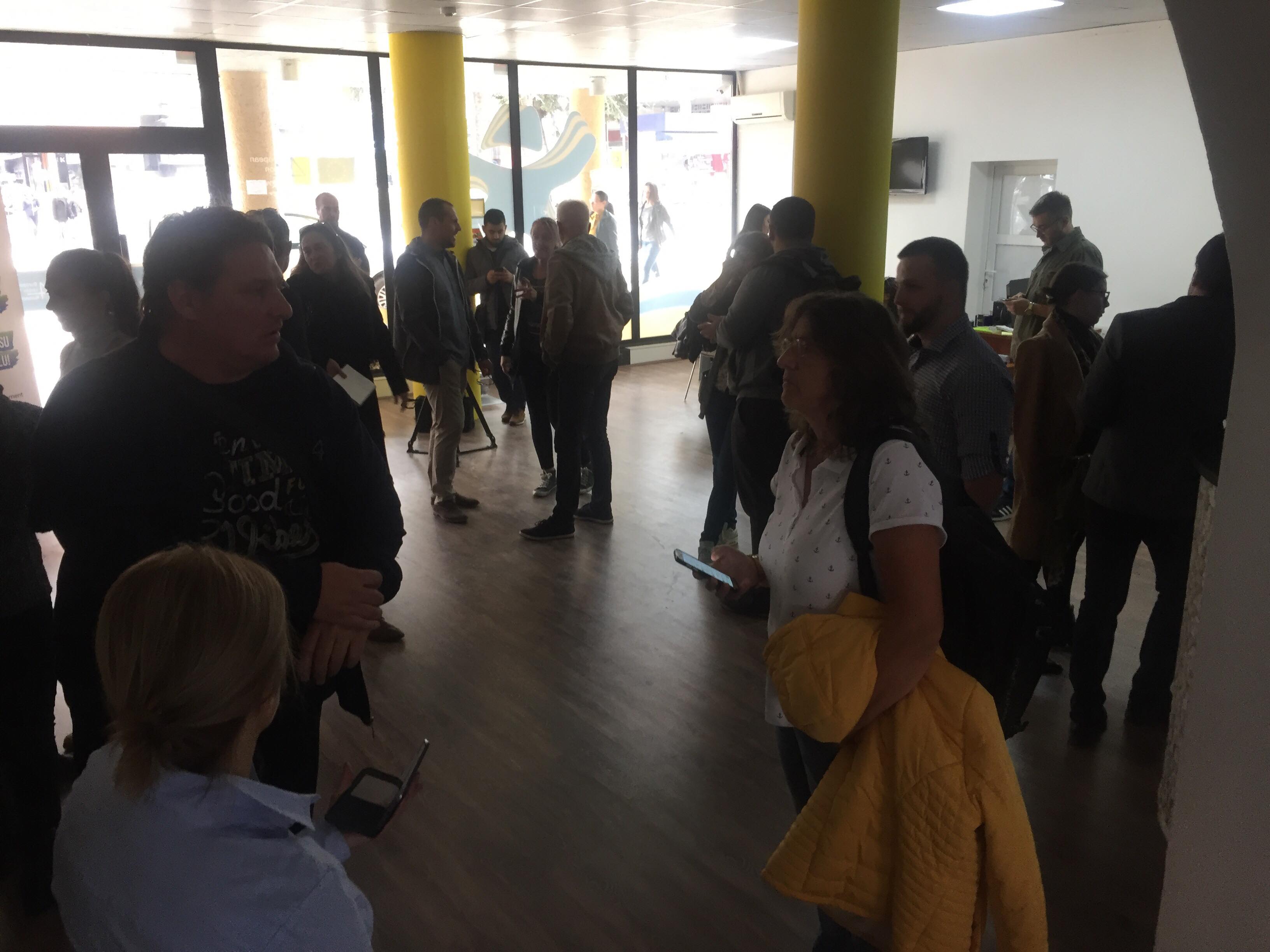
Lazarevic: If this is how the issues are being resolved at a high political level, then you understand why we found ourselves at such a Brussels dead end.
The editor of KoSSev, Tatjana Lazarevic, said that by the beginning of the event, they were unable to get in contact with the officials of the EU Office, despite continuous calls and alert and clarification messages to their spokesperson Dinka Zivalj.
The team leader of the EUICC, Vjosa Berisha, also refused to talk to the editor, providing an explanation via one of the EU Mitrovica staff that she will „send an email“, Lazarevic added shortly before the event.
She said that one could unofficially hear in EU info Mitrovica office that Pristina’s reasoning was a „late booking“ of the space and that events are usually announced two weeks in advance.
The official reply from Vjosa Berisha, however, arrived in the late afternoon in which she confirmed that the request for reservation was sent late and that it was necessary to book the space at least ten days in advance.
Dinka Zivalj responded later during the day, after the news of what happened was published. She stated that she was hospitalised: „I see you mentioned me. I have private issues, I am not in Kosovo, this is why I could not respond when you called earlier. I am not familiar with these developments. As soon as I could, I forwarded the message to my colleagues.“
EUICC in North Mitrovica did not host any other events yesterday.
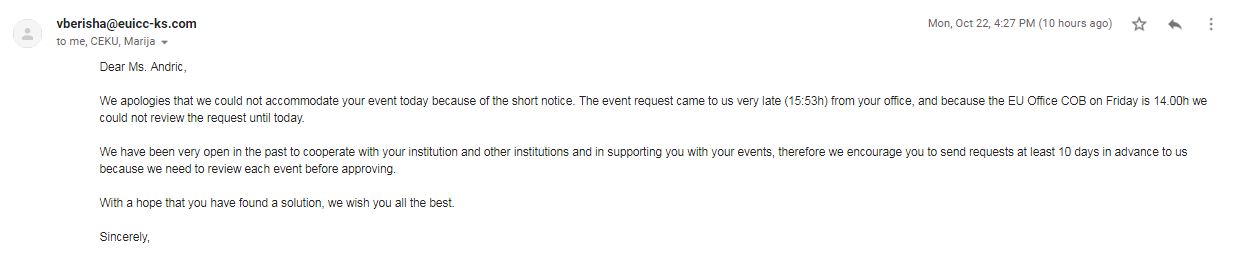
However, as Lazarevic stressed, it is known that several events have also been booked only a couple of days in advance, and that this is common practice for the office in Mitrovica that can be easily confirmed as a common shared experience, while taking into account that this office in Mitrovica has so far been open to civil and media initiatives, with the aim of promoting freedom of speech, multiculturalism, multi-ethnicity, education and public debate and the promotion of European values.
No bureaucratic rule can replace the lack of consideration that the EU Information Office in Pristina demonstrated today, said Lazarevic.
She raised criticism against the professional work performance of the EU Information Office in Pristina.
Even if we, as the organizers of this event, made a mistake in not booking it two weeks in advance, they on their side have not demonstrated any will or flexibility to consider the well-being of promoting the idea of freedom of speech, pluralism of opinions, open debate on the key topic for the public at the moment, she emphasized.
„Today we are talking about something that is basically being talked about in Brussels all the time – the idea of delimitation. I do not see why the local community is being denied the right to talk about it, why civic activists are being denied their right to talk about it. If this is how the issues are being resolved at a high political level, then you may understand why we have found ourselves at such a Brussels dead end. You can understand exactly what happened at the high level, just based per such a small example,“ said Lazarevic.
Preuzimanje i objavljivanje tekstova sa portala KoSSev nije dozvoljeno bez navođenja izvora. Hvala na poštovanju etike novinarske profesije.