The St. Peter of Korisha Hermitage, a significant Serbian Orthodox historical monument dating back to the 13th century, has been severely damaged during construction works carried out by the municipal authorities of Prizren, the Raška-Prizren Diocese announced on Wednesday. The works were reportedly conducted in violation of the Law on Specially Protected Zones, which safeguards historical complexes, including this ancient religious site. Furthermore, these activities were carried out without the consent or knowledge of the Serbian Orthodox Church, which is now calling for immediate action from both international and local institutions to halt further desecration of the site.
A Threat to Archaeological Integrity
The St. Peter of Korisha Hermitage, the largest monastic complex in a cave, is one of oldest and most significant Christian landmarks in Kosovo. It holds immense historical value, not only for the Serbian Orthodox community but for all Christians worldwide.
The site has long been a target of destruction, particularly after the post-war period in Kosovo following 1999. As a result, it was included in a system of specially protected zones alongside other important Serbian Orthodox monasteries in the region.
However, this cultural heritage has now suffered further damage during construction work undertaken by the Prizren Municipality.
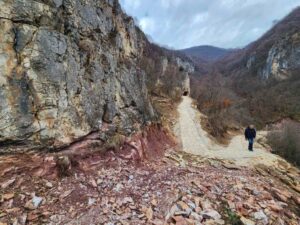
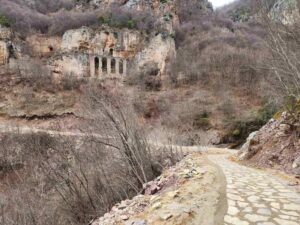
According to the Diocese’s statement, the Economic Development and Tourism Directorate of the Municipality carried out excavation work to create and pave a pathway leading to the cave where the hermitage is located. In addition, the foundation of this medieval complex has been undermined, jeopardizing the structural integrity and archaeological value of the site.
Violation of Law and Lack of Church Consent
The works were executed in direct contravention of the Law on Specially Protected Zones, under which the hermitage is one of 50 protected sites. This law stipulates that such religious and historical sites must be preserved and protected from inappropriate development.
The Diocese highlights several key provisions of the law. Article 1 ensures the protection of Serbian Orthodox monasteries, churches, and other religious sites, as well as historical and cultural landmarks of special importance to the Serbian community in Kosovo. The hermitage is specifically listed in Article 7r, with a designated protected zone mapped around it.
The law also mandates that any development or intervention within these zones must be approved by the Serbian Orthodox Church and the Council for the Implementation of Protected Zones. Despite these clear legal requirements, the Prizren Municipality proceeded with the works without consulting or obtaining approval from the Church.
“The law explicitly prohibits any intervention in these areas, including road construction or vegetation clearance, without the Church’s consent,” the Diocese stated.
“By bypassing this requirement, the Municipality has flagrantly violated the law and endangered this valuable historical site.”
The works were reportedly carried out by the local Kosovo-Albanian company “EUROVIA,” and the Diocese has provided photographs of the construction activities.
A Deepening Crisis for Serbian Heritage
The Diocese has expressed strong protest against the local authorities, accusing them of displaying a blatant disregard for the preservation of Serbian Orthodox heritage. The Diocese emphasized that the ongoing damage to the complex, including the use of heavy machinery and the careless disposal of construction debris, suggests that cultural heritage experts were not involved in the planning of the works.
“The unprofessional conduct of these works is evident,” the Diocese said.
The Diocese also warned that the vandalism and damage inflicted upon this medieval holy site mirrors the broader disregard for Serbian heritage across Kosovo, where many religious sites have been subjected to brutal desecration and attacks over the years.
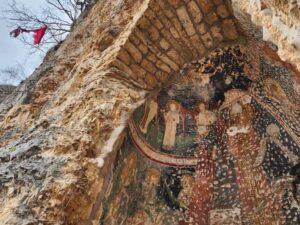
The Hermitage of St. Peter Korisha, for instance, has previously been damaged, with graffiti on medieval frescoes and the placement of an Albanian flag above the site after the 1999 conflict.
Urgent Call for Action
In response to this violation, the Diocese has called for immediate action from both local and international institutions. It is urging the European Union, EULEX, the OSCE, KFOR, and other relevant bodies to intervene and halt the illegal works.
The Diocese also demands that Kosovo’s local authorities take responsibility for the damage caused and ensure that the site is protected in full accordance with the law.
The Diocese also plans to notify UNESCO and other international organizations dedicated to the protection of cultural heritage about the ongoing threats to this historical site.
The Historical and Moral Significance of the Hermitage
Beyond the legal aspect, the Diocese stressed the profound moral and historical significance of the St. Peter Korisha Hermitage for the Serbian Orthodox Church and the wider Christian community.
Dating back to the 13th century, the hermitage is mentioned in Serbian medieval texts, including the Life of St. Peter Korisha, written by the monk Teodosije Hilandarski. The site was also a metochion of the Hilandar Monastery on Mount Athos and has been visited by Serbian rulers, including Emperor Stefan Dušan in the 14th century.
For centuries, the hermitage has been a place of monastic devotion, known for its rich library of manuscripts. Given its historical importance, it has rightfully earned a place within the system of specially protected zones, they added.


Preuzimanje i objavljivanje tekstova sa portala KoSSev nije dozvoljeno bez navođenja izvora. Hvala na poštovanju etike novinarske profesije.