A group of Serbian civil society organizations on Kosovo expressed concern over a recent visit by students from a technical school in Peja/Peć to the Peć Patriarchate, warning of what they described as the promotion of “historical revisionism” and a broader pattern of contested interpretations regarding Serbian Orthodox heritage.
In a joint statement, 13 NGOs called on local institutions, educational and cultural bodies, as well as international actors monitoring human rights, religious freedoms and cultural heritage, to clarify the circumstances surrounding the incident.
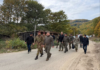
According to publicly available information, students and teachers from the “Rifat Gjota” Technical School visited the Peć Patriarchate on March 30, accompanied by representatives of the Peja/Peć City Museum. During the visit, media reports indicate that interpretations were presented describing the complex as an “old Albanian church”.
In a related social media post, the Patriarchate was described as a complex of “early pre-Romanesque and Byzantine churches” that were allegedly “systematically transformed into Raška-Serbian Orthodox churches”.
Claims were also made that restoration works carried out during the 20th century and between 2006 and 2008 led to the “degradation” and “destruction” of older layers said to document earlier Christian periods.
As part of the visit, a lecture on the “development of the Albanian church in Peja/Peć” was delivered by archaeologist Sefer Lajçi from the local museum.
Images circulating from the visit also appear to show some students displaying Albanian national symbols within the monastery grounds.
“Serious concern” and call for investigation
The NGOs said such claims are “historically unfounded” and expressed concern that these interpretations were presented to students within a functioning religious site.
They described the incident as:
“A serious violation of the sanctity and purpose of a religious site, as well as a departure from the basic standards of responsible education, professional ethics and respect for freedom of religion.”
The organizations emphasized that the Peć Patriarchate is a protected religious and cultural monument, listed as a UNESCO World Heritage site and recognized as one of the most significant sites of the Serbian Orthodox Church.
They warned that:
“Any attempt at politicization, arbitrary reinterpretation or ethnic appropriation represents an attack on the dignity of the Serbian Orthodox Church, on the right to peacefully enjoy religious and cultural heritage, and on efforts to build interethnic trust.”
“Part of a broader pattern”
The NGOs further stated that the case does not appear to be an isolated incident.
“It seems to be part of a broader pattern of contested interpretations, provocations and attempts to alter the character and identity of Serbian Orthodox heritage in Kosovo,” the statement said.
They cautioned that such developments risk further straining already sensitive interethnic relations, deepening mistrust and undermining efforts to build a society based on mutual respect, equality and the rule of law.
The organizations called for a prompt and thorough investigation, urging authorities and international actors to take measures to prevent similar incidents.
They also stressed that protected religious sites must remain spaces of respect, professional responsibility and peaceful coexistence — not venues for:
“the dissemination of historically controversial, ethnically charged and potentially politically inflammatory narratives.”
Historical context
Long-standing archaeological research and internationally recognized historical sources identify the Peć Patriarchate as one of the most important monuments of medieval Serbian culture.
The complex became the seat of Serbian archbishops in the mid-13th century, and later patriarchs. It consists of four churches built between the 13th and 14th centuries, associated with prominent Serbian ecclesiastical figures such as Archbishop Arsenije I, Nikodim II and Archbishop Danilo II.
Since 2006, the Peć Patriarchate has been included on UNESCO’s World Heritage List as part of the “Medieval Monuments in Kosovo,” where it is defined as a masterpiece of Serbian-Byzantine architecture and a spiritual center of the Serbian Orthodox Church.
While scholars acknowledge that many medieval churches in the Balkans were built on earlier Christian or Byzantine foundations — a common historical practice — this does not alter the established identity, function and artistic heritage of the current complex.
Today, the Peć Patriarchate remains both a historic seat of the Serbian Orthodox Church and a repository of significant artistic and cultural heritage.
Preuzimanje i objavljivanje tekstova sa portala KoSSev nije dozvoljeno bez navođenja izvora. Hvala na poštovanju etike novinarske profesije.