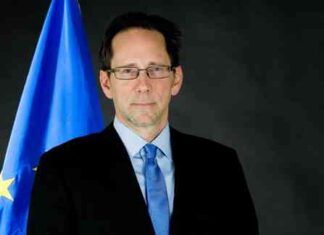
By Dragutin Nenezic
It now appears all but certain that on Monday, February 27th, the representatives of Belgrade and Pristina will accept the Franco-German plan (no longer a proposal) in Brussels or at least agree to „implement“ it in some upcoming period abiding by some kind of „roadmap“ – thereby avoiding full stigmatization in their communities. Simultaneously, it will represent a symbolic gesture of Belgrade’s inclusion in the current world conflict, a couple of days after the anniversary of the outbreak of the fratricidal war in Ukraine. In this text, I would like to highlight a couple of consequences of such a course of events, which I believe to be of huge consequence for the future of Serbs in Kosovo.
Will it concern the recognition of Pristina by Belgrade?
I think that the joint legal machinery of Brussels, Belgrade and Pristina, and possibly Washington, will be focused on defending the stance that this is not a matter of formal recognition of Pristina by Belgrade.
Arguments used in the decisions of the Court of Justice of the EU will probably be employed, which read as follows on the topic of Pristina’s statehood:
30) It follows that the provisions of the TFEU relating to ‘third countries’ are clearly intended to pave the way for the conclusion of international agreements with entities ‘other than States’. Thus, the European Union may conclude international agreements with territorial entities, covered by the flexible concept of ‘country’, which have the capacity to conclude treaties under international law but which are not necessarily ‘States’ for the purposes of international law. To claim the contrary would be to create a legal vacuum in the European Union’s external relations.
31) In that connection, it should be noted that European Union has concluded a number of international agreements with entities other than sovereign States. These include the agreements concluded with the Palestine Liberation Organisation (PLO), the Separate Customs Territory of Taiwan, Penghu, Kinmen and Matsu, the Government of the Hong Kong Special Administrative Region of the People’s Republic of China and the Macao Special Administrative Region of the People’s Republic of China.
32) It should also be noted that the European Union has entered into several international agreements with Kosovo, thus recognising its capacity to conclude such agreements. It concluded the Kosovo SAA under Article 217 TFEU and the Framework Agreement between the European Union and Kosovo on the general principles for the participation of Kosovo in Union programmes (OJ 2017 L 195, p. 3) in accordance with Article 212 TFEU. The conclusion of those agreements was legally possible only because the concept of ‘third country’ referred to in those provisions of the TFEU could be construed broadly, thereby allowing the European Union to regard Kosovo as such.
(2020 first instance judgment) as well as:
43) In the present case, the General Court concluded, in paragraph 30 of the judgment under appeal, that the provisions of the FEU Treaty relating to ‘third countries’ pave the way for the conclusion of international agreements with entities ‘other than States’. It is on that basis that the General Court held, in paragraph 35 of the judgment under appeal, that the concept of ‘third country’ used in EU primary law cannot be construed differently when the same concept appears in a provision of secondary legislation such as Article 35(2) of Regulation 2018/1971. It inferred from this, in paragraph 36 of the judgment under appeal, that the scope of the concept of ‘third country’, within the meaning of Article 35(2), goes beyond sovereign States alone. (…)
52) That treatment of Kosovo as a third country does not affect the individual positions of the Member States as to whether Kosovo has the status of an independent State that is claimed by its authorities, as the first footnote to the decision at issue indicates.
53) It follows from the foregoing that, contrary to what is claimed by the Kingdom of Spain, Kosovo may be treated in the same way as a ‘third country’, within the meaning of Article 35(2) of Regulation 2018/1971, without infringing international law.
(second-instance judgment from January of this year)
Thus, Pristina is not a „state“, but it has a certain international legal capacity (namely, it is a „country“), and it seems that this will remain the case for the EU until all member states recognize it. In this sense, it will be argued that Belgrade did not formally and directly recognize Pristina’s statehood, but no one will be able to dispute that it additionally renounced its claims to its own statehood and territorial integrity by explicitly agreeing that Pristina continues to act in the international field independently.
The examples from the judgment (Palestine and Taiwan) show that this does not always have to be the case, but with this Belgrade will thus confirm that it is neither Israel nor China when it comes to its own statehood and territorial integrity. Most importantly, it will be argued that this solution is fully in line with international law, probably by (incorrectly) referencing the advisory opinion of the International Court of Justice.
Will the so-called ASM be formed?
Pristina will likely agree to this, but in accordance with the decision of its own constitutional court, which I have already written about on several occasions.
In order for that to happen, elections will either have to be held in the disbanded municipalities in northern Kosovo, or illegitimate assemblies (where they exist) will have to decide on behalf of those municipalities, or even worse, some kind of imposed administrators, who are being considered in an asymmetric triangle Pristina-Brussels-Washington (or an even more asymmetrical quadrilateral that includes London).
I will write more about the (il)legality and (il)legitimacy of such behavior if it comes to that, but I would like to briefly note that no interpretation could make such a thing valid. However, it would certainly not be the first time, and it definitely won’t be the last time Pristina violates all its legal acts from the constitution and more with international support and cooperation.
Will the police force withdraw from the north of Kosovo?
I am positive that this will not happen until the Serbs return, according to the same principle that I expect conditions for the formation of the ASM to be created.
It is possible that after the escalation of shame at the public discussions held in recent weeks, the expropriation for the purpose of building bases for those forces will simply die, out without a formal suspension, but this will certainly not affect their withdrawal.
The comments of international structures, both political and security, confirm this to some extent – it can be heard that the police have every right to be there, but that they violated trust, so in this sense, we can expect increased activities of those structures related to „(re)building trust“.
Conclusion
Everything hints at the conclusion that the implementation of the Franco-German plan will take place primarily at the expense of Serbs from northern Kosovo. Belgrade can condition them via its financial support to return to the institutions, that is, to participate in the elections and apply for competitions (therefore, they will not be paid what they are entitled to for leaving the institutions if they do not return to those institutions), while the international factor will slowly persuade them to accept their own occupation (thus, embracing those who came to „replace“ them when they left the institutions).
This pathological situation cannot end well – for starters, some people already, and unfortunately there will be more of them, are unable to return to their homes for various security reasons, unless a general amnesty is declared, as was the case between the first barricades and the „first agreement“.
Also, bearing in mind the general anti-Serb attitude of Pristina on the one hand, and Kurti’s need to justify to various structures that he did not capitulate on the other, it is to be expected that Pristina will continue to harass Serbs from northern Kosovo even more than it was the case before.
Finally, in the codification of the reduction of jurisdiction through the ASM, those who will not be affected by the previous two things will also suffer.
The only glimmer of hope I see is the unity shown in recent weeks at the public discussions on the expropriation in Leposavic and Zubin Potok. It gives me hope that the missed chances to formulate an authentic North Kosovo, and then Kosovo-Metohija Serb policy, may not be totally wasted, to use a Kurti-esque term. But for that to happen, those who are affected by the negotiations must be included in the negotiations, starting with the Serbs from Kosovo and beyond, otherwise different fields of non-institutional struggle will begin again.
The opinions and views expressed represent the views and opinions of the author and do not necessarily reflect the views of the editorial office or donors.
Preuzimanje i objavljivanje tekstova sa portala KoSSev nije dozvoljeno bez navođenja izvora. Hvala na poštovanju etike novinarske profesije.