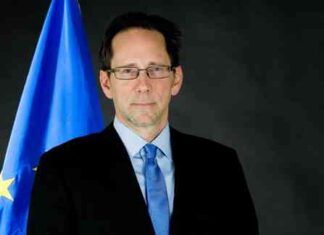
Twenty-six years after the February 2000 violence in northern Mitrovica, Kosovo’s Prime Minister Albin Kurti recalled what he described as a campaign of ethnic cleansing carried out by the Serbian state.
In a statement marking the anniversary, Kurti said:
“On the night between February 3 and 4, 2000, the state of Serbia, through the police and the criminal paramilitary group ‘Bridge Guards,’ carried out ethnic cleansing in northern Mitrovica against the local Albanian population. Ten Albanians were killed, 25 wounded, and 1,564 families – totaling 11,364 people – were expelled. The people and the state of Kosovo forget no one and nothing, not even once!”
Kurti also linked the events to more recent security concerns, noting that actions by the Kosovo government in northern Mitrovica and across the north:
“Must be seen in the context of the events in February 2000 in Mitrovica, as well as the terrorist attack in Banjska on September 24, 2023, aimed at annexing territory.”
The February 2000 Violence
The violence came shortly after an explosion at the popular Bel Ami café, a key gathering place for young Serbs in northern Mitrovica. Of three hand-thrown bombs, one exploded, seriously injuring more than ten people, some suffering amputations. The incident triggered retaliatory attacks by local Serbian groups against Albanian civilians in the north, resulting in 10 deaths and mass displacement.
According to Faton Peci, mayor of southern Mitrovica, commemorations tomorrow will include the unveiling of a memorial plaque on the new pedestrian bridge connecting north and south Mitrovica, an exhibition of photographs from February 2000, and candle-lighting. Peci described the events as the “Night of Terror,” stating that around 12,000 Albanians were expelled from northern Mitrovica.
Discrepancies in Numbers
Official Kosovo sources, including Kurti, frequently cite 12,000 displaced Albanians. However, a UNHCR report from February 11, 2000, notes that only 4,500 Albanians were recorded living in northern Mitrovica before the violence, and just over 630 registered with UNHCR after the events. UNHCR estimated the real number of displaced to be much higher, as many fled quietly to join family and friends in other parts of Kosovo, often leaving property behind that was looted or sometimes occupied by ethnic Serbs.
This contrast highlights a long-standing difference between official Kosovo accounts, international agency records, and testimonies of local residents from northern Mitrovica, a point of scrutiny for observers when assessing the actual scale of displacement and the way the events have been represented in different narratives.
Responsibility and Legal Proceedings
Albanian media and officials have repeatedly linked the February 2000 violence to organized structures of the Serbian Ministry of Internal Affairs, naming retired MUP colonel Dragan Delibašić and the late Serbian politician Oliver Ivanović.
Delibašić was acquitted of all charges related to war crimes by Kosovan authorities in 2016. Ivanović, meanwhile, was killed in 2018 before the appeals process concluded; in 2016, he was acquitted for events in 2000.
Kosovo Albanian discourse, however, continues to associate both men—and by extension the Serbian state—with responsibility for the 2000 events. Meanwhile, Serbian media have largely focused on Serbian victims from the same period, and coverage of the events has largely faded in recent years. Albanian coverage, by contrast, emphasizes the suffering of Albanian civilians, a contrast that has become more pronounced over time.
Remembering the Victims
Kosovo officials, including Kurti and former Prime Minister Ramush Haradinaj, followed by Albanian media, have named Albanian victims: Nezir Voca, Sebiha Abrashi, Selime Berisha, Nerimane Xhaka, Remzije Canhasi, Niman Sejdiu, Bashkim Rrukeci, Muharrem Sokoli, and Nderim Ayeti. According to official accounts, they were among the first targeted by Serbian parallel structures in Mitrovica.
“Glory to the fallen on February 3 and 4, 2000,” Haradinaj wrote, reflecting the enduring emphasis on Albanian victimhood.
Rebuilding and Present-Day Mitrovica
Kurti highlighted what he describes as the city’s transformation:
“Once ethnically cleansed of local Albanians, Mitrovica now hosts all citizens of Kosovo freely, regardless of ethnicity: Albanians, Serbs, Bosniaks, Roma, Turks, and others. Kosovo is a democratic state that treats all citizens equally.”
According to Kurti, over the past four years, more than 150 homes have been built or rebuilt across four northern municipalities, allowing displaced families—including Mustafa Behrami and his family—to return. Kosovo officials present these efforts as part of a broader, reportedly state-led initiative to address the long-term consequences of the February 2000 violence.
Divergent Narratives
The events of February 2000 remain a point of contention in media narratives:
Serbian media primarily recall the injury and deaths of Serbian civilians, largely omitting Albanian victims, and in recent years coverage of the events has almost entirely receded.
Albanian media and officials continue to highlight the scale of Albanian suffering, with annual commemorations, memorials, and public statements keeping the memory alive.
This divergence underscores a persistent selective remembrance, where each side emphasizes its own losses, while international observers note discrepancies between official figures, local claims, and UN reports. This contrast, along with the disputed scale of displacement, remains a key focus for those analyzing the region’s contested historical narratives.
Preuzimanje i objavljivanje tekstova sa portala KoSSev nije dozvoljeno bez navođenja izvora. Hvala na poštovanju etike novinarske profesije.