Years of struggle for justice
Milorad Đoković, from the village of Vitomirica near Peć, spent years fighting a legal battle to reclaim the property he abandoned during the 1999 war. Despite court rulings in his favor, municipal authorities in Peć persistently refused to enforce the court’s decision. Unfortunately, Đoković’s story is not unique—dozens of Serbs who have tried to reclaim their property have faced similar obstructions. His fight reached a climax when he was arrested on charges of war crimes, raising questions: Are these charges part of a larger political game?
What does the case of Milorad Đoković say about the justice system in Kosovo?
Written for KoSSev by: Darko Dimitrijević
The case of Milorad Đoković, a returnee to the village of Vitomirica near Peć, is not just the story of one man’s battle for the right to his property, which the author of this article, as a journalist, has followed for a decade. It is also a reflection of the complex and controversial legal and political circumstances in Kosovo.
Đoković’s long struggle, which began as an attempt to reclaim the property he abandoned during the 1999 war, culminated in his arrest on war crimes charges.
This story raises many questions about the functioning of the judicial system in Kosovo, as well as the treatment of Serbs in Kosovo who face attempts to reclaim their property rights and, in many cases, end up accused of alleged war crimes.
Property Rights and Non-Enforcement of Court Decisions
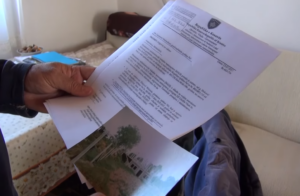
After the conflict, Milorad Đoković left his property in the village of Vitomirica, as did many other Serbs from Kosovo. Two decades later, he managed to win a Supreme Court of Kosovo ruling affirming his right to reclaim his property. This ruling, along with several other lower court decisions, clearly indicated that Đoković had the right to the property that the local authorities had seized.
However, the municipal authorities in Peć persistently refused to enforce the court’s decision. Instead, the ruling was repeatedly delayed on the basis of other administrative resolutions, casting doubt on the judicial system and the rule of law in Kosovo.
This case is not isolated—many Serbs in Kosovo, and there have been cases involving other communities as well, face similar problems when attempting to reclaim property, suggesting a systematic obstruction of court rulings regarding Serb property rights.
Despite the final ruling by the Supreme Court, Milorad Đoković never managed to regain possession of his land. This clearly points to a lack of respect for judicial decisions and a violation of the principle of legal security, a cornerstone of any democratic society.
Not only are the rights of Kosovo Serbs being neglected, but in practice, the legal system is not applied equally to all citizens of Kosovo.
Arrest on War Crimes Charges
After more than a decade of fighting to reclaim his property, Đoković was arrested in 2022 on charges of war crimes. The indictment accuses him of participating in a 1999 attack on Albanian civilians in the village of Ozrim and committing numerous other crimes. There is no concrete evidence apart from the testimonies of several witnesses who only after so many years remembered that Đoković was a “war criminal.”
The most controversial aspect of this case is the fact that the charges were brought only after Đoković had secured a final ruling on the return of his property. This raises questions about the political motivation behind the charges and the timing of the arrest.
The fact that witnesses in this case came forward with their statements only after 17 years, following Đoković’s return to Kosovo, further adds to the suspicion that the entire process was initiated to hinder, or even prevent, the return of Kosovo Serbs.
The right to a fair trial is guaranteed by international conventions, yet Đoković was detained for more than a year before an indictment was filed, which may suggest a violation of his basic rights.
During his time back in Vitomirica, Đoković lived openly. He participated in many public debates, was active in civil society, appeared in the media where he spoke about property rights issues, and eagerly anticipated the restoration of the church in his village.
Despite his willingness to cooperate with authorities on any issue, he was arrested just before Vidovdan on June 27, 2022, and is now facing trial for the most serious war crimes.
The Political Dimension of the Case
Đoković’s case reflects a broader issue faced by Serbs returning to Kosovo. Many of them encounter numerous administrative and legal obstacles when attempting to reclaim their property. Furthermore, some, like Đoković, face criminal prosecutions that appear politically motivated.
The challenges Serbs face in reclaiming property in Kosovo are numerous. They deal with direct and indirect discrimination, problems with retrieving ownership documents, illegal occupation of their property, and difficulties accessing courts. Additionally, there are cases where returnees have been accused of war crimes, further complicating their legal battles.
Such cases can often be interpreted as attempts to discourage Serbs from returning to Kosovo. In international law, such actions can be seen as violations of the right to a fair trial.
The question is whether these charges and criminal proceedings represent a genuine fight against impunity for war crimes or are part of a broader strategy of political pressure on Kosovo’s Serbs.
Demolition of the House and Continuation of the Struggle
While Milorad Đoković awaits the end of his trial, his house, the subject of the dispute, was demolished to the ground despite the court’s ruling that it should be returned to him.
This act further highlights the fragility of property rights for Serbs in Kosovo and how vulnerable returnees are to political and legal maneuvers.
The demolition of the house is not just a physical loss—it is a symbolic display of the judicial system’s failure to protect basic human rights. There is almost no reaction to such issues from international representatives.
The case of Milorad Đoković illustrates how difficult it is to achieve justice in Kosovo, especially when it comes to the rights of Kosovo’s Serbs.
The disregard for court decisions, politically motivated charges, and administrative obstacles have become a daily reality for returnees.
While the international community often emphasizes the importance of the rule of law, on the ground, the situation looks very different.
In the end, Đoković’s case is not just the struggle of one man for his property—it is a battle for justice in a society where the rules are not applied equally to everyone, where political games often overshadow the law, and where the rule of law remains an ideal on paper without concrete action from the international community.
The author is the director of Radio Goraždevac.
Preuzimanje i objavljivanje tekstova sa portala KoSSev nije dozvoljeno bez navođenja izvora. Hvala na poštovanju etike novinarske profesije.