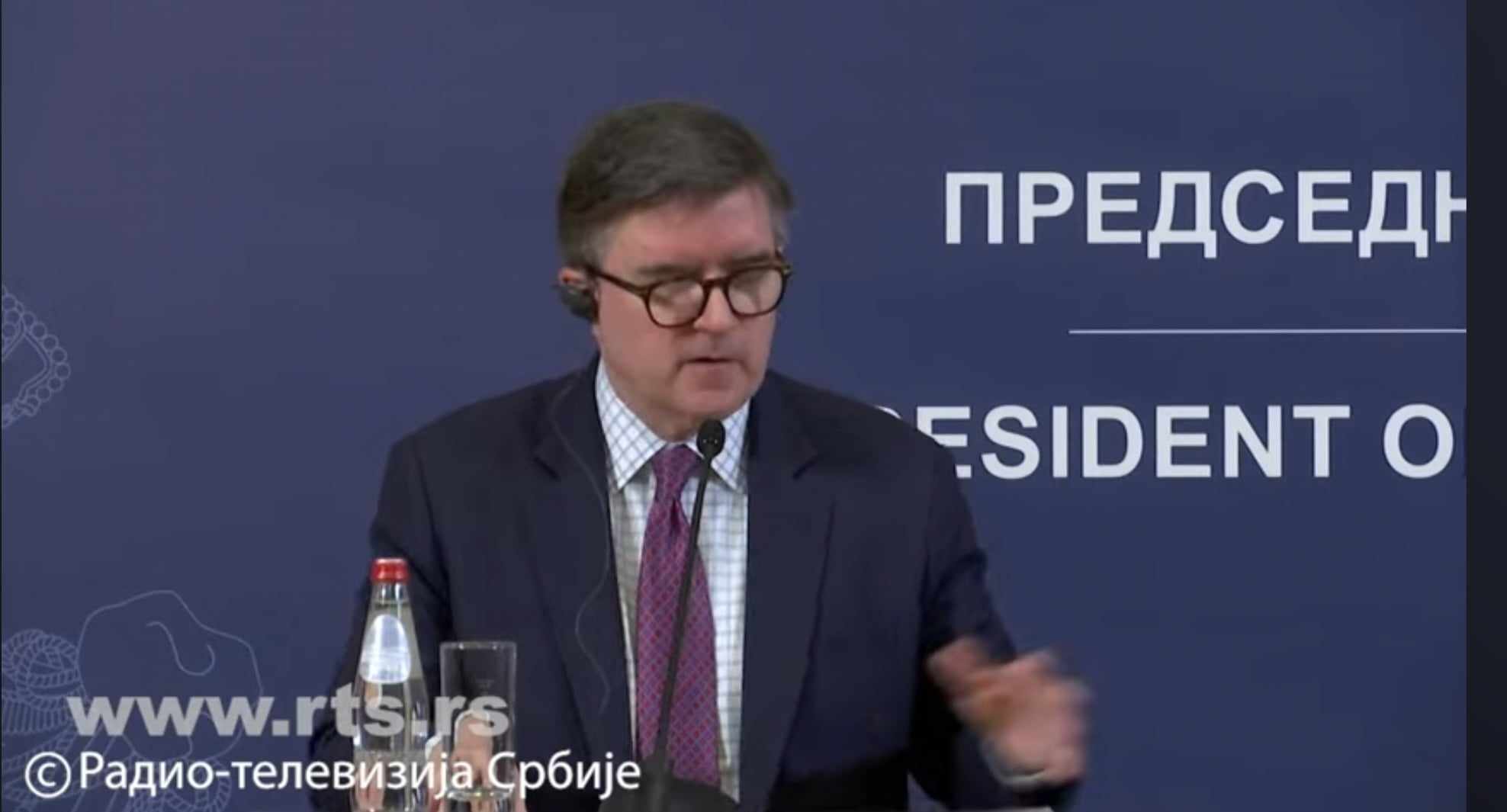
During an interview with RTS this morning, James O’Brien, U.S. Assistant Secretary of State for European and Eurasian Affairs, stressed the importance of furthering discussions around the formation of the Association of Serb-Majority Municipalities (ASM) in Kosovo. However, O’Brien emphasized that progress must be made on the integration of Kosovo Serbs into everyday life before the official establishment of the ASM.
“The Community of Serb Municipalities must be submitted to the Constitutional Court for review. However, there should also be a broader dialogue, meaning that Serbs in Kosovo, as half of those living south of the Ibar are already doing, are integrated—we want this to happen in the North as well.,” O’Brien said.
O’Brien, who has been in Belgrade since yesterday, is accompanied by Angelina Eichhorst, the Executive Director for Europe at the European External Action Service. Their meetings with Serbian officials, including President Aleksandar Vučić, have focused on Serbia’s European integration and the situation in Kosovo, particularly concerning the Serb community.
After his meeting with the U.S. and EU officials, Vučić took to social media to express concern for the challenges facing Serbs in Kosovo.
„I informed them in detail about the situation in Kosovo and Metohija, and I expressed my deep concern about the daily challenges faced by the Serbian people there,“ Vučić wrote.
In an interview for RTS this morning, O’Brien echoed this concern, stating that agreements made during the Belgrade-Pristina Dialogue need to be respected, with the key objective being that Kosovo’s Serbs should live as normal European citizens.
“It’s essential that Serbs in Kosovo live normal lives, have their marriages and children registered, and be integrated into the system,” he added.
While recognizing the importance of the ASM, O’Brien insisted that practical improvements for Kosovo’s Serbs must happen before its formation.
“The obligations exist since 2015, but the most important thing is that the Serbs live as normal European citizens,” he remarked.
U.S. Support for Dialogue, Not Sanctions
O’Brien clarified that while the United States plays an active role on the ground, it is not the venue for the ongoing negotiations between Serbia and Kosovo.
“What’s important is that the rights of all citizens, regardless of nationality, are protected,” he noted.
The diplomat also welcomed Pristina’s recent decision to lift the ban on imports from Serbia. He is scheduled to travel to Pristina today, where he will discuss ways to improve the flow of goods across the border, not just from Serbia, but from other countries as well, including Germany and the U.S.
“Opening the border crossing is a success, but there’s a lot of traffic moving through there, and that will redistribute over time as other crossings open,” O’Brien explained.
O’Brien also addressed the question of potential U.S. sanctions against Kosovo’s government, reiterating that the focus is on dialogue rather than punitive measures. He pointed out that Kosovo’s failure to coordinate its actions with the U.S. and NATO has raised concerns that the government is more focused on asserting its power than on improving the lives of its citizens.
“There are consequences to this behavior, such as when major European countries blocked Kosovo’s entry into the Council of Europe,” O’Brien noted.
However, he stated that U.S. sanctions are typically reserved for issues of corruption or human rights violations, and in this case, problems should be resolved through dialogue.
“Problems are resolved through discussions, and both sides need to learn how to solve their issues in the way that European countries do—through dialogue and economic rewards,” he added.
Serbia’s Role in Regional Economic Growth
Turning to the topic of European integration, O’Brien reaffirmed U.S. support for all Western Balkan countries on their path toward EU membership. He highlighted the importance of the Growth Plan, which aims to integrate the region’s economies and make financial transfers cheaper.
„Serbia is the largest and strongest economy, and the region will not be able to progress if Serbia does not apply the same rules and integrate with the rest of the region. Old conflicts, especially from the 90s, can only hold Serbia back on this path. We appreciate that Serbia is taking steps and shifting its focus toward the future, committing to dialogue and agreements, but it is also working on practical measures to integrate all the economies of the region.,“ O’Brien emphasized.
He warned that old conflicts could hinder Serbia’s path toward European integration if not addressed.
“The goal of the Growth Plan is to bring what is beneficial for integration, and it’s crucial that the transfer of money becomes cheaper,“ O’Brien concluded.
Preuzimanje i objavljivanje tekstova sa portala KoSSev nije dozvoljeno bez navođenja izvora. Hvala na poštovanju etike novinarske profesije.