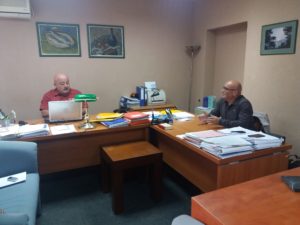
 More than two and a half years after the agreement in Brussels on the integration of the judiciary, in October 2017, 42 judges on Serbia’s pay roll and 14 prosecutors were integrated into the Kosovo judicial system. Almost a year after integration, the Basic Court of Mitrovica still remains dysfunctional. Despite the integration, the workload of lawyers in the North has drastically decreased. On the latest challenges, KoSSev spoke two of the most famous lawyers in the North – Ljubomir Pantovic and Nebojsa Vlajic. Insufficient work of court is the biggest problem, they say.
“A representative judiciary and uniform implementation of the Kosovo law will further reinforce rule of law as a key public service and a critical incentive for economic growth and investments,” the EU wrote in a statement following the integration on October 24, 2017.
Vlajic and Pantovic, however, testify that the desired effects of the integration were not achieved. The work of the integrated Basic Court of Mitrovica is even less effective than it was with less than half the judges that worked before integration.
This well-known office mostly deals with criminal cases – serious crimes, such as war crimes, murders, rapes. They work in all courts in Kosovo, in Serbia as well, but most of their cases proceed at the Basic Court of Mitrovica.
Pantovic said, however, that even six months after the integration of the judiciary the lawyers barely stepped foot into the courtroom.
„It is true that me and most of my colleagues from the North did not have a case or job in court even six months after the integration, some even longer,“ said Pantovic.
Although being aware of the immediate post-integration technical challenges, such as those concerning the training of judges and studying the cases, translation issues and the takeover of cases, Pantovic, nevertheless, emphasized that these problems can no longer be excuses for the reduced scope of work capacity at the Mitrovica Basic Court.
„I know that the court is a complex mechanism that needs to be organized and prepared, however, this court did not start from scratch. This court has operated before, Serbian judges and prosecutors have just joined the system,“ Pantovic said, adding that the problem of translation is also slowly being solved.
„There are more translators now when compared to the pre-integration period. I would say that they are better than those who worked here before, therefore, we only need to work more,“ he underlined.
His colleague, Nebojsa Vlajic, agrees: The technical issues such as the takeover of cases and the translation – cannot be accepted anymore as objective excuses for the dysfunction of the judiciary.
„The Serbian employees of the court, which was in fact dysfunctional for 20 years or they performed their work at a reduced capacity -brought these old habits to the new court. To be worse, Albanian judges picked up the same habit. Now nobody works,“ Vlajic said.
This lawyer rarely has hearings – had only three scheduled hearings in relation to the cases filed before the integration, while he received no calls for the cases filed after integration.
Both of them claim that the working conditions are currently better but the efficiency is far worse.
The integrated court now operates from three buildings, while the branch in Vucitrn functions from several offices. The judges meet the statutory norm only with outdated cases, while there are no ‘live’ cases in the integrated court.
Citizens are the ones who are suffering the most due to the current situation, especially in civil lawsuits for which hearings are not called for years.
„A general lack of work and the slow work of courts also affect detention cases. Trials last too long. Instead of the banal trials, with the defendant being held in custody, ending in several hearings, they end after more than 10 hearings. It affects everyone, not just people who are in custody. You have citizens who cannot exercise any of their rights. If someone has caused some damage to your property or you have a problem with your neighbors over the property border or your apartment is usurped, you file a lawsuit, but you cannot exercise your rights. We have lawsuits which have been filed several years ago and which have not been scheduled yet,“ Vlajic described the current situation in the courtroom.
„As far as the integration is concerned, everybody fell short,” Vlajic assesses.
The blame at this stage is not on Belgrade but on Pristina, since the judiciary is now completely in Pristina’s hands, the lawyers add. But both sides failed to see the integration as a substantial issue while the entire process was carried out under a great external pressure.
„Pristina wanted to get rid of the court, which they called a parallel Serbian court in Mitrovica, and Belgrade wanted to receive some concessions by agreeing to integration. The integration has been entirely in Pristina’s hands since it was carried out under a great external pressure. I am very surprised that, a year later, the court is doing absolutely nothing,“ said Pantovic.
„This basically says that nobody in Pristina was even interested in this integration. They were interested in stopping the work of the Serbian court. And nothing else. This new court did not even start operating,“ he concluded.
Citizens also have problems with other legal services, such as the services of bailiffs and notaries, the Law Office Vlajic and Pantovic underlined. Notary services are not available in the North, which is why citizens are forced to sign contracts drafted in Albanian language and authenticated by a notary in South Mitrovica who refuse to certify contracts written in the Serbian language.
Preuzimanje i objavljivanje tekstova sa portala KoSSev nije dozvoljeno bez navođenja izvora. Hvala na poštovanju etike novinarske profesije.