Translation provided by KoSSev
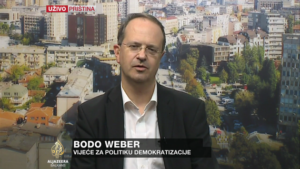
A political analyst from the Democratization Policy Council, Bodo Weber, hopes that Chancellor Merkel’s message will put an end to a risky and (self) destructive dynamic in the process of Kosovo-Serbia dialogue, which we have been watching for almost a year.
Koha Ditore: Last week, Chancellor Merkel said that a change of the borders in the Balkans could not happen, thus denying recent statements and proposals by Presidents Thaci and Vucic. Why was it necessary for Merkel to publicly oppose this idea and to close the discussion on partition/exchange of territories/border correction?
Bodo Weber: The statement by Chancellor Merkel and officials of the German government that the time for a change in borders in the Western Balkans has passed is something that was said at the beginning of the dialogue, it made it possible and this was one of the key principles of the original framework of the process.
It was therefore natural for Chancellor Merkel to come out publicly to reiterate this basic fact, regardless of the political statements on partition, the exchange of territories, the correction of the border, etc., from the announcement of the final phase of the dialogue in July 2017, which originated in Belgrade, and has recently spread to Pristina and several western capitals.
This is also a clear sign that the messages of Berlin, behind closed doors – directed to Vucic and others to stop with meaningless, dangerous map design – proved insufficient, and that a strong public message was necessary.
In my opinion, this should have happened earlier, but it is good that she said this publicly. I really hope this will put an end to dangerous and (self) destructive dynamics, which we have been watching for almost a year.
The full interview is available in the print edition of Koha Ditore newspaper.
Preuzimanje i objavljivanje tekstova sa portala KoSSev nije dozvoljeno bez navođenja izvora. Hvala na poštovanju etike novinarske profesije.