PERSONAL OPINION: Marina Milentijević
At the end of August, North Mitrovica lost the graffiti and murals that had covered the walls of buildings in the town center for years. The repainting operation, carried out with police assistance, was organized by municipal authorities. At the roundabout, murals dedicated to Patriarch Pavle and Metropolitan Amfilohije were whitewashed. On the same building, only on a different wall, graffiti reading “Because there’s no going back from here, Kosovska Mitrovica” and one dedicated to the fighters from Kosare were also erased.
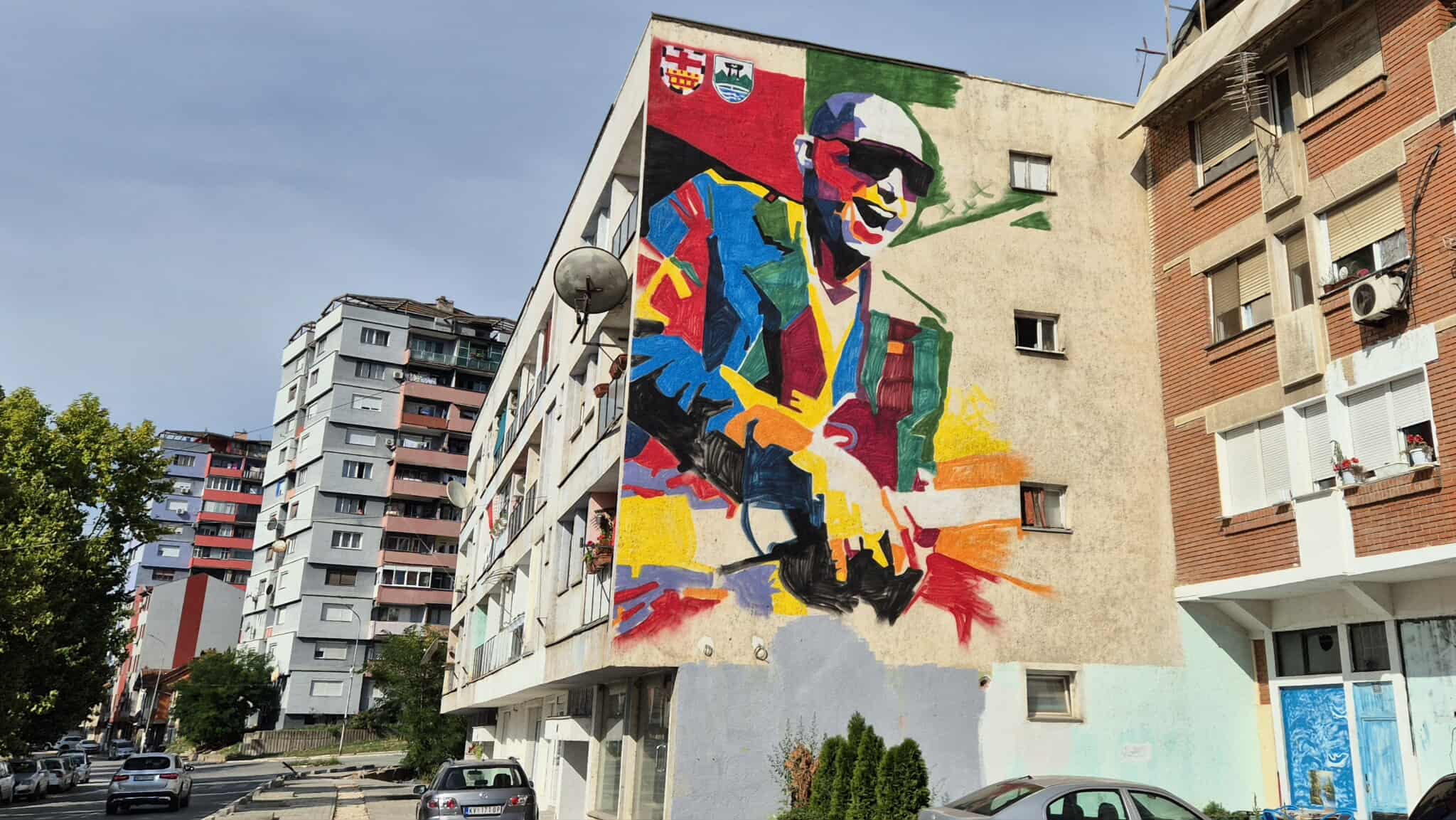
A few weeks later, the same fate befell the mural dedicated to the “Golden Dolphins,” Serbia’s water polo players who won Olympic gold in Rio in 2016. In place of Filip Filipović and the names of the championship team members, residents today are greeted by a mural of an American guitarist, Joe Satriani—largely unknown to them—playing for the public on a building not far from the main bridge.

The previous mural, painted “out of gratitude to the guys who never let us down,” had been done voluntarily as a caricature. The new one, according to eyewitnesses, was created under the watchful eyes of Mayor Erden Atić and municipal inspector Fatir Berzati—clear evidence that even wall painting in the north now has its official quality controllers. Not even a coat of paint can be applied without the municipal stamp—literally: the stamp is embedded in the mural itself through the new municipal emblem which, like the mural itself, the citizens did not ask for. The previous emblem, likewise, never bothered them much.
The whole operation is unfolding in the midst of local elections. While the provisional municipal bodies continue to tend to democracy and the rule of law by whitewashing the few walls that remain as part of collective memory—or rather recollection—of another time and, as it happens, another municipal emblem. In this joyless atmosphere, the golden water polo players are clearly unwelcome, but a musician who has nothing to do with Kosovo is welcome—appearing only as a spray-painted abstraction next to, again, the new municipal emblem. If the saying “you get what you pay for” holds true, it is natural to conclude that North Mitrovica has become the new World Trade Center: music is played even when no song has been requested, and to an audience that refuses to applaud.
Residents admitted on social media that most of them have no idea who Satriani even is. Yet that was apparently no obstacle for him to take over the wall where the Olympic champions’ names once stood. The irony was further underscored by Satriani himself, who thanked the artists and wrote that he would like to see the mural in person and “hug everyone.” In doing so, he also misspelled the name of Kosovo, calling it “Kosov.” The malicious would say: American. We, the well-intentioned, would attribute it to a typo. The keyboard betrayed him just as some local officials betrayed their promise to bring the whitewashed murals back to the promenade.
Speaking of murals—the history of this art form is tightly bound to political activism. We may not have Banksy in Mitrovica, but since politics permeates every aspect of our city’s social life, it is only natural to think that whitewashing murals of Serbian athletes to make way, for the hundredth time, for a new municipal emblem carries a symbolic message in an exceptionally politically insidious way.
While muralists around the world risk arrest, ours are produced under the authorization of municipal officials. Elsewhere, murals serve as an expression of a community’s identity and beliefs. Here, identity is painted over in the name of, as those same officials say, urban “orderliness.” In a town that is not orderly even in terms of human relations—in a town that is not even a town, but only half a town—a half-political, half-message is sent that a community’s memory is unwelcome; all done in a way that is insufficiently subtle yet sufficiently indirect. Enough to raise the question—why; not enough, however, to get an honest answer.
Where once Mitrovica celebrated a team that “won everything there was to win,” now a guitarist is promoted on a wall whose songs most residents would not recognize even if he serenaded them under their windows. The only certainty is that this mural, like the previous ones, will have an expiration date—as long as the election campaign lasts. After that, it will remain only to greet anyone crossing the new bridge to see the new mural. With the new emblem. Near new cafés. Ahead of a new election campaign.
Preuzimanje i objavljivanje tekstova sa portala KoSSev nije dozvoljeno bez navođenja izvora. Hvala na poštovanju etike novinarske profesije.