August 12 unfolded through two strikingly different news agendas in Kosovo. For the Serbian public, the day was dominated by the case of Nenad Rašković from Dren near Zubin Potok/Zubin Potok, who says he was beaten by a Kosovo Police officer, and by the widening property disputes and demolitions around Gazivode/Ujman Lake. In Pristina, attention was overwhelmingly focused on the continuing institutional deadlock: an opposition attempt to force the continuation of parliament’s constitutive session collided with an open-door event for young people and the diaspora, producing shouting, water-throwing and scuffles. By evening, a visitor’s call for Ramush Haradinaj to be “executed by firing squad” had turned part of the political turmoil into a criminal case.
Rašković: From Dren to intensive care and then Belgrade
The case of 57-year-old Nenad Rašković remained one of the dominant stories in Serbian-language media throughout the day.
Rašković was admitted to the Clinical Hospital Center in North Mitrovica on August 11 with multiple injuries reportedly after a Kosovo Police operation at his home in Dren, in the Zubin Potok area.
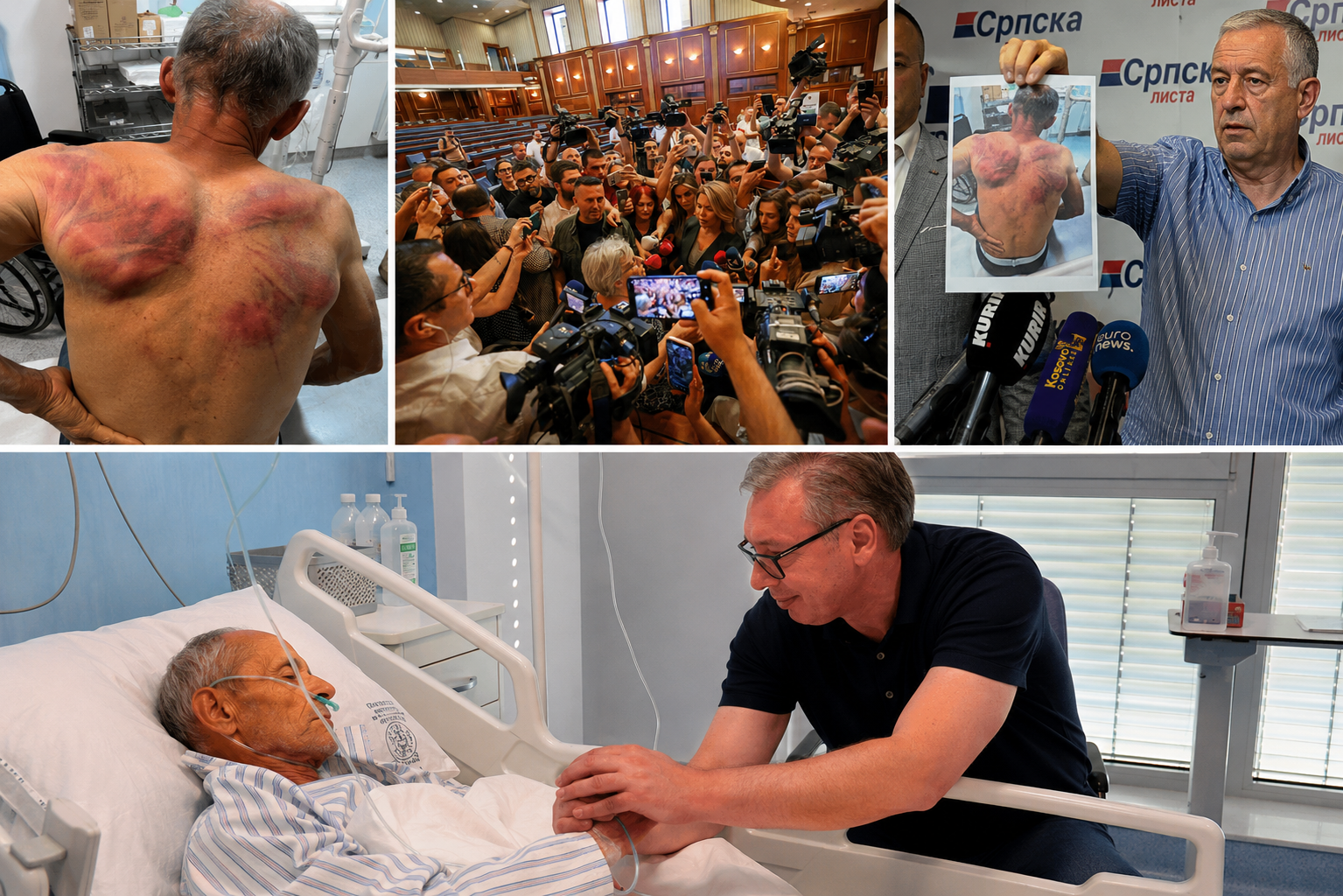
Speaking from his hospital bed, he alleged that one of three Kosovo Police officers first beat him inside his home while demanding that he reveal where weapons were hidden. He said he was later handcuffed, taken into a forest, tied to a beech tree and beaten with a piece of rubber hose, while a cloth was placed in his mouth.
“They knocked me down. He cocked the pistol. He cut off a half-inch hose. He cocked the pistol. They tied me to a beech tree. They beat me there. And they put a cloth in my mouth,” Rašković told Radio Kontakt Plus.
He also said he was questioned about weapons, war crimes and Momir Jakšić.
Doctors in North Mitrovica diagnosed injuries to his head, back and chest, hematomas and a fractured rib. He was initially placed in intensive care.
On August 12, Zlatan Elek – director of the North Mitrovica hospital and president of the Serb List – announced that a medical team had assessed Rašković’s condition as unstable and decided to transfer him to Belgrade for further treatment.
Several hours later, Serbian President Aleksandar Vučić published a photograph of himself standing over Rašković’s hospital bed at the Clinical Center of Serbia.
“The injuries are more serious than we expected,” Vučić wrote, adding that doctors had discovered that a second rib was fractured.
Vučić said that after learning about the additional fracture, Rašković asked for his family to be brought to him and for his brother to take care of his livestock. Rašković, who lives from farming in Dren, has said he keeps around 100 sheep and two cows.
Serb List: “Occupation” – but no withdrawal from institutions
Rašković’s case also prompted an emergency press conference by the Serb List, where party officials broadened the issue beyond the injuries of one man and described the situation facing Serbs in the north in stark political terms.
Igor Simić said the party had information about seven additional people from the Ibar Kolašin area who, according to their accounts, had been “seriously beaten.” The party did not publicly present details of all seven cases at the press conference, meaning these claims remain to be independently established.
Simić described the current situation as “the worst ever” and went on to use the word “occupation.”
KoSSev then asked how that assessment squared with the Serb List’s continued participation in Kosovo institutions – particularly given that the party had supported the collective withdrawal of Serbs from those institutions in November 2022.
Simić argued that the 2022 withdrawal had been “forced” by the circumstances. Asked directly how the party could now describe the situation as an “occupation” while remaining inside the institutions, he replied:
“We will fight until the end. We will fight democratically, we will fight politically.”
The Serb List also expressed deep frustration with international representatives, saying it had repeatedly informed them about alleged police violence and other problems affecting Kosovo Serbs but had seen no concrete results.
Asked by KoSSev what international officials actually tell them during such meetings, Simić offered a striking description:
“Sometimes I feel as if I am in a confessional.”
He said international representatives ask the party for information, photographs and documentation – “and nothing”, as he put it, suggesting that the exchanges have produced no visible follow-up.
This added a broader political dimension to the Rašković case: while the Serb List presented his injuries as part of a wider pattern and used the term “occupation” to describe the situation, it simultaneously made clear that it does not intend to respond by again abandoning Kosovo institutions, but says it will continue its struggle from within them through political and democratic means.
Two narratives around the same case
The case also illustrated the sharply different ways in which developments in the north were being presented to Serbian- and Albanian-speaking audiences.
While Serbian-language coverage focused primarily on Rašković’s injuries, his testimony and allegations of police brutality, several Pristina media reports placed the police operation in the context of weapons searches and allegations linked to the 1998–99 war.
Some reports went considerably further, carrying claims that weapons allegedly found in connection with the case had been intended for use against Albanians in 1999.
That distinction is important: such claims should not be treated as established facts without confirmation from the competent authorities. Rašković himself confirmed that police questioned him about weapons and war crimes, but denied possessing the weapons they were seeking.
Kosovo Police initially told KoSSev that it had no information that police officers had beaten anyone.
“We have no information that police beat anyone,” Deputy Regional Police Commander for the North Veton Elshani said.
The Kosovo Police Inspectorate (IPK), however, has now opened a preliminary investigation ex officio into allegations that several Kosovo Police officers exceeded their authority during the operation in Dren.
IPK said the purpose was to collect and assess the available information and evidence and establish the relevant facts and circumstances.
Thus, neither the allegation that police officers inflicted Rašković’s injuries nor competing claims surrounding the weapons search can yet be presented as judicially established facts.
NATO cites “improvements to the security situation”
Against that backdrop, NATO issued a notable message on Wednesday, saying it had begun adjusting KFOR’s posture in Kosovo due to what it described as “improvements to the security situation.”
“NATO is working to ensure that our peacekeeping mission in Kosovo, KFOR, is optimized for the current environment, given improvements to the security situation,” NATO’s spokesperson said.
Under KFOR Commander Major General Özkan Ulutaş, NATO said it had begun adjusting its posture “in close coordination with all relevant authorities and stakeholders.”
According to NATO, the changes demonstrate “tangible progress” in supporting a safe and secure environment for all people in Kosovo and freedom of movement, in line with UN Security Council Resolution 1244.
Crucially, NATO stressed that the process is conditions-based and reversible “if warranted.”
The statement comes as KFOR has already begun a gradual transition of its permanent presence at the main Ibar/Ibër bridge in Mitrovica and the gradual integration of Kosovo Police into KFOR’s security architecture at the Visoki Dečani/Deçan Monastery.
The timing was particularly striking in the Serbian information space: NATO was speaking of an improved security situation on the same day that the alleged beating of Rašković dominated Serbian-language coverage and the Serb List described conditions for Kosovo Serbs as “the worst ever” and even as an “occupation.”
Gazivode/Ujman: Who demolished Hotel Jezero?
The second major story for the Serbian public came from Gazivode/Ujman, where disputes over property, demolitions and the authority of the Ibar-Lepenac/Ibër-Lepenc water company continued to widen.
At the first court hearing in the Jakšić family’s case over the demolition of Hotel Jezero, Ibar-Lepenac denied that it had carried out the demolition.
The denial is particularly significant because Kosovo Police had repeatedly told the media, including KoSSev, during previous demolition operations that officers were present only to assist Ibar-Lepenac. The company’s director, Faruk Mujka, had also publicly discussed the removal of structures around the lake, including Hotel Jezero.
The court is expected to inspect the site with a geodetic expert and seek written information from Kosovo Police and the relevant ministry concerning who carried out the demolition.
But Hotel Jezero is increasingly only one part of a much broader property dispute.
Lawyer Dragutin Nenezić, part of the Jakšić family’s legal team and now representing other affected families, described what property owners around Gazivode are facing as “something between an airborne assault and a bombardment.”
He was not referring to physical bombardment.
Rather, he described a “bombardment with different summonses, notices and proceedings, coming from different sides,” which, he said, leaves people “often not knowing what to do.”
His legal team has now filed lawsuits for the Đukić and Đurić families and requested interim measures aimed at preventing demolitions before courts can examine the disputes.
Nenezić also raised questions about cadastral records. According to documents available to his team, the Đukić family was registered in 1997, while Ibar-Lepenac appeared as the owner in 2018.
“It is a very big question how Ibar-Lepenac appeared in the cadastre instead of them,” he told KoSSev.
New deadlines expire on August 18 and 19. And, according to Nenezić, the cases now involve not only weekend cottages but family homes and a village hall.
“This already encroaches on the right to a home,” he said.
In Pristina: Parliament open to the diaspora, but not for a session
While Rašković and Gazivode dominated much of the Serbian news agenda, Pristina was consumed by the political and institutional crisis surrounding the Kosovo Assembly.
There was no continuation of the constitutive session on August 12.
The Assembly chamber was nevertheless anything but empty.
Opposition MPs, particularly from PDK and AAK, arrived demanding that the constitutive session resume. At the same time, the Assembly had opened its doors to young people and members of the diaspora as part of activities marking International Youth Day.
The combination produced an extraordinary day inside the institution.
Verbal confrontations between opposition MPs and LVV representatives escalated into shouting, water-throwing, papers being thrown and several confrontations that came close to becoming physical.
PDK MP Ganimete Musliu threw water at LVV’s Ardian Gola, accusing his party of violating the Constitution. There were confrontations involving Donika Gërvalla and PDK representatives, while chants referring to the UÇK/KLA could also be heard.
Acting president Albulena Haxhiu returned to the chamber, saying she was there because of the diaspora visit. She accused the opposition of unjustifiable actions and insisted that a political agreement must precede another parliamentary session.
Meanwhile, Albin Kurti again invited the leaders of the three main Albanian opposition parties – PDK’s Bedri Hamza, LDK’s Lumir Abdixhiku and AAK’s Ardian Gjini – to talks, without setting a date.
PDK indicated that, as far as it was concerned, another meeting with Kurti was a “closed issue.”
PDK: We will be here every day
PDK Secretary General Vlora Çitaku said the Assembly was “effectively closed” and MPs were being prevented from exercising mandates given to them by voters.
“This is not only a suspension of the Assembly; this is a suspension of democracy,” she said.
PDK announced that it would again formally request the continuation of the constitutive session after 48 hours.
But the party also signalled an escalation of its political response.
Çitaku said PDK MPs would come to the Assembly every day, while the party would expand its activities beyond parliament through broader political, democratic and civic mobilisation and discussions with citizens, students, doctors, farmers, businesspeople and other groups.
From parliamentary turmoil to a criminal investigation
The most serious incident of the day, however, came not from an MP but from among the visitors.
According to Pristina media reports, a man described as a member of the diaspora called for former prime minister and AAK MP Ramush Haradinaj to be “executed by firing squad.”
The statement triggered immediate reactions.
Kosovo Law Institute director Ehat Miftaraj called on prosecutors to enforce the law, warning:
“When someone calls in front of a camera for someone to be shot, tomorrow he goes out and does it.”
AAK officials demanded that the man be identified and arrested.
Burim Ramadani described what had been heard in the Assembly as “a call for murder,” while Time Kadriaj accused the government of cultivating hostility towards former UÇK/KLA commanders.
By evening, the matter had moved from political reactions to criminal proceedings.
The suspect was arrested, and the Special Prosecution ordered his detention for 48 hours. It identified him only by the initials S.L. and said he was suspected of the criminal offences of “inciting division and intolerance” and “threatening.”
Pristina media subsequently identified the arrested man as Skender Llugiqi.
AAK MP Bekë Berisha later alleged that Llugiqi was close to Tefik Llugiqi, whom Berisha described as a former UDB official from the 1980s. That claim has not been independently confirmed by police or prosecutors.
UÇK veterans welcome the arrest
The Organization of UÇK War Veterans subsequently welcomed the swift police and prosecutorial response.
It condemned “without reservation” hate speech and direct threats against Haradinaj, describing public calls for violence as criminal acts that threaten public security and the constitutional order.
“Every such threat must face the full force of the law,” the organization said.
The veterans called for an equally firm legal process following the arrest, warning that hesitation could create a dangerous precedent.
“The Republic cannot be held hostage”
Beyond the confrontations inside parliament, pressure over the institutional deadlock also came from outside party politics.
A group of 46 intellectuals, academics, legal experts, professionals, artists and civil society figures issued a public appeal entitled:
“The Republic Cannot Be Held Hostage.”
They called for the urgent formation of institutions and protection of the constitutional order, warning that prolonged institutional paralysis was damaging public confidence in democracy, Kosovo’s economic and social development and its international standing.
Their appeal called on political parties to abandon ultimatums and attempts to place party interests above those of the state.
By the end of August 12, Kosovo appeared to be living through two markedly different news days at once.
For much of the Serbian public, the central images were those of Nenad Rašković’s battered body and hospital bed, and excavators, court files and threatened homes around Gazivode/Ujman.
In Pristina, the defining images came from an Assembly that could open its doors to visitors but still could not resume its constitutive session – MPs shouting and throwing water, opposition parties promising to return every day, and a visitor’s call for Haradinaj to be shot ending, within hours, in an arrest and a Special Prosecution case.
Different stories dominated the two information spaces. Yet beneath them ran much the same theme: institutions, their authority, and the question of whether citizens can trust them to establish what happened and act within the law.
Preuzimanje i objavljivanje tekstova sa portala KoSSev nije dozvoljeno bez navođenja izvora. Hvala na poštovanju etike novinarske profesije.