Once a neuralgic flashpoint in the fraught relations between Serbs and Albanians in the immediate post-war years, the main bridge over the Ibar River in Mitrovica/Mitrovicë long stood as the symbol of an unresolved question — a political fault line and the first place where tensions over the north would surface.
It was here that clashes were recorded in the early post-conflict period, most often during attempts by larger, sometimes hardline Albanian groups to cross into the north. Violent ethnic confrontations turned the bridge into a lasting pressure point and a barometer of security.
At the same time, it became a mandatory stop for Western diplomats, foreign correspondents and representatives of international missions — a stage for what many described as “political tourism,” where the progress of dialogue was measured and stability informally assessed.
Although still closed to vehicle traffic, the atmosphere around the bridge has shifted in recent years, particularly since Albin Kurti and his Vetëvendosje movement first came to power.
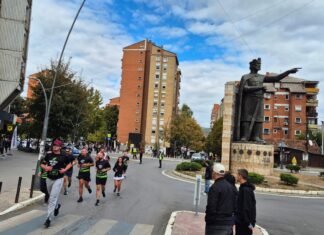
Northern Mitrovica is increasingly visited by Albanians from other parts of Kosovo, as well as from the diaspora. The bridge itself has become an almost obligatory stop — a place to walk across, photograph and symbolically affirm as part of one’s own state. Its daily rhythm is no longer what it was just a few years ago.
Following the withdrawal of Serbs from Kosovo’s institutions in late November 2022, Vetëvendosje gradually established territorial, administrative and political control over the north over the next four years. The institutional vacuum was filled with new structures, and political reality began to reflect a doctrine that insists on a single, unified Mitrovica/Mitrovicë — without emphasizing the division between North and South municipalities, despite that division being defined under the Ahtisaari Package, incorporated into Kosovo’s Constitution and legal framework.
Efforts by the government during its previous mandate to reopen the bridge to vehicle traffic ultimately failed. But that setback was offset by the rapid construction of two new bridges nearby — one pedestrian and one for vehicles. Between them stands the main bridge, whose crossing has, for some, become a matter of “national pride,” a symbolic step toward what they describe as a “free north.”
This year, Serbs formally returned to institutional life through local government structures. In the meantime, however, the political, security and administrative framework in the north has already changed significantly. A “new reality” has been established — a phrase once frequently invoked by northern Serbs themselves when defending their argument that this was the only urban area where they had managed to endure in post-war Kosovo.
The shift in discourse is visible in the voices of passersby we met on the bridge.
Some, speaking of “democracy” and “brotherhood and unity,” argue that “Serbs should now listen to Albanians, just as Albanians once had to listen to Serbs,” or simply say, “they can leave.” Others insist that “Mitrovica/Mitrovicë is one,” that they “walk freely in their own country,” and that they cross from north to south every day.
Among them are visitors from the diaspora and from across the region — from Albania and Sweden to Kačanik/Kaçanik and Vučitrn/Vushtrri — some stepping onto the northern side for the first time.

There are also residents of the north who speak in a more measured tone about both the war and the present, aware of the complexities of life in a divided city. Their cautious optimism reflects a genuine aspiration for tolerance and coexistence.
Serbs, however, are rare interlocutors on the main bridge. Many are reluctant to speak. Those who did were more often not from Mitrovica/Mitrovicë itself — students from central Serbia or individuals staying in the north for business, who typically cross south mainly for shopping.
Between its past as a zone of confrontation and its present as a scene of symbolic presence, the main bridge over the Ibar remains the place where political change is first made visible — in the confident steps of those who cross it openly, and in the restraint of those who still cross quietly.
Preuzimanje i objavljivanje tekstova sa portala KoSSev nije dozvoljeno bez navođenja izvora. Hvala na poštovanju etike novinarske profesije.