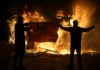
Today marks 21 years since March 17, 2004, when the largest outbreak of ethnic violence occurred in Kosovo following the arrival of international military and civilian forces.
This morning, representatives of the Serb List laid wreaths and paid tribute to Jana Tučev and Borivoje Spasojević at the memorial site on Kolašinska Street. They also placed wreaths at the „White Angel“ monument near the main bridge over the Ibar River.
Once again, media invitations were sent selectively, as our editorial office did not receive one this year either.
1 od 9
FOTO: KoSSev
FOTO: KoSSev
FOTO: KoSSev
FOTO: KoSSev
FOTO: KoSSev
FOTO: KoSSev
FOTO: KoSSev
FOTO: KoSSev
FOTO: KoSSev
The anniversary will also be commemorated in Gračanica, with a two-day program titled „Pogrom – A Rewarded Crime.“
The event will feature testimonies from survivors, performances by artists, participation from students and professors, as well as representatives of the Serbian Orthodox Church and government officials.
At 11:00 a.m. today, a memorial service was held at Gračanica Monastery, followed by the laying of white roses at the „Missing“ memorial installation and the monument to the victims in the courtyard of the Gračanica Cultural Center.
On the second day of the program, at 7:00 p.m., an art exhibition from the „Autumn in Prizren 2024“ painting colony will open, along with the presentation of a thematic collection of national significance, „The March 2004 Pogrom: Causes, Destruction, Consequences.“
A memorial service for the victims of the March violence was also held today in Belgrade, officiated by Serbian Patriarch Porfirije at 12:00 p.m. in the Cathedral of St. Michael the Archangel.
Petković: The Violence Was Long and Carefully Planned
Marking the anniversary, the Director of the Kosovo Office, Petar Petković, issued a statement, describing the March 17 events as the „first pogrom in 21st-century Europe.“
„Beyond evoking empathy and solidarity in every honorable person, this tragic event has strengthened the Serbian people and the Serbian state’s determination to never allow such brutality against Serbs to happen again,“ Petković said.
He dismissed what he called the „false narrative of a spontaneous revolt triggered by the drowning of Albanian boys,“ asserting that:
„There is no doubt that the pogrom was long and meticulously planned and organized by Albanian political, criminal, and paramilitary structures with the goal of ethnically cleansing the remaining Serbs from Kosovo and Metohija. Unfortunately, in many parts of our southern province, this goal was successfully carried out.“
Petković also accused Pristina of continuing its policy of „ethnic cleansing“ through different methods.
„By shutting down Serbian institutions that are vital to our people’s survival, the aim was to deprive Serbs of salaries, pensions, and social benefits. Meanwhile, the presence of heavily armed forces was meant to complete the forced displacement of Serbs and fulfill Kurti’s openly stated goal—an ethnically pure Kosovo and Metohija. However, Pristina has not achieved this goal, nor will it ever!“ he stated.
Drowning of Albanian children in the Ibar
In the afternoon of March 16, 2004, three Albanian boys from Cabra, a village in the municipality of Zubin Potok, drowned in the river Ibar. Immediately after the accident, the Kosovo media reported this tragic event as an ethnically motivated crime, stating that the boys jumped into the river because they were being chased by Serbs with a dog.
The media referred to the statements of the fourth, surviving boy and the only eyewitness to the accident, but it turned out that the boy was talking about how the Serbs cursed at them from a nearby house – which scared him and his friends – and not that the Serbs were chasing them.
Later, after an investigation was carried out into this event, the international prosecutor concluded that the evidence offered did not support the existence of a reasonable suspicion that a criminal offense had been committed.
These facts were confirmed by several relevant addresses – domestic and international, but to this day, the interpretation of the Serbs as being responsible for the death of children in Cabra, as well as for the riots itself, has remained de facto position among the majority community.
The role of the media
In March 2004, the role of the Kosovo media emerged as a special issue, on which the OSCE in Vienna issued a special report in which it criticized the „obvious spin“, „irresponsible and sensational“ reporting by the electronic media in Albanian.
“It should also be noted that the media, specifically the broadcasting sector, displayed unacceptable levels of emotion, bias, carelessness, and falsely applied ‘patriotic’ zeal. In particular, the reporting on the evening of 16 March by the three main Kosovar TV channels deserves the strongest possible criticism,” OSCE report states.
“As a detailed report by the OSCE’s Representative on Freedom of the Media later showed, the ethnic Albanian media played an irresponsible, inflammatory role, broadcasting information that was still unconfirmed: the surviving ethnic Albanian boy never publicly stated that the group were chased into the river by Serbs, only that the young Albanian boys had been sworn at by Serbs from a distant house,” the Human Rights Watch underlined in its report immediately after the violence, titled “Failure to protect.”
The experts of this organization described the manner of media reporting in the following manner:
“The interpretation that the boys were chased in the river by Serbs came from other sources, such as Halit Berani, a Mitrovica-based ethnic Albanian human rights activist (see below). Such subtleties didn’t matter to the private and public state-funded media, who began broadcasting and printing unequivocal reports that the ethnic Albanian boys had been chased into the river by Serbs.
Moderating voices, such as the UNMIK spokesperson Tracy Becker, who warned that an ethnic motivation for the incident had not been established, received almost no airtime, while „experts“ who denounced the Serb „bandits“ were given unfettered and unchallenged access.
For example, Halit Berani, the chairman of the Council for the Defense of Human Rights and Freedoms in Mitrovica-an ethnic Albanian human rights group with a strongly nationalist agenda-was given more than 4 minutes of the RTK news broadcast, compared to the 12 seconds given to the moderate UNMIK spokesperson (see above). Berani, who had not witnessed the incident, told the audience:
‘Today around 16:00 in the village of Caber, Zubin Potok municipality, while six children from the above mentioned village were playing, a group of Serb bandits attacked these children, the Serb bandits also had a dog, and swearing at their Albanian mother they forced the Albanian children to run away. Two of them managed to hide in the roots of the willow trees by the river Lumebardh [Ibar river], whereas the other four fell into the river. It is known that the Lumebardh river, apart from being very deep, has very cold water and is fast-moving. Most probably the children could not swim well. There is no information about the fate of three of them, whereas one survived after making it to the other side of the river. We are used to these Serbian bandits. We think that is in revenge for what happened in Caglavica, the case that showed what the Serbs are willing to do when the situation is getting calm in Kosovo.’
The sensational reporting on the Serb „bandits“ drowning young Albanian children set off a firestorm of protests and violence across Kosovo. However, while the drowning of the three children was a tragedy, a thorough investigation by the United Nations and a respected ethnic Albanian judge from Kosovo casts serious doubt on the allegations of Serb complicity in the drownings, citing inconsistencies in the accounts given by the surviving boy, and a lack of corroboration of the boy’s account by the two other surviving children and an elderly Serb who was working in the area. The U.N. investigative team did a thorough search of the area where the drownings took place, and could not find any Serbs who fitted the description given by the surviving boy.”
Figures
About 286 Serb-owned houses, over 35 churches, monasteries and cemeteries were destroyed and set on fire and more than 4,000 Serbs were expelled from the south of Kosovo in the violence carried out by extremist Albanians from March 17 to March 18.
About 51,000 participants in demonstrations in at least 33 individual riots that broke out in 48 hours attacked Serbs throughout Kosovo.
According to the initial information, eight Serbs and 11 Albanians were killed – the latter were killed in a confrontation with the US and French KFOR, which was trying to stop the violence (the data is mainly from Human Rights Watch), but later the Humanitarian Law Fund confirmed 23 victims, including an unidentified Albanian from Pristina.
According to data collected by the HLC in the months after the March violence, around 170 Serbs were seriously injured, 150 of them were beaten in their homes, while 20 were attacked outside. About 800 Serbian, 90 Ashkali and two Albanian houses were completely destroyed or seriously damaged, and 36 Orthodox religious buildings were demolished and burned.
A total of 72 UN vehicles were destroyed in the riots. The report of the UN Secretary General from April 2004 states that 954 people were injured in the March violence, including 65 international policemen, 61 members of KFOR and 58 members of the then Kosovo Police Service.
Admiral on ethnic cleansing
The violence stopped after more active involvement of NATO and US troops.
The then Admiral of NATO forces, Gregory Jones, described what happened on the 17th and 18th in carefully selected words:
„This type of activity is almost equal to ethnic cleansing and cannot continue.“ Jones’ message also coincided with the actions of US soldiers in Caglavica, who stopped the Albanian extremists thanks to their strong response.
“Failure to protect“
The Human Rights Watch reportpublished immediately after the violence, entitled „Failure to Protect“ says:
„The security organizations in Kosovo-KFOR, UNMIK international police, and the KPS-failed catastrophically in their mandate to protect minority communities during the March 2004 violence.
In numerous cases, minorities under attack were left entirely unprotected and at the mercy of the rioters.
The former UNMIK spokesman Gyorgy Kakuk recalled the scenes from this village about ten years ago in a statement for KoSSev, after he, together with other international staff, was evacuated to the KFOR military base, near this once richest Serbian village in the Mitrovica region:
„When we were evacuated to the French base on the night of the 17th, we reached the hill where the base overlooks Svinjare and I saw 157 houses burning. This image is etched in my memory and I will never forget it. The first house that burned was located exactly 400 meters from the KFOR base. I measured that later. The population of Svinjare was evacuated. I later entered the village with a journalist colleague from Hungary and we found a terrible scene. Besides the burning houses, there were dead animals lying on the road, and some were hanged. On some of the remnants of Serbian houses UCK was written, and in front of one a boy was waving the Albanian flag proudly posing for us. All we could do was take photos.“
1 od 4
FOTO: Gyorgy Kakuk
FOTO: Gyorgy Kakuk
FOTO: Gyorgy Kakuk
In Svinjare, French KFOR troops failed to come to the assistance of the besieged Serbs, even though their main base was just a few hundred meters away-in fact, the ethnic Albanian crowd had walked right past the base on its way to burning down the village. French KFOR troops similarly failed to respond to the rioting in Vucitrn, which is located in between two major French bases.
In Prizren, German KFOR troops failed to deploy to protect the Serb population and the many historic Serbian Orthodox churches, despite calls for assistance from their UNMIK international police counterparts, who later accused German KFOR commanders of cowardice.
In Kosovo Polje, UNMIK and KFOR were nowhere to be seen as Albanian crowds methodically burned Serb homes.
The village of Belo Polje, rebuilt on the outskirts of Pec to house returning Serbs, was burned to the ground even though it was almost adjacent to the main Italian KFOR base. Italian KFOR soldiers refused to approach the besieged Serbs, forcing the Serbs to run for several hundred meters through a hostile Albanian crowd, before KFOR evacuated them. Several Serbs were wounded in the process.
Even in the capital Pristina, Serbs were forced to barricade themselves into their apartments, while Albanian rioters shot at them and looted and burned the apartments below and around them, for up to six hours before KFOR and UNMIK came to their assistance.
The failure of UNMIK international police and KFOR to effectively respond to the violence left much of the security in the hands of the Kosovo Police Service (KPS). The locally recruited KPS, many of them only recently trained, were poorly equipped to deal with the violence.
Some KPS officers acted professionally and courageously, risking their own lives to rescue besieged Serbs and other minorities in many towns and villages. However, many other KPS officers stood by passively as the ethnic Albanian crowds burned homes and attacked Serbs and other minorities, even when those attacks took place just meters away.
Some KPS officers showed a clear bias by arresting only Serbs and other minorities who were defending their homes, while ignoring the criminal behavior of ethnic Albanians occurring in front of their eyes. In a few cases, KPS officers were accused of taking an active part in the burning of minority homes.
The international community appears to be in absolute denial about its own failures in Kosovo. While international actors have been universally-and accurately-critical of the failures of the Kosovo Albanian leadership during and after the crisis, the dismal performance of the international community has escaped similar critical scrutiny.
Instead, the leadership of KFOR and UNMIK seem happy to continue with „business as usual,“ rather than putting in place the reforms needed to prevent a recurrence of mass violence-and a renewed collapse of the security institutions in the future.
An exhaustive and transparent review of Kosovo’s security institutions, resulting in a drastic overhaul of its inefficient structures, is urgently needed. Kosovo’s security institutions need to be adequately staffed with personnel who are well trained and adequately equipped to respond to riot situations.
A coordinated security system must be developed between KFOR, UNMIK, and the KPS, putting an end to inter-institutional tensions and rivalries. KFOR in particular must develop a unified command structure and a common response system to violence in Kosovo, abandoning the decentralized structures and widely disparate national doctrines that contributed to the chaos of March 17 and 18.
Ultimately the security of minority communities will rest in the hands of locally created institutions such as the KPS-just as it did in many locations during March. It is essential to the future of minorities in Kosovo therefore that the KPS is developed into a truly professional, impartial, well-trained police service that sees protection of minorities as one of its core mandates.
The international community has lost tremendous ground in Kosovo as a result of the March violence: ethnic Albanian extremists now know that they can effectively challenge the international security structures, having demolished the notion of KFOR and UNMIK invincibility; and ethnic minorities have lost almost all of the remaining trust they had left in the international community.
Time is running out for both the international community and minorities in Kosovo, and now is the time for resolute and transparent action to rectify the all-too obvious shortcomings of the international community’s security structures in Kosovo.
Security institutions in Kosovo – KFOR and UNMIK police, and the Kosovo Police Service – have failed to protect non-Albanians and their property – states the unanimous assessment of all independent experts who shared their view of these events.
HLC reminder
Last year, the Humanitarian Law Fund recalled the infamous role of international forces and the Kosovo Police Service during those three days in 2004, referring to the HRW report.
The events in Kosovo caused a domino effect in Niš, Belgrade, and Novi Sad.
Protests broke out in several cities in Serbia, which soon became violent. Protesters in Belgrade set fire to Belgrade’s Bajrakli mosque on the night between March 17 and 18. Until the protesters broke through the police cordon, the police had an order not to use force. The Bajrakli mosque, thanks to its construction, was not completely burned, but its interior was largely destroyed, including the library and art objects. Protesters in Niš set fire to Islam-aga’s mosque and it was even more severely damaged than Belgrade’s mosque.
In Novi Sad, rioters broke shop windows, destroyed and set fire to bakeries owned by Albanians and other Muslims, and broke windows to the Islamic Center premises. The police were mostly passive, standing aside while the protesters stoned the houses in Roma and Ashkali communities, although Roma and Ashkali were not in any way involved in violence against Kosovo Serbs, but they themselves were also victims of the violence, HLF reminded.
“According to the HRW report, members of the international forces interviewed after the March riots showed a lack of self-criticism and unawareness of their mistakes, shifting the blame to each other, but also justifying themselves by lack of material and human resources, inexperience in suppressing protests, surprise factor, lack of coordination, etc. Members of KFOR were unable to prevent the attacks, but mostly acted as rescue teams, helping Serbs evacuate. They would leave unsecured houses behind, and in the presence of KFOR, Serb and Ashkali houses in several municipalities throughout Kosovo were destroyed and looted. UNMIK police have also shown that they cannot control the situation and have no authority.
The Kosovo Police Service (KPS) acted without command and instruction, so the conduct of KPS members varied from place to place. Some police officers sided with the protesters and participated in the destruction of property or they would arrest Serbs and Ashkali who were trying to defend themselves, ignoring at the same time the Albanian violence. Most KPS members were passive observers and wouldn’t interfere even when Serbs were being beaten by the protesters. The third group includes police officers who acted professionally in an effort to facilitate a safe evacuation, which some Serbs see as indirect participation in the expulsion, while others point out that this saved their lives.”
Lives that were lost
The violence resulted in the following deaths: Macedonian Jana Tučev, who lived in North Mitrovica, nine Serbs – Dragan Nedeljković, Slobodan Perić, Dušanka Petković, Borivoje Spasojević, Borko Stolić, Dobrivoje Stolić, Slobodan Tanjić, Zlatibor Trajković and Nenad Vesić, and thirteen Albanians – Fatmir Abdullahu, Ferid Çitaku, Bujar Elshani, Kastriot Elshani, Isak Ibrahimi, Alumuhamet Murseli, Agron Ramadani, Nexhat Rrahmani, Arben Shala, Gazmend Shala, Ajvaz Shatrolli, Esat Tahiraj and one Albanian from Pristina whose name the Humanitarian Law Center (HLC) failed to identify.
Jana Tučev was shot dead with a firearm in her apartment in northern Mitrovica, while Dušanka Petkovic from Urosevac, who was a heart patient, died in KFOR base the day after she was kicked out from her house.
Four of the Serbs were killed by Albanians with firearms, two were burned in their homes, the cause of death of one of them is unknown, and one disappeared during the evacuation.
Two of the Albanians were killed by KFOR members, three lost their lives in clashes with KFOR and Serbs, one was killed by a UNMIK policewoman when he attacked another person with a knife, one was killed by a sniper by Serbs, and the reason of the death of the other Albanians is unknown, reveal HLC data.
“The behavior of Albanian political leaders did not help stop the violence. Even when they called for an end to the violence, those calls seemed insincere and forced,” they said last year.
Court proceedings marked with numerous issues
According to the UNMIK statistics from 2008, 242 people have been charged for the March violence (206 before local and 36 before international prosecutors), and additionally, 157 people have been charged before courts for misdemeanors.
International judges and prosecutors dealt mainly with cases involving serious crimes such as murder, attempted murder, incitement to national hatred and causing general danger, while the most common offenses before domestic courts were participation in a group that committed a criminal offense and aggravated theft.
The trials of these indictments were accompanied by a number of problems and difficulties, including defaulting witnesses, changing the testimonies of witnesses, procrastination of the police in submitting reports, postponing the main hearing, disregarding ethnic motives, imposing minimum sentences or even sentences below the prescribed minimum, the too frequent imposition of suspended sentences, etc.
Out of a total of 399 people indicted, 301 were convicted by April 2008. According to the OSCE, 86 persons were sentenced to prison (including suspended sentences), and the maximum sentence was 16 years in prison.
Restoration of churches and holy sites
The majority of damaged holy sites were reconstructed from 2005 to 2010. According to the Diocese of Raska and Prizren, the restoration of holy sites destroyed in the March riots was led by the CoE Commission, along with the SOC and Institute for the Protection of Cultural Monuments, other countries also paid through Kosovo institutions, the Government of Serbia, believers of the Serbian and Russian churches also helped.