Peci Leads March from South Mitrovica to North Mitrovica – Speaks to Students About “Genocidal Serbia”; Radojević: Abuse of Children and Overstepping Municipal Competences
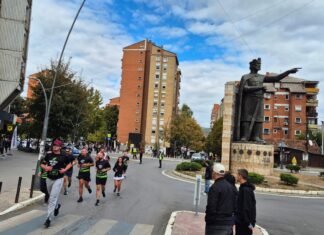
The Mayor of South Mitrovica, Faton Peci, visited Bosniak Mahala in North Mitrovica today to pay tribute to Albanians killed in 1999, where he stated that the crimes were committed by what he called “the bloody Serbian hand,” responsible for the “massacre of 23 innocent Albanian citizens.” He made the remarks in front of a group of students he led in a march from the premises of the Mitrovica gymnasium in the Bair area to the multi-ethnic center of the city in the north.
According to his statement, Peci said: “This crime was committed by the bloody Serbian hand, which carried out a massacre of 23 innocent Albanian citizens, where we laid fresh flowers to keep the memory alive. Justice for the missing! Glory to the fallen.”
His remarks referring to a “genocidal Serbia” were also delivered in front of students participating in the march.
The Mayor of North Mitrovica, Milan Radojević, reacted by stating that such actions “in no way represent a path toward reconciliation between communities,” adding that they constitute “the abuse of children for political purposes, which is unacceptable,” while also pointing to “interference in municipal competencies.”
Peci had already marked commemorations for victims of 1999 for two consecutive days. A day earlier, he paid tribute in South Mitrovica at a memorial plaque dedicated to those killed in former Miladin Popović and Njegoš Street.
According to court records referenced in previous proceedings, those cases relate to crimes against Albanians in which groups of civilians were taken from their homes, with men separated from women and children and subsequently taken away. At least 15 men from those groups went missing, while some were later found dead. The total number of victims is estimated at 31 civilians, which has been described as one of the most serious crimes against Albanians in the Mitrovica region during the war period.
“April 14, 1999 marks one of the darkest dates for our city – the killing of 31 Albanian civilians, unarmed and innocent, in the most barbaric way, by criminal and genocidal groups of Slobodan Milošević in the Kovacica neighborhood,” Peci said, adding that the only “guilt” of the victims was that they were Albanians.
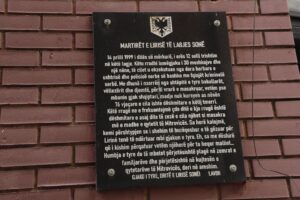
Memorial plaque inscription
FOTO: Faton Peci
The plaque in Bosniak Mahala reads, among other things:
“Martyrs of Freedom of Our Neighborhood
On Wednesday, April 14, 1999, at noon, sorrow struck this neighborhood. The blood of 30 men and one mother was shed by the barbaric hand of the Serbian army and police, together with their criminal Serbian neighbors. They forcibly took fathers, brothers, and sons from their homes and killed and massacred them solely because they were Albanian, not sparing even a 76-year-old mother who witnessed this horror… Their blood is the light of our freedom.”
Commemoration in Bosniak Mahala
Peci continued the commemoration today, marking the 27th anniversary of what he described as the killing of 23 civilians in Bosniak Mahala in 1999.
Media outlets in Albanian have for years reported on the case, describing an incident in which Serbian forces reportedly gathered around 80 people in the house of Mustafa Sahiti, where 23 Albanians were killed.
The Sahiti house in Bosniak Mahala has been turned into a museum, with a memorial plaque bearing photographs of victims. Another inscription states that the victims were “killed and massacred by the Greater Serbian fascist machinery.”
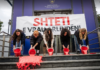
The commemoration included a march from the Bair area in South Mitrovica, across the newly built bridge, after a symbolic display of 104 empty chairs and 104 white roses in the gymnasium courtyard, which organizers said represent missing persons from Mitrovica.
Peci said the 104 white roses symbolize “the innocence of our people,” adding that the commemoration aims to prevent “forgetfulness from covering truth and pain.”
FOTO: Faton Peci
Reaction from North Mitrovica
Radojević said the actions represent political misuse of education and children, and warned that they deepen divisions between communities. He also raised questions about the fate of displaced Serbs, damaged Serbian property, and what he described as erased traces of pre-1999 Serbian presence in the southern part of the city.
He called on the international community to react, warning that such activities undermine coexistence and institutional stability in the region.
Preuzimanje i objavljivanje tekstova sa portala KoSSev nije dozvoljeno bez navođenja izvora. Hvala na poštovanju etike novinarske profesije.