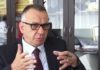
The EU is committed to providing the support needed to speed up the membership processes for this region. For Kosovo, it comes with a clear expectation to adopt the Association or Community of Serb Majority Municipalities, on the one hand, and to adequately and fully translate into practice its well-established legal framework for the protection of non-majority community rights, Eva Palatova, deputy head of the EU Office in Kosovo, said at the UNMIK trust-building forum currently being held in Thessaloniki.
In her speech, Palatova underscored that accession to the EU is a merit-based process.
“We need to see tangible progress, starting with the fundamentals, and that includes fundamental rights and indeed non-majority community rights,” she added.
She underlined that everyone will benefit from “a secure and thriving multi-ethnic Kosovo.”
“A vibrant multi-ethnic and multi-cultural Kosovo is a key goal in our work. On the policy side, we engage with the GoK, its institutions, various local and international partners to advice and support advancement of non-majority communities’ language rights, access to health and education, participation in society and institutions, security and access to justice.”
Addressing the recent Kosovo Progress Report of the European Commission, Patalova stated the legal framework in general guarantees the protection of fundamental rights and is in line with European standards. Kosovo already made significant progress – she added.
She encouraged the Kosovo government to put the rights of non-majority communities higher on its agenda:
“To adopt the strategy for protection and promotion of the rights of communities, adopt the law on cultural heritage and the law on religious freedom, re-establish relations with the Serbian Orthodox Church and implement the Kosovo Constitutional Court decision on the Decani Monastery.”
These are challenging and unfortunately, oftentimes overly politicized matters due to the long-lasting post-conflict dynamics, but achieving them nevertheless remains a steadfast commitment of the European Union towards all people in Kosovo
Speaking about the Belgrade-Pristina dialogue, the deputy head of the EU Office in Kosovo said there is “intensive work ongoing to provide a stable, secure and predictable framework” within which the Kosovo Serb community “in particular but not exclusively,” will be able to arrange their lives in Kosovo.
“This has been a long and challenging process, but one that will lead to great benefits for Kosovo as a whole, for all communities residing there, as well as in its relations to Serbia.”
She also referred to the media and social media in particular, noting that it is “an increasingly critical area for social cohesion.”
“Media and especially social media transform into vectors of division around many topics, fed by polarisation and hate speech,” she said, adding that the EU is dedicated to fostering a diverse media environment, based on factual information provided by independent local journalists.
“Our goal is to ensure citizens and leaders become aware of this trend and develop good reflexes to counter it,” Palatova concluded.
Preuzimanje i objavljivanje tekstova sa portala KoSSev nije dozvoljeno bez navođenja izvora. Hvala na poštovanju etike novinarske profesije.