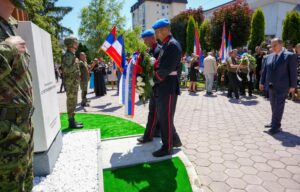
A monument dedicated to members of the 37th Motorized Brigade was unveiled and consecrated in the southern Serbian town of Raška on Saturday, as the brigade continues to feature prominently in disputes between Belgrade and Pristina over wartime archives, missing persons and war crimes investigations.
According to Serbia’s Interior Ministry, the monument commemorates 60 brigade members killed, three listed as missing and 186 wounded during the 1999 NATO bombing campaign against the Federal Republic of Yugoslavia.
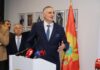
The monument was erected at the initiative of the Association of Members of the 37th Motorized Brigade, with the support of the local authorities. The ceremony was attended by Serbia’s Deputy Prime Minister and Interior Minister Ivica Dačić.
Dačić described the monument as „an expression of respect for those who honourably served their homeland,“ saying their sacrifice would not be forgotten.
„When a community decides to erect a monument to its brigade, it preserves the memory of all its members – those who gave their lives, those who endured the war while fulfilling their duty, and their families, who shared the burden of that sacrifice,“ he said.
He added that members of the brigade had carried out their duties „honourably, professionally and courageously“ and said the monument, erected in front of the Raška Primary School, would serve as „a silent teacher of history“ for future generations.
Dačić: „We Fought a Defensive War“
In his address, Dačić linked the ceremony to broader debates over the legacy of the wars of the 1990s, arguing that Serbia is facing attempts to „revise history.“
„We fought a defensive war. All our fighters were defenders of freedom and war heroes, not war criminals,“ he said.
Dačić also stated that nearly 1,000 Serbian police officers had been killed during the Kosovo conflict and in attacks he described as being carried out by „Albanian separatists and terrorists.“
Former Serbian Army Chief of the General Staff Ljubiša Diković, who commanded the 37th Motorized Brigade during the conflict, said the unit had earned a place among Serbia’s most distinguished military formations.
„May this monument remain a symbol of our respect for the victims and a reminder that they must never be forgotten,“ Diković said.
The 37th Motorized Brigade was deployed in Kosovo during the 1999 conflict as part of the Yugoslav Army. The unveiling forms part of Serbia’s broader efforts to commemorate members of its military and police forces who died during the conflicts of the 1990s.
From Commemoration to Missing Persons Investigations
While the monument was being unveiled in Raška, authorities in Pristina were continuing an exhumation in nearby Mala Kaludra, across the administrative boundary, in search of the alleged remains of 23 Kosovo Albanians from Mitrovica reportedly killed during the 1999 conflict.
The parallel developments once again brought the 37th Motorized Brigade into focus.
For years, war crimes investigations and the issue of missing persons have remained among the most contentious issues in relations between Belgrade and Pristina. Kosovo authorities have repeatedly called on Serbia to open military and police archives, with the archive of the 37th Motorized Brigade becoming one of their principal requests.
Kosovo Seeks Access to the Brigade’s Archive
In July 2024, Kosovo Prime Minister Albin Kurti announced that a formal request had been submitted to Serbia seeking access to the archive of the former Yugoslav Army’s 37th Motorized Brigade under the Declaration on Missing Persons adopted in Brussels on May 2 that year.
Kurti argued that Serbia’s refusal to open the archive meant it was failing to implement its obligations under the Declaration on Missing Persons and said access to the documentation could help clarify the fate of people still missing from the conflict.
The request was reiterated in June this year during a meeting of the Joint Commission on Missing Persons, where Kosovo representatives identified access to the brigade’s archive as one of two priorities, alongside the continuation of excavations in Batajnica.
At the time, Kushtrim Gara, head of the Missing Persons Unit in the Office of Kosovo’s Prime Minister, described access to the archive as „a test“ of Serbia’s willingness to implement the declaration.
The Serbian delegation, meanwhile, presented its own requests for additional information and investigations, particularly regarding persons reported missing after the official end of the conflict.
Humanitarian Law Center’s Rudnica Dossier
The Belgrade-based Humanitarian Law Center (HLC) has for years maintained that the archive of the 37th Motorized Brigade could help clarify wartime events in Kosovo.
In 2015, the organisation said then-Defence Minister Bratislav Gašić had classified the entire archive of the brigade’s former headquarters, arguing that the decision restricted access to documentation that could be be relevant to establishing the circumstances surrounding war crimes and the fate of missing persons.
The HLC subsequently filed a complaint against Gašić, claiming the classification violated Serbia’s Law on Data Secrecy.
According to the HLC’s Rudnica Dossier, bodies exhumed from the Rudnica mass grave belonged to Kosovo Albanian civilians killed in four separate incidents in the Drenica region in April and May 1999, an area that was then within the brigade’s zone of responsibility.
The HLC says 52 victims were identified in Rudnica and argues that documentation in its possession points to an operation aimed at removing bodies from crime scenes and concealing them in Serbia.
The organisation has also stated that Serbia’s War Crimes Prosecutor’s Office possessed information as early as 2010 indicating that the bodies recovered in Rudnica had been transferred from primary burial sites in Drenica. It has questioned whether members of the brigade were ever interviewed regarding those allegations.
The HLC further says that much of the documentation underpinning its conclusions consists of authentic military and police records used in proceedings before the International Criminal Tribunal for the former Yugoslavia (ICTY).
Serbia’s Ministry of Defence rejected the HLC’s claims, saying the decision to classify the archive had been made in accordance with Serbian legislation and did not apply to requests from courts, prosecutors or the ICTY.
Searches in the Raška Area Since 2013
Searches for potential mass grave sites linked to the Kosovo conflict have been carried out intermittently in the Raška area since 2013.
The searches have included the Rudnica and Kiževak sites and involved Serbian institutions as well as international experts from EULEX and the International Commission on Missing Persons.
Preuzimanje i objavljivanje tekstova sa portala KoSSev nije dozvoljeno bez navođenja izvora. Hvala na poštovanju etike novinarske profesije.