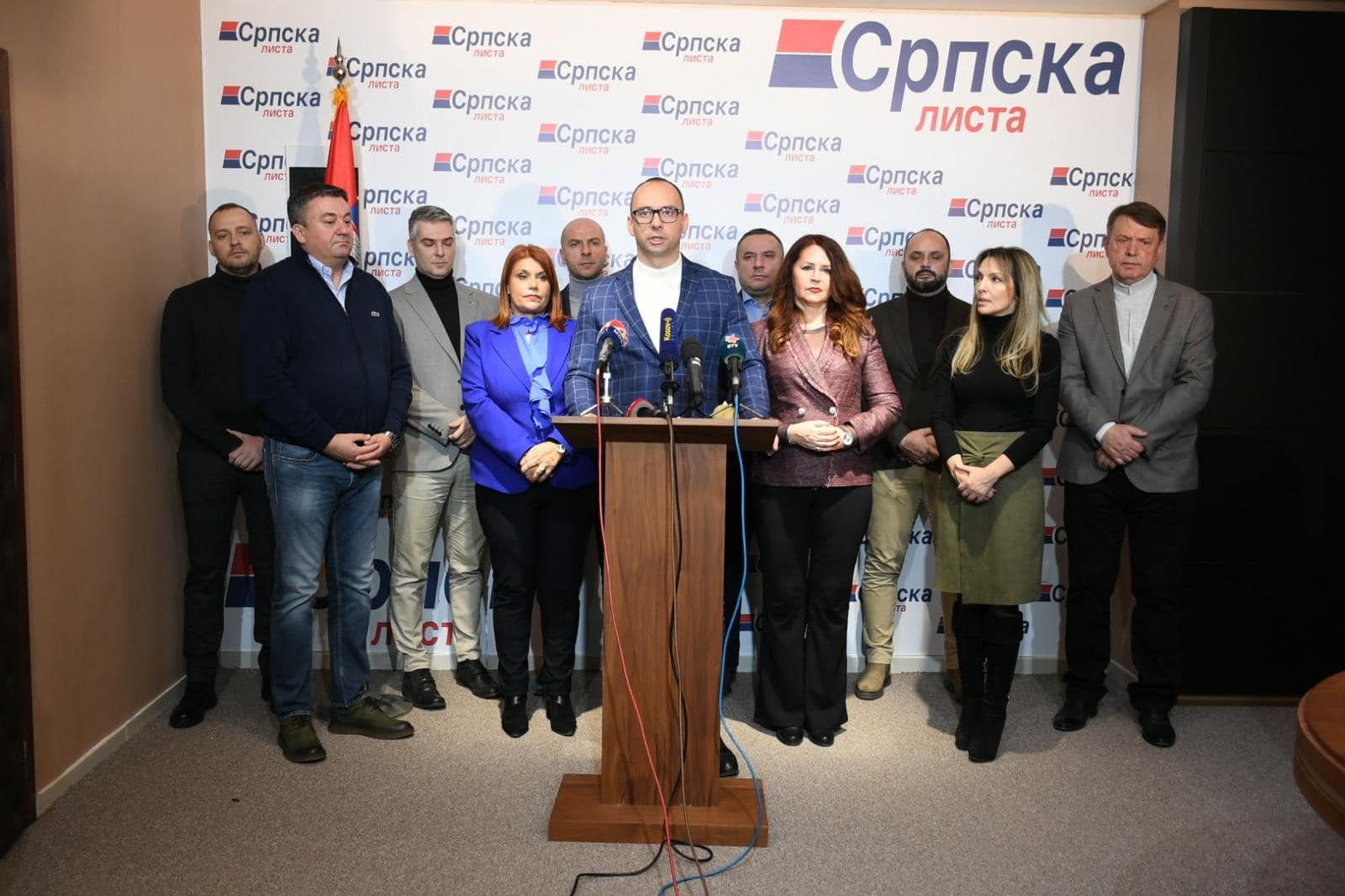
Srpska Lista has filed a formal complaint with the Election Complaints and Appeals Panel in Pristina, citing concerns over unequal representation in electoral boards ahead of the upcoming February 9 elections. The party alleges that a disproportionate number of members from Albanian parties, as well as from the party of the current Minister for Communities and Returns, have been appointed to municipal electoral boards—regardless of the significantly lower number of votes these parties received in previous elections.
Speaking at a press conference today, Igor Simić, a member of Srpska Lista, detailed the party’s grievances regarding the distribution of electoral board members. He emphasized what he described as a deliberate and systemic exclusion of Srpska Lista representatives from key positions in polling stations, including chairpersons and vote counters, even in municipalities with significant Serbian populations.
Disproportionate Representation
Simić highlighted several examples of alleged inequities. In municipalities such as Istok, Klina, Kosovo Polje, Kamenica, and Lipljan, he claimed Srpska Lista has no representatives in polling boards or vote-counting centers.
“It is paradoxical that other party, one supported by the regime, is granted representation despite having no mayors or councilors,” Simić said.
For instance, he pointed to Kosovo Polje, where Nenad Rašić’s party reportedly secured 17 votes in the 2021 elections but has been allocated 14 board members, including one reserve.
In other areas, such as Obilic, Prizren, Pristina, Orahovac, the Pec region, and Leposavic, Simić noted that rival Serbian party received an equal number of representatives as Srpska Lista, despite a stark disparity in electoral support.
He cited Leposavic, where Srpska Lista garnered 8,127 votes in the 2021 elections compared to 19 votes for a rival party.
Simić stated that out of 168 representatives in this municipality, 104 positions were allocated to Albanian representatives, leaving Serbian parties with a minority.
Similar disparities were noted in Novo Brdo, where Srpska Lista secured only 20 out of 120 positions, and in Zubin Potok, where the party of Nenad Rašić, which received just one vote in the 2021 elections, has five more representatives than Srpska Lista.
Simić emphasized that the underrepresentation extended to municipalities such as Zvecan, Gracanica, Ranilug, and North Mitrovica, where Srpska Lista holds just 18 representatives across 24 polling stations, with only three chairpersons.
“In six classrooms with approximately 6,000 potential voters, we have no control over the process. We have no members to monitor,” he said.
Concerns Over Conditional Voting
Simić also raised alarms about „conditional voting“ locations, where voters unable to cast their ballots in their home municipalities are allowed to vote. According to him, Srpska Lista has no representation in these polling stations, creating opportunities for vote manipulation.
“All conditional votes are counted days after the election in the Kosovo Polje center, where we have no representatives. This poses a serious risk of electoral fraud,” he said.
Electoral Rule Violations
The party claims the distribution violates Regulation 11/2024, which mandates fair representation based on population and electoral results. Simić explained:
“The CEC must ensure fair representation in election boards for all communities based on their population distribution within a municipality… It must also consider the number of votes each political entity received at both the municipal and national levels.”
“These principles have been blatantly ignored,” Simić asserted.
He further alleged that Srpska Lista’s representative in the CEC did not approve these decisions and that the finalized allocation was altered after the official session.
“The printed decision was modified to significantly disadvantage Srpska Lista. It wasn’t officially voted on during the CEC meeting but was signed, stamped, and distributed to municipal election commissions to follow,” he claimed.
Call for Action
Following the press conference, Srpska Lista announced it had filed a formal complaint, while Simić called on international representatives to assess the process’s legality and fairness. “February 9 elections are shaping up to be anything but legal, legitimate, or democratic,” Simić concluded.
Preuzimanje i objavljivanje tekstova sa portala KoSSev nije dozvoljeno bez navođenja izvora. Hvala na poštovanju etike novinarske profesije.