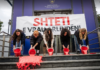
Today marked the third consecutive time Kosovo observed a day of remembrance for the victims of sexual violence during the 1999 conflict.
This solemn occasion, first proposed by President Vjosa Osmani, was officially declared a day of commemoration by the Kosovo government in 2023. The date, April 14th, was chosen due to the incident of the alleged rape of a minor in Babin Most in 1999, which prompted the declaration.
“April 14 is not only a day of remembrance – it is a call for justice,” echoes President Vjosa Osmani.
“It is a day to raise our voices for the thousands of women, men, and children who suffered sexual violence during the war, at the hands of Serbia’s genocidal regime,” she reiterates.
“Their strength and courage remain a profound source of inspiration. Vasfije, Shyrete, and many other women – and now Ramadan Nishori, along with many men – refused to be silenced by pain. They chose to speak out not only for themselves, but for all those who still cannot. They became the voice of truth, the voice of justice. We stand with all survivors – today and every day. The wounds remain open, but our fight for justice will never cease.”
Kosovo officials, including outgoing Kosovo’s Justice Minister and Prime Minister, paid their respects at the „Heroine“ memorial in Pristina.
Prime Minister Albin Kurti shared a message on social media, highlighting the ongoing struggles of survivors of sexual violence, which he claimed was systematically used as a weapon of war by Serbia in the 1990s.
Kurti’s post centered on the story of Ramadan Nishori, a man who, for the first time publicly, revealed his experience of sexual violence during the war.
Nishori disclosed in a statement at the Kosovo Center for Rehabilitation of Torture Victims that he was reportedly sexually assaulted in 1998 by two police officers while detained at a station in Glogovac, where he was rescued by an ethnic Albanian. He also revealed that he was subsequently threatened not to speak of the crime.
„Ramadan Nishori has become the first public voice of male survivors of sexual violence during the war,“ Kurti wrote. „His bravery is a powerful call for society to support other male survivors who continue to face prejudice and numerous obstacles in seeking justice.“
Alongside Nishori’s testimony, Kurti paid tribute to other individuals such as Marta Tunaj, Vasfija Krasniqi Goodman, and Shyhrete Tahiri Sylejmani, who have “testified about the crimes committed by Serbia during the Kosovo war.”
The Kosovo government also announced an extension of the deadline for survivors to apply for official recognition of their status, ensuring that “no survivor is left without the recognition and support they rightfully deserve.”
In his message, Kurti also addressed the broader issue of the wartime sexual violence, underscoring that it was “a strategy of Serbian forces during the 1998-1999 conflict.”
The official government Commission for the Recognition and Verification of the Status of Victims of Sexual Violence in the War began its work in February 2018. As of 2022, it had recognized the status of 1,217 women and 57 men as survivors, with a total of 1,736 individuals having applied. Despite the continued efforts, the number of recognized victims remains controversial, particularly the figure of over 20,000 survivors cited by Kosovo officials. This figure, though widely reported, has faced scrutiny, particularly from Belgrade, which has dismissed it as unverified.
Where Did the 20,000 Figure Come From?
The controversial number of 20,000 survivors stems from various sources, including a 2000 report by the World Health Organization and estimates from local NGOs, though it has never been officially confirmed.
Atifete Jahjaga, President of Kosovo from 2011 to 2016, indicated that the figure of 20,000 victims was derived from research conducted by „specialized organizations and experts.“
On the other hand, Siobhan Hobbs, who led the UN team that prepared the 2016 report on the status of sexual violence victims in Kosovo, questioned this figure.
„The estimate of 20,000 is based on the incorrect application of a formula, but it was done in good faith with the limited data available at the time. It was not an intentional mistake. The fact is, no one knows for sure,“ Hobbs told BIRN in 2016.
In a 2000 report, Human Rights Watch documented 96 cases of sexual violence against ethnic Albanian women in Kosovo, which, according to the report, occurred during the NATO bombing. The report noted that the actual number of such cases was „likely much higher“ and suggested that „some of these cases may have been duplicated by local and international organizations.“
The report also stated that in most cases, the violence was carried out by paramilitary units, who wore different uniforms. These were not isolated incidents committed by individuals, but rather deliberate acts, used as an „instrument of terrorizing civilians, extorting money from families, and forcing people to flee their homes.“
April 14 is not only a day of remembrance – it is a call for justice. It is a day to raise our voices for the thousands of women, men, and children who suffered sexual violence during the war at the hands of Serbia’s genocidal regime.
Their strength and courage remain a profound… pic.twitter.com/V8Km1MgObz
— Vjosa Osmani (@VjosaOsmaniPRKS) April 14, 2025
Preuzimanje i objavljivanje tekstova sa portala KoSSev nije dozvoljeno bez navođenja izvora. Hvala na poštovanju etike novinarske profesije.