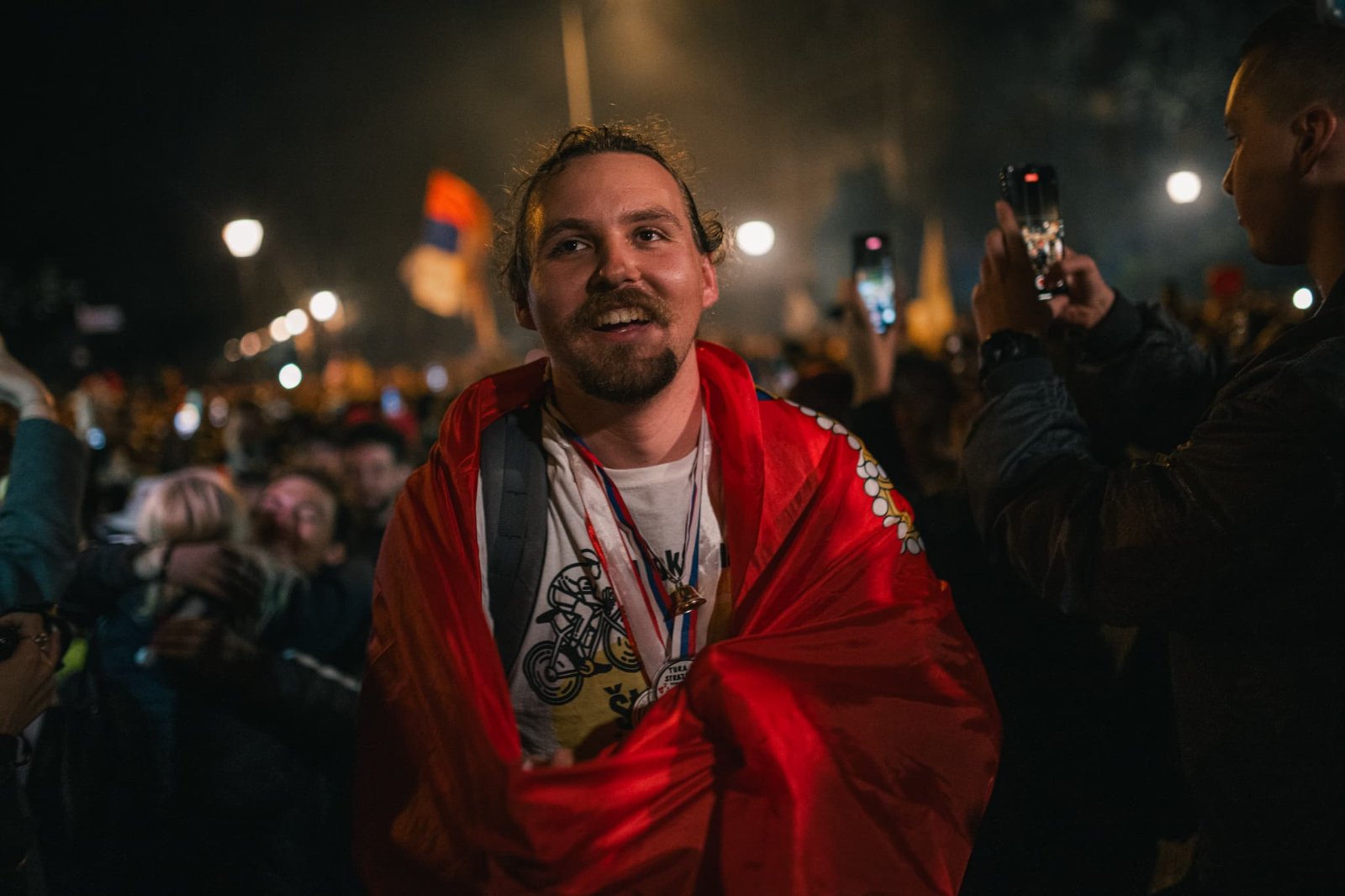
“Failure was never an option.” With that short but resolute phrase, 24-year-old Luka Đelić from North Mitrovica summed up his 13-day, 1,400-kilometer cycling journey to Strasbourg — part of the historic “Tour to Strasbourg,” undertaken by 80 students determined to deliver a message of democratic urgency to the heart of Europe.
An applied graphic design student at the Faculty of Technical Sciences in Novi Sad, Đelić spent the Orthodox Easter holidays with his family in his hometown, reflecting on what had unfolded. As one of the ride’s organizers and its most emblematic participants, he carried not just the flag of his university, but of a city — and a cause.
He bought his bicycle just days before departure. For his parents and for himself, the road ahead felt like a rollercoaster.
“This ride wouldn’t have been possible if we didn’t have strong support — from our people, and the overwhelming warmth from those who welcomed us across the route,” he said.
A Personal and Collective Awakening
Riding through towns and cities of European countries, Đelić said he grew as a person, “hugging people who, until yesterday, were so far from us, about whom we were taught differently.”
What he discovered instead was a shared thread of joy, grief, and history that transcended borders.
“That kind of connection doesn’t just change your awareness — it changes theirs too. Because when we embrace each other, we pass on something that’s been missing for years,” Đelić said.
„I Dream of Pedaling“
The journey still feels surreal. “I’m still processing everything. I feel like I’m still on the bike,” he said. “I dream of pedaling — the hills, the landscapes. And talking to the others, we’re all the same: none of us know what to do with our lives now that we’ve stopped turning the pedals.”
Though a longtime cycling enthusiast, his only major ride before this was from Novi Sad to Niš — around 380 kilometers. The rest of his experience came from working as a bike courier. He didn’t know what to expect or whether his body would hold up.
But what pushed him forward was a belief — a love for a pure idea: that democracy in Serbia can be restored.
“People asked me if I’d make it through 13 days. I said, ‘We’ll see.’ There were moments I thought I’d quit — I fought through pain, through self-doubt. But the desire to reach our goal always beat out the voice of logic.”
The Harshest Stretch
The most grueling part of the journey came en route to Győr, Hungary. With no police escort, bad roads, and fierce headwinds of up to 40 km/h, Đelić recalled nearly falling off his bike multiple times. That night, he suffered hypothermia.
“For a trip like this, you need an iron will, a deep sense of unity. None of us could’ve done this alone.”
Critics, Rumors, and Resilience
The group faced public criticism — accusations that the ride was a tourist stunt, that bikes were transported in vans, and even false claims that Novak Đoković funded the bikes.
“These kinds of rumors didn’t break us. If anything, they gave us more fuel,” Đelić said.
“We disconnected from the internet while riding, and what truly carried us forward was the mindset — a Novak Đoković mindset.”
Đelić was disappointed by the media distortion, especially involving Đoković’s name. He underlined that the students would be honored to meet him, to learn something from him.
„We Shift Gears, Not Principles“
The students’ mission was clear: to raise international awareness of the lack of justice and dialogue in Serbia. In a letter to French President Emmanuel Macron, they described their journey as both a cry of despair and an act of unwavering hope.
“Our mission is simple, yet urgent: to highlight the erosion of democratic values in our country — a place where institutions no longer protect citizens, where media is pressured, elections are compromised, and critical thought is under attack”, reads the students’ letter to Macron.


A Message to the Diaspora
One of the most emotional moments came in Munich, where Serbian healthcare workers greeted them with hugs and homemade signs urging the students to “show us the way back home.”
“That hit me hard,” Đelić said.
“What kind of home are they hoping to return to? I’d like it to be a free home, full of love, where people can speak their minds without fear, and where doctors don’t get sick working 12-hour shifts.”
He quoted trauma expert Gabor Maté, saying many Serbian doctors abroad likely experienced a moment where their bodies said “No, I can’t live like this anymore.”
Still, Đelić believes the diaspora is waiting.
“Waiting for the moment their homeland gets healthier, so they can come back.”
Beyond Borders, Beyond Stereotypes
Unique among the 80 cyclists as a native of Kosovo, Đelić emphasized that he had no special treatment. What mattered more, he said, was the human connection with peers from all across Serbia and the region.
He recounted how, in Salzburg, a woman from Split (Croatia) burst into tears and hugged him, saying she and her mother had traveled just to show support.
„I’m glad when people tell us where they’ve come from, how far they’ve traveled, and how they support us. That doesn’t just change my own awareness—I believe it deeply changes them too, because in embracing one another, we’re sharing something that’s been missing all these years.“
Organizing the Impossible
Behind the spectacle of 80 students pedaling westward was a tireless logistical effort. Đelić, one of the organizers, revealed that the plan was finalized in just one week — a feat requiring sleepless nights and unyielding determination.
“There was no option to delay. No option to fail,” he said. “The night before we left for Subotica, I slept for 12 minutes — in the bathtub.”
Back to Where It All Began
Now back in North Mitrovica, Đelić rests and reflects.
“Whenever I’m in Novi Sad, I always say I’m from here — from Mitrovica. Everything I gained here in Kosovo and Metohija, both as a child and as an adult, meant a great deal to me for the road ahead.“
He refuses to see himself as a hero.
“I don’t want to say I did something big while someone else did something small. Everyone deserves to make their own choices freely, without judgment.”
But one thing is certain: Luka Đelić, with the rest of his fellow cyclists, rode not just to Strasbourg, but into history — shifting gears, but never principles.
Preuzimanje i objavljivanje tekstova sa portala KoSSev nije dozvoljeno bez navođenja izvora. Hvala na poštovanju etike novinarske profesije.