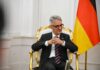
Enver Hasani, former President of the Constitutional Court of Kosovo and former Rector of the University of Pristina, said in an interview with KoSSev that Kosovo’s most recent elections “were neither free nor fair,” claiming that the alleged mass distribution of several hundred million euros to voters amounted to “the largest vote-buying operation in Kosovo’s post-war history.”
Parliamentary mandates obtained in this way, he said, are immoral, while calling early elections this year would constitute “political suicide” for Prime Minister Albin Kurti.
In the interview, Hasani said he does not believe in a second presidential mandate for Vjosa Osmani.
“I seriously doubt that Mr. Kurti would support a person who represents a permanent challenge to his power and authority. Ms. Osmani has proven to be someone Kurti cannot reliably depend on,” the university professor said.
Because, as he claims, Kurti personally accepted political autonomy for Kosovo Serbs in Ohrid in 2023, Hasani believes that the Prime Minister views the Association of Serb-majority Municipalities as inevitable and will therefore choose a president above all who is a “loyal person” — one “who possesses strong moral-patriotic qualities.”
“Not only is this likely, it is more than certain that he will do so,” Hasani said, referring to the Association.
According to him, the current government is leading Kosovo toward the disintegration of the Ahtisaari model, but in a way that creates parallel “Albanian” and “Serb” Kosovos.
“All conduct by Kurti’s government over the past several years has fully legitimized and legalized, at the international level, the demands of local Serbs for autonomy and a separate political life in Kosovo, based on asymmetric institutional foundations.”
Hasani warned that the authorities led by Vetëvendosje, through populist rhetoric, have homogenized the Serb community along national lines and driven it into a “state of panic,” while the removal of Cyrillic signs forced Serbs to write in a script that is not their own — a practice he described as “unconstitutional and illegal,” further deepening tensions and social divisions.
“The most problematic and unforgivable act is the unconstitutional and unlawful lynching of Serb political representatives. It was an incredibly low blow, because through populist rhetoric the Serb community in Kosovo was homogenized along national lines and pushed into a state of panic, which is harmful to Kosovo’s Euro-Atlantic path.”
He also criticized Serbs for withdrawing from institutions instead of exerting pressure on the government from within the system to protect the interests of the Serb community.
“Such a move should have been used as a last resort, not as the first step. These actions later encouraged various hooligans from the Serb community and individuals with criminal backgrounds to present themselves as legitimate representatives of Serbs, which led to violence and, ultimately, terrorist incursions in Banjska.”
When Political Processes Collapse, Violence, Demagogues, and the Underworld Take Over
Hasani believes that today’s statement by Kosovo’s foreign minister, Glauk Konjufca, about conducting dialogue with Serbia through that ministry is not merely a matter of legality or realpolitik, but rather part of the propagandistic communication style employed by Albin Kurti and his government.
Such statements, he said, are often presented as firm and courageous positions toward Serbia, but in essence reflect readiness — or “preparing the ground” — for the Prime Minister to implement obligations arising from the Ohrid Agreement.
In the interview, Hasani also addressed Kosovo’s participation in the Peace Committee initiative, stressing that he sees nothing problematic in the decision to join, as Kosovo does not have the luxury of rejecting an American initiative. He also believes that the resources of the Kosovo Security Force are “sufficiently trained for such missions.”
As for the proceedings against former leaders of the Kosovo Liberation Army, which are nearing completion before the Kosovo Specialist Chambers in The Hague, Hasani said the indictment for a joint criminal enterprise is not provable and claims that no such enterprise existed.
“Nothing of the sort existed. Statements and testimony by high-ranking Western military, security, and diplomatic officials are decisive on this issue, given that they had full control over the critical situation during 1998–1999, which is essential to the indictment,” he said.
The full interview with Enver Hasani will be published tomorrow.
Preuzimanje i objavljivanje tekstova sa portala KoSSev nije dozvoljeno bez navođenja izvora. Hvala na poštovanju etike novinarske profesije.