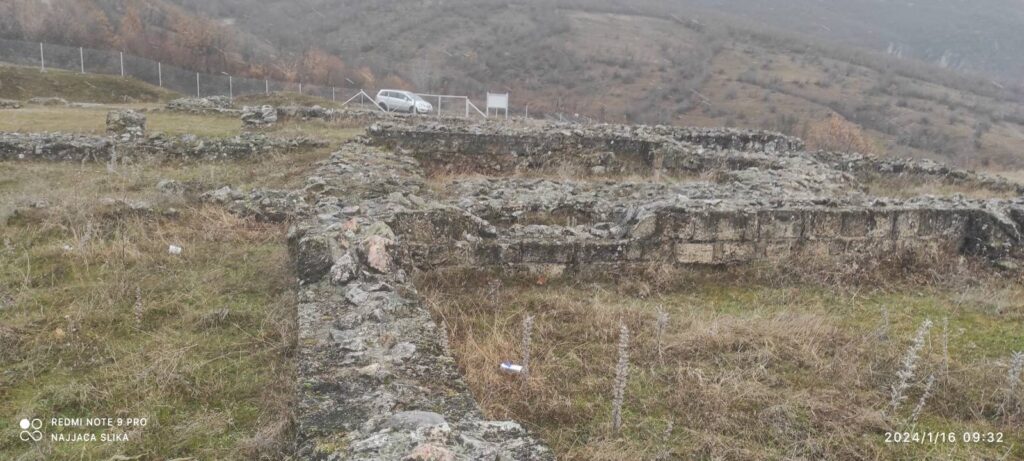
Following media reports about a fence recently erected around the foundations of the Serbian monastery of Bogorodica Hvostanska in Studenica, in the municipality of Istok, and the installation of a sign in Albanian stating that it is actually a basilica, the Diocese of Raska-Prizren reacted, saying that this is another example showing “the real intentions and methods of Kosovo authorities, who- have a clear desire to create an ethnically-pure Kosovo and advance the disappearance of the Serbian Orthodox Church and its followers.”
In a statement, the Diocese highlighted that this latest case of “taking over” the remains of the monastery Bogorodica Hvostanska (Mother of God of Hvosno) – one of the most significant sites of our Church in Kosovo and Metohija and the ancient seat of the Hvosno diocese since 1219 takes places after a recent attempt to occupy the Serbian Orthodox Church in the village of Rakitnica near Podujevo.
The Kosovo Police, contrary to all laws, refused to initiate an investigation, the Diocese underscored.
Shortly after that, they added, the church of the Lifegiving spring, in the village of Vinarce near Kosovska Mitrovica was declared as a Roman Catholic church under the “care” of Kosovo’s Ministry of Culture.
They remind that the latest case takes place in the midst of “the media’s distortion of the history of the church Bogorodica Ljeviška in Prizren in Pristina’s leading news portal Koha” and “the general surge in aggressive historical revisionism and erasure of traces of the Serbian Orthodox Church in the region by Kosovo authorities.”
Even though several medieval SOC churches in Kosovo were renovated and expanded on the foundations of earlier abandoned or damaged early Byzantine sacral structures over 800 years ago, the Diocese alerted that “no one has the right to now forcefully take over and rename churches that for centuries have been the foundation of our people’s and Church’s identity.”
“Leading us to a situation where we must prove and repeat what is contained in numerous previous archaeological research, findings, artefacts, historical records, and testimonies in the region and the world, and even despite the sacral and liturgical continuity that the Serbian Orthodox Church has maintained in these areas.”
The Diocese of Raska and Prizren said that the latest move has understandably sparked sharp reactions among professionals as well as believers.
Such behaviour cannot and must not be tolerated in the 21st century, especially considering the obligations Pristina undertook before Western countries since 2008 and the provisions of UN Resolution 1244, which insists on preserving Serbian patrimony, they added.
According to the Diocese, the Serbian Orthodox Church, with its holy sites, has significantly marked the history of Kosovo to such an extent that all four UNESCO World Heritage sites in this area are churches from the Serbian Nemanjić dynasty medieval period.
They added that these sanctuaries are simultaneously listed as endangered world heritage and have been under (KFOR or police) armed protection for 25 years due to ongoing security threats.
“These religious sites, with their precious architecture and frescoes from the 13th century onwards, represent a universal value and are not only significant for the Serbian people and our Church, which built, renovated, expanded, and preserved them in the most difficult times of the last several hundred years and represent places of liturgical gathering and collective memory but are also part of European and global heritage. Instead of being respected, we face a situation where their survival is impossible without armed protection, and they can be arbitrarily fenced off and renamed overnight into something they have never been.”
They also wondered: By what logic can those who unreservedly glorify armed groups and their ideological followers, who participated in the systematic destruction of dozens of Serbian Orthodox churches and hundreds of cemeteries since the 1999 war, especially during the Pogrom in 2004, convince our people and the world of their “good intentions” to protect the spiritual and cultural heritage of our Church or declare the churches whose destruction they encouraged as their own?
The Diocese warned that the church is denied daily fundamental rights, and freedom of access to certain sites.
“At the same time, some media and tabloids in the Albanian language continues promoting extremely one-sided historical narratives that do not rest on historical facts but on selective interpretations of history and crude reinterpretations, omitting centuries of existence of these churches and monasteries, many of which were respected and even protected by Kosovo Albanians.”
“Such behaviour directly calls for open persecution and repetition of vandalism committed against our Church after the 1999 war, now continuing with repressive measures and denial of rights to the Serbian people and Church by Kosovo authorities,” they stated.
“Denying religious rights that lead to the erasure or crude alteration of history blatantly contradicts the basic foundations of democratic societies. Other examples of violations of our Church’s rights, non-recognition of decisions by the highest courts, and the systematic destruction of our holy sites, especially since 1999, represent clear indicators that Kosovo authorities evidently see no place or future for the Serbian people and the Serbian Orthodox Church in this region.”
The site itself, as acknowledged even on the sign posted in the Albanian language, has been thoroughly researched by eminent Serbian historians and archaeologists, who found and preserved numerous artefacts, such as the 15th-century Rodop’s bell and various other items that testify to the identity of this holy site.
Serious history is based on facts grounded in incontrovertible material evidence and cannot be improvised based on arbitrary conjectures, selective and arbitrary approaches to history, and especially not on the foundations of radical political-national ideologies of recent times, the Diocese underscored.
Furthermore, they called on local and international representatives in Kosovo to “stop the process of politicisation and selective presentation of the spiritual and cultural heritage of the Serbian Orthodox Church, which as an autocephalous Church has existed and operated in these areas for 800 years and is deeply connected with the history of this region.”
“The historical revision of this and other churches and monasteries of the Serbian Orthodox Church in Kosovo and Metohija represents a process that profoundly endangers ethnic and religious relations in the wider region and leads to the erasure of a centuries-old identity of the Serbian people and the appropriation of its heritage, which has survived hundreds of years of Ottoman rule and two world wars.”
The Diocese also presented a historical overview of the monastery of Bogorodica Hvostanska, and we publish part of it below:

The remains of the monastic complex of the Bogorodica Hvostanska Church (The Mother of God of Hvosno), also known as Studenica Hvostanska or Mala Studenica, are located in the village of Vrela, approximately 8-9 km west of Istok. The first mention of the village as the “hamlet of Vrela” dates back to 1397 when Princess Milica donated it to the Dečani Monastery. The next mention of the monastery is in an Ottoman census of 1485, where it is recorded as the monastery “Ivrala” (Vrela, or Studenica Hvostanska), housing “the son of Metropolitan Tijokan” and four monks. In a later Ottoman census, it was referred to as Vrelo Prečiste (the Most Holy Theotokos). In 1560, a Prologue was written there. During the reign of Sultan Suleiman the Magnificent (1494-1566), the Ottoman census recorded four houses at this location. The subsequent Ottoman census of 1570/71 noted that Monk Makarije led the monastery, undoubtedly the future Patriarch Makarije Sokolović. In the next Ottoman census of 1582, the monastic estate was managed by Monk Gerasim, who was also involved in falconry, as evidenced by a special permit.
The early history of the monastery’s origin is little known. In 1219, when St. Sava, reorganising the newly established Autocephalous Serbian Church, founded the Hvosno Diocese at the monastery “in Fosne, in Mala Studenica,” an ancient cult site, as evidenced by a record in the Serbian medieval genealogy:
“THIS MOST REVEREND FIRST ARCHBISHOP SAVA OF SERBIA APPOINTED IN THE DIVINE CHURCHES THROUGHOUT HIS FATHERLAND HONORABLE MEN CHOSEN. HE APPOINTED THEM AS SHEPHERDS OF THE CHURCH AND BISHOPS. WITH HIS ORDINATION, HE APPOINTED THE FIRST BISHOP IN THE LAND OF HUM, IN STON, IN THE CHURCH OF THE HOLY MOTHER OF GOD; THE SECOND BISHOP IN ZETA DIACLITIAN SEASIDE, IN THE CHURCH OF ARCHANGEL MICHAEL; THE THIRD IN DABAR IN THE CHURCH OF SAINT NICHOLAS; THE FOURTH IN BUDIMLJA IN THE CHURCH OF SAINT GEORGE; THE FIFTH IN RAS IN THE CHURCH OF THE HOLY APOSTLES; THE SIXTH IN HVOSNO, IN MALA STUDENICA, IN THE CHURCH OF THE HOLY MOTHER OF GOD; THE SEVENTH IN PRIZREN IN THE CHURCH OF THE HOLY MOTHER OF GOD; THE EIGHTH IN GRAČANICA IN THE CHURCH OF THE MOTHER OF GOD; THE NINTH IN THE CHURCH OF SAINT NICHOLAS IN TOPLICA; THE TENTH IN BRANIČEVO IN THE CHURCH OF SAINT NICHOLAS; THE ELEVENTH IN BELGRADE IN THE CHURCH OF THE HOLY MOTHER OF GOD; THE TWELFTH IN MORAVICA IN THE CHURCH OF THE HOLY FATHER ACHILLIUS.”
The Diocese, from 1381, became a metropolis, and the first Hvosno bishops are mentioned at the beginning of the 14th century, the last, named Viktor, in 1635. The second half of the 16th century was a period of prosperity for the monastery, marked by significant artistic activity. In the second half of the 17th century, likely during the Great Migration of 1690, the monastery was abandoned and began to decay. Over time, the building materials from Bogorodica Hvostanska were scattered. Among other uses, they were incorporated into the village mosque, where parts of marble slabs and masonry, with or without Cyrillic inscriptions and ornaments, were secondarily inlaid. Travellers who saw the monastery in the 19th century testify that Bogorodica Hvostanska was entirely in ruins.
The oldest church was a three-aisled early Byzantine basilica with a narthex, where a particular space for relics was located in its semi-circular apse and most likely a spacious atrium in the western part of the basilica. Based on stylistic analogies and the absence of diaconicon and prosthesis alongside the lateral sides of the apse, the basilica is dated to the mid-6th century. Early Byzantine remains in the complex of Bogorodica Hvostanska include two built underground tombs intended for multiple individuals. The old monastery was likely fortified with walls, which are only partially preserved, their foundations generally following the relief of the surrounding land.
As a remnant of the basilica complex, the foundations of a smaller single-nave church with a small narthex located north of the basilica are visible today, hence called the north church. It was likely reconstructed after establishing the independent Serbian Church in 1219 and existed throughout the Middle Ages.
On the basilica’s foundations, a church was built in the early 13th century, which became the seat of the Hvosno diocese (Hvostanska Eparhija) as part of the Serbian medieval ecclesiastical organisation recognised by Constantinople. Constructed in the style of the Raška architectural school, with harmonious proportions, it was a single-nave building intersected by a transept to the east, above which a dome rose. To the east was a spacious altar area, semi-circular inside and rectangular outside, continued on the western side by a rectangular narthex with a reinforcing arch. An external narthex, divided into six bays by two free-standing columns in the middle, extends its length.
Northern and southern chapels with semi-circular apses and flat outer wall surfaces were located alongside the narthex. Above the chapels, likely two towers were rising higher than the church’s dome. An unknown time later, a diaconicon and prothesis were added beside the altar apse.
The Monastery of Žiča might have influenced the church’s builders. The semi-circular apse, rectangular on the outside and semi-circular inside, could have been inspired by buildings in the Bay of Kotor, suggesting the builders’ origin. In the 13th and 14th centuries, skilled builders worked in Kotor, and it’s conceivable that the founders of Bogorodica Hvostanska brought builders from there.
Alongside the main church of Bogorodica Hvostanska in the Middle Ages, as was customary, smaller chapels were built. The foundations of one such chapel were discovered to the south of the church. Judging by the remnants of a discovered inscription mentioning Emperor Stefan (Dušan), it is dated to the mid-14th century. It was a smaller single-nave building with a semi-circular apse on the east side, covered by a semi-cylindrical vault.
During archaeological research, the foundations of an old refectory of elongated rectangular shape with a semi-circular apse for the abbot’s table were discovered.
Relatively few findings during archaeological work indicate that the monastery ruins had been excavated multiple times. Collected fresco fragments show two layers of paint, suggesting the main church was painted twice. In addition to remnants of late-antique pottery, pieces of pottery – pots, jugs, pitchers from the 13th to 15th centuries – were found in the ruins of Bogorodica Hvostanska. From later periods, a luxurious example of Ottoman pottery stands out – a decorated jug made in Iznik in the second half of the 16th century.
Around the church were several graves with stone slabs. Some were used in the construction of mosques in the villages of Vrelo and Studenica but are now transferred to the Patriarchate of Peć. Inscriptions on the slabs show that local dignitaries and Hvosno bishops were buried around the church during the 14th and 15th centuries.
At the beginning of the 20th century, a local resident found a large bell (with a Cyrillic inscription) in the ruins, containing three pieces of painted fabric. Two of these are now preserved in the Patriarchate of Peć. The largest is a shroud from around 1300, while the smaller, an aer shroud depicting the Lamentation of Christ, was drawn by the Dečani painter monk Longinus in 1597.
The former monastic complex of the church of Bogorodica Hvostanska is now a ruin, almost levelled to the ground.
Preuzimanje i objavljivanje tekstova sa portala KoSSev nije dozvoljeno bez navođenja izvora. Hvala na poštovanju etike novinarske profesije.