The once peaceful village of Banjska, known for its touristic charm, is now bustling with activity—but not from tourists. Special forces from the Kosovo Police, KFOR, EULEX, and numerous media outlets have descended upon the area. While there was no official announcement, the situation on the ground since yesterday hinted that Kosovo’s Prime Minister Albin Kurti would make an appearance, which he did earlier today. Overhead, the constant hum of drones and the roar of a helicopter now add to the already tense atmosphere.
Today’s event marks the anniversary of the deadly clash in Banjska. On September 24, 2023, a Kosovo police sergeant, Afrim Bunjaku, was killed in an ambush, followed by the deaths of three local Serbs in a violent confrontation between strong Kosovo police forces and a heavily armed group led by Milan Radoičić.
For Kosovo authorities and media, this has been a central focus since last week, with special broadcasts running on Pristina-based television since last night.
A Somber Memorial
At the entrance to Banjska village, where Bunjaku was killed, numerous media teams have gathered. A newly erected pillar with a sign stands at the site, draped in a red cloth and surrounded by flowers from the Zvečan municipal delegation.
The sign bears Afrim Bunjaku’s name, and Kosovo’s government recently decided to rename a section of the highway from Balaban to Banjska in his honor.
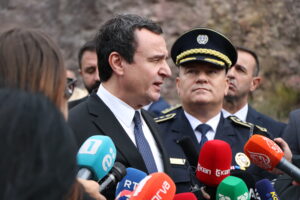
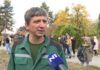
Accompanied by Kosovo’s interior minister, local officials, and the police director, Kurti arrived just before 11 a.m. He unveiled the sign, receiving applause from some attendees.
He then addressed the media.
Kurti reiterated previous statements, describing the incident as an „act of aggression“ and a „terrorist attack by a paramilitary group,“ directly linking it to Serbia, which he accused of financing and organizing the operation through „autocratic pro-Russian regimes“ and „criminals like Milan Radoičić and Zvonko Veselinović.“
He also repeated claims from the indictment that the group aimed to annex northern Kosovo.
Initially, Kurti refused to translate his remarks into Serbian, despite multiple requests from Serbian journalists. However, after concluding his speech, a police official provided a statement. Kurti eventually did respond to questions in Serbian later in the day.
Albin Kurti told the Serbian media that the attackers in Banjska were mercenaries, not patriots, but millionaires who had been bringing weapons to Kosovo for a year to incite conflict. He claimed that Radoičić and his group had no chance against special forces and had fled into the mountains. Kurti reiterated his call for Serbia to extradite them, seeking international support for this.
He emphasized that there would be no tolerance for those wanting war in Kosovo and the Balkans, asserting that they wouldn’t walk freely in Kosovo. He also addressed negative media portrayals in Belgrade, denying any plans for the persecution of Serbs, and announced that special forces would remain in the North until complete security was established.
Remembering the Fallen
In a Facebook post earlier today, Kurti reflected on the events of a year ago: “On the anniversary of the terrorist and paramilitary attack on our country in Banjska, we honor and will never forget the sacrifice of hero Sergeant Afrim Bunjaku, who lost his life defending the sovereignty and territorial integrity of the Republic of Kosovo.”
A delegation from Pristina, sponsored by Kurti, paid respects this morning at Bunjaku’s family home in Samodreža, near Vučitrn, followed by a ceremony at his gravesite.
Kosovo’s President, Vjosa Osmani, also issued a statement this morning, emphasizing Bunjaku’s sacrifice:
“A year ago today, Bunjaku fell to remind us, as history has shown for centuries, that this land is our eternal homeland.” She further stressed Kosovo’s indivisibility, declaring, “Kosovo will remain undivided, and our freedom and borders are inviolable, now and forever.”
Political Leaders Mark Anniversary
Kosovo’s Interior Minister, Xhelal Sveçla, who had visited Banjska yesterday, was also present today alongside Kurti.
In an interview yesterday, Sveçla stated, „According to the law, terrorists can be tried in absentia.“ This followed the Special Prosecutor’s indictment of 45 individuals, including Milan Radoičić, earlier this month. The trial is set to begin tomorrow.
FOTO: Džefri Hovenijer
International officials also paid tribute today to the slain Kosovo police commander. The U.S. Ambassador Jeffrey Hovenier joined a delegation from the Kosovo government to honor him at Bunjaku’s grave. They remain consistent in honoring only the slain police commander, making no mention of the deceased attackers. International diplomats continue to classify the event as a „serious security incident“ and an „attack,“ for which they seek a judicial resolution.
Divided Interpretations: Pristina vs. Belgrade
Kosovo’s top officials have consistently framed the Banjska events as an „act of aggression“ and a „terrorist attack“ backed by official Belgrade. European and Brussels-based statements, meanwhile, have described the incident as a „serious security incident.“
In contrast, Belgrade, led by Serbian President Aleksandar Vučić, has denied any responsibility for the events. Vučić has pointed to local Serbs as the main actors, distancing Serbia’s official stance from the incident, much as he did on September 24 last year.
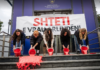
Among the victims of that day were Bojan Mijailović, Igor Milenković from Leposavić, and Stefan Nedeljković from Zvečan. Last night, Belgrade-based media reported that members of the Delije, a Serbian football fan group, paid tribute to Nedeljković, calling him a „hero of Banjska“ through an elaborate choreography at the stadium.
This tribute marks the only public acknowledgment from Serbia regarding the anniversary, as Serbian officials have remained silent.
FOTO: Kim
The family of the slain Stefan Nedeljković gathered to light candles in memory of their loss, marking „a sad day and sad event,“ according to his father, Dragan Nedeljković. He expressed plans to erect a cross at the site where Stefan died, emphasizing the need for resilience as a year has passed since the tragedy. Dragan noted that candle-lighting has been a spontaneous act, with people visiting frequently to pay their respects, though the area remains difficult to access. He stated there were no issues with the Kosovo police during their visit. Dragan also highlighted the presence of Bojan Mijailović’s family, who still do not know the location where their son was killed, urging assistance in helping them reach the site to honor him as well. The location of Stefan’s death is near the closed Banjska monastery.
President Vučić has not addressed the topic directly, but he is expected to deliver a 25-minute speech later today at the UN General Assembly in New York. Serbian media, however, dedicated significant portions of their programming to the anniversary yesterday and continue to follow the story closely today.
As the anniversary unfolds, Kosovo police presence has noticeably increased. NATO’s KFOR mission has also ramped up joint patrols with the Kosovo police, particularly in the border areas with Serbia and in the village of Banjska itself.
What happened a year ago in Banjska?
The tragic events of September 23–24, 2023, began with the killing of a Kosovo police officer, followed by hours of armed conflict in Banjska. Three attackers were killed, and several others were wounded or arrested. All were later identified as being from northern Kosovo. The attackers were heavily armed, with military equipment worth millions of euros seized.
Responsibility for the attack was claimed by Milan Radoičić, then vice-president of Srpska Lista, the largest political party representing Kosovo Serbs.
The Banjska Monastery found itself in the midst of chaos after Radoičić’s group forcibly entered and broke the monastery gate, subsequently occupying the lower hotel facilities of the broader monastery complex. Initial reports, which were later debunked, suggested that the monastery had been involved in the attack or had hidden weapons. Some even speculated that monks had harbored terrorists.