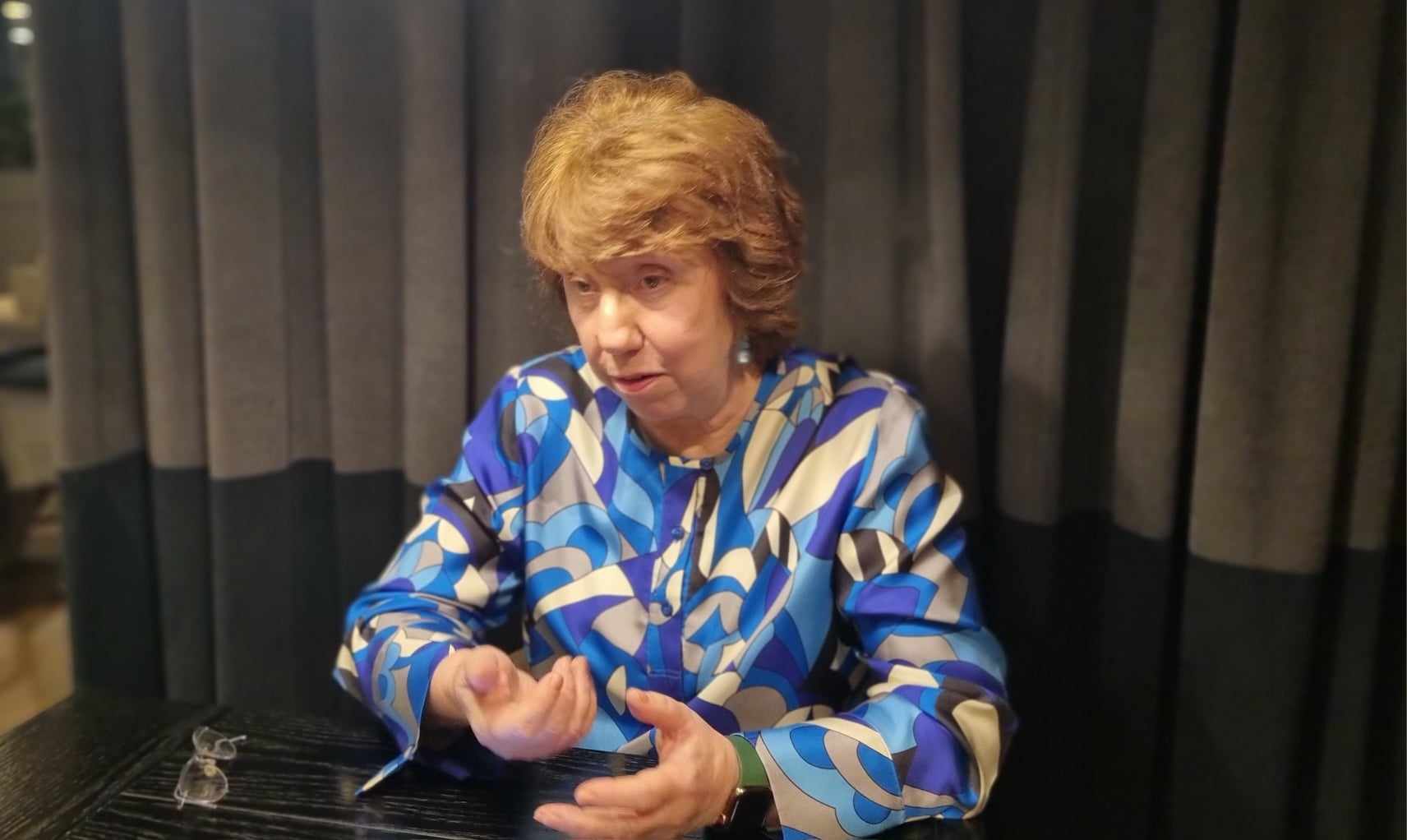
I hear much more about the Association (ASM) than I expected, and I hear so many things that are sort of given to it – like it’s some sort of negative magical thing. But actually, all it is – is the ability to be able to work together and to talk with Pristina in the ways that the (cf. Serbian) community feels more secure, Catherine Ashton said following a decade of non-implementation of this part of the Brussels agreement.
At the recently held UNMIK trust-building forum in Thessaloniki, the former High Representative of the European Union for Foreign and Security Policy, former Vice President of the European Commission, and mediator in reaching the Brussels Agreement in 2013, reminded of the points of the agreement related to the formation of the Association of Municipalities with Serb majority.
„The Association comes from one of seven questions that I put to Belgrade and Pristina in the dialogue. The question for Pristina said: in order for us to get Belgrade not to interfere – as they would see it, or not be part of the structures in the northern of Kosovo, it is important for the Serb community to have a relationship with Pristina that they feel is special. In the European Law on Local Authorities, all of the European Union can collaborate on the provision of services anywhere, which is part of European law. So the issue became what is that would make this particularly important that the Serb communities that if they have problems, they have a hotline, a direct relationship with Pristina,” Ashton said.
She stressed that for the Serbs in Kosovo, placing an emphasis on citizens in the North, it is important that Belgrade and Pristina talk to them.
According to Ashton, Kosovo Serbs having communication with both sides would be a positive thing for dialogue and the best way to move forward.
She mentioned compromise as an unfairly underestimated, but actually powerful word.
“So, the word compromise gets a bad press. It is seen to be giving it, and it’s really not. You can’t negotiate something, you can’t move forward, unless you are prepared to make sure that you stand up for the things that really matter, that you are prepared to understand that the people you are talking to have things that really matter to them, too. And you are working out and trying to find the way to do as much as you can for your own community, your own people, but also to recognize that other people, other communities, need things, too,“ Ashton said in an exclusive interview for KoSSev.
Were Hashim Thaci and Ivica Dačić people of compromise?
“I think they absolutely understood that the future for both lay in their ability to have good relations next door to each other. I think they both understood that for the Western Balkans to grow and develop and have opportunity, the relationship between Serbia and Kosovo, in the end, had to be sorted out. And that was especially true in the north, where the negative side of all those relationships was on display. And they could be, in a sense, able to show the way of how they could get closer to the European Union. And for the European Union to say ‘okay, these are difficult things to do, because they were, but by doing that we’re able to bring you closer and eventually to the EU.’ This is all about win, win, win, win, win. But in order to win, you’ve got to be prepared to say ‘these are important things, other things I can live without, and that I would recognize your point of view wherever you are.’”
In her words, this is what she observed in the former Belgrade-Pristina negotiating duo.
“It takes a lot to be prepared to sit in a room and say ‘okay, I will agree to that, I will accept that.’ It’s brave to do this. Many leaders across the world I’ve met, they get into a leadership position and they’ve done it. They sit there, they don’t rock the boat. They don’t rock the boat for their own supporters because they know if they do something extraordinary or brave they might lose the next election, something may happen to them. And that’s what I saw in this region, there are politicians who are absolutely capable of that. I’ve seen bravery across the region, I just want to see some more of it,”
She underlined that she is aware “things don’t always go smoothly.”
“Getting an agreement is one thing, implementing it is quite different. And it’s harder, because that’s when you come across all of the issues,“ she emphasized.
Although the goal of the Brussels dialogue was and is to improve the lives of citizens, especially for those living in the north, Ashton noted that the obstacles that people face every day would not be resolved in a short period of time.
“So, you need a combination of practical things happening and a lot of political will. And that’s political will not just a government level, it’s also local mayors, it’s about local communities, it’s about the NGOs. It’s about everybody pushing forward. It was never going to be a straight line in these ten years. It was always going to wobble about, and it was always going to be a challenge when we look at the practical things we had to do.”
Nevertheless, Ashton admits that, despite the differences between the two sides, she personally would like the negotiation process between Belgrade and Pristina to go more quickly, stressing that the agreement should be a living one, while also raising the issue of responsibility – instead of negotiators refusing to carry out obligations only because they were undertaken by someone who was in power before them:
“It should also be a living agreement. It’s an agreement that they need to look at and revisit and look at the practicalities of what they do. It doesn’t mean ripping it up, it doesn’t mean making big changes. It just means trying to be creative, so that it’s fixed within the political framework that exists now, which is different to ten years ago.“
If you had asked any average citizen of the north at the time, they would have told you – ‘we don’t want 2013. We don’t want the Brussels agreement. Because it represents a break in ties with Serbia. We want to stick to our Serbian system and we don’t want to be forced into a system that we don’t recognize as friendly’. Ten years later, they are even more convinced of this because nothing has improved for them.
“So, I understand that for many people in the north this felt like a big change. It is up to politicians and leaders in Kosovo, in Serbia, and in the north, to make sure people understand what the objective is. It is not about making people feel less safe, it is about them feeling that this is going to be better. And we were very careful when thinking about the agreement from the Brussels’ end – the EU’s end, that this had to be about a recognition of going forward, and dealing with all the problems that existed, because in 2013 – this was not a happy time in the northern Kosovo, there were lots of problems and issues, through parallel structures, the justice system didn’t work for many people in the north. We had to get the police service to work, the justice system that worked. We had to recognize that people had to have stability and economic opportunity and all the things that people want, that people want everywhere – it is the same thing.“
Ashton claims that by reaching the Brussels agreements, all parties tried to find solutions for the citizens in the north to live normal lives, just like anywhere else.
“That is what we were trying to address, with the support of Belgrade and Pristina, we were able to find solutions that we could start to implement. Now, we knew that in implementing them, people would look very carefully about what this meant.“
The need to treasure the past and understand each other’s past
She emphasizes that at the time she held the position of a mediator in the dialogue, there was never any suggestion that the process itself was about denying the past.
„You need to always nurture the past and treasure it in its own way and mourn what happened. All of that is a critical part of finding an agreement,“ she said, adding:
„This is about respecting the past in the right way and allowing people to understand each other’s past, and how easily things can fall into chaos, in darkness, in any community anywhere in the world, and how quickly it begins with small steps. The little tiny things that happened that are signals that things are moving in the wrong way.”
The former dialogue facilitator explained that after the signing of the Brussels agreement, there were a lot of details to work out, as well as plenty of assessments that the agreement is either good or bad, however:
“The principles were there. It seems to me that this is about politicians taking responsibility for saying ‘this is what we want to try and do, we want people’s lives to be better in the north, therefore, what else do we need to do?’ Not just one agreement there’s lots of things they can do.”
Within the EU, there is “a lot of goodwill” for this process to be successful, she added.
“There is so many people who so want the northern Kosovo, Kosovo – to succeed. We have to kind of pull into this the best we can, and try and see what’s happened and why people (now) feel uncertain at best or, frankly, insecure at worst?“ reads Ashton’s message for the citizens in the north.
When asked about the deadlock of the dialogue, the erosion of the negotiation process over the past few years, Ashton repeatedly highlighted the qualities of the current European facilitator in the dialogue, Miroslav Lajčak, whom she described as a friend.
Would you be ready to assist to this process if you are invited?
“You are flattering me. However, ten years ago, everybody said ‘you won’t do this’, everybody said ‘it’s all stuck’, everybody said ‘it’s chaos, you’ll never get these leaders into a room, never mind into an agreement.’ It’s always possible if you start and if you try. Miroslav Lajčak is doing a great job. He is a great friend. I will support and help him in any way I possibly can. Of course, I stand ready to engage if that was something I could usefully do.”
Interview conducted by Tatjana Lazarević
Preuzimanje i objavljivanje tekstova sa portala KoSSev nije dozvoljeno bez navođenja izvora. Hvala na poštovanju etike novinarske profesije.