“Those who should be learning truth and cultural values are instead being made an example for falsifying history,” Serbia’s Ministry of Culture said, reacting to a visit by students from the “Rifat Gjota” Technical School in Peja/Peć to the Peć Patriarchate and claims made during the event that, according to the Ministry, amount to an attempt to appropriate and reinterpret Serbian cultural heritage.
Serbia’s Ministry of Culture strongly condemned what it described as “the latest example of an attempt to appropriate Serbian cultural heritage by falsifying history in the most bizarre way,” following a student visit to the Peć Patriarchate and a related publication by the Peja City Museum.
In its statement, the Ministry warned that the case represents an attempt to reinterpret one of the most significant monuments of Serbian medieval culture, describing it as part of a broader pattern of historical revisionism and a threat to cultural heritage.
The Ministry emphasized that the Peć Patriarchate is listed as a UNESCO World Heritage site as a “masterpiece of Serbian-Byzantine architecture,” noting that it served as the seat of the Serbian Orthodox Church, was built in the 13th century, and developed over decades under Serbian archbishops.
It also pointed to the historical continuity of the complex, including its role as the seat of the Patriarchate and a burial site for high-ranking church officials, as well as the fact that it was targeted in attacks in 1981.
The Ministry described the claims surrounding the site as part of what it called “a multitude of fabrications, falsifications and manipulations,” expressing particular concern over suggestions that such initiatives should serve as a model for other schools.
“Those who should be learning truth and cultural values are instead being encouraged to falsify history and appropriate cultural heritage,” the statement said.
The Ministry further warned that such practices, particularly when involving educational institutions, are “disturbing and tragic,” adding that similar narratives in the past had preceded violence against the Serbian people and cultural heritage.
It said it would continue to oppose what it described as the “destruction of civilizational values,” and would act to protect cultural heritage and historical truth.
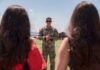
The Ministry’s reaction followed a visit by students and teachers from the “Rifat Gjota” Technical School in Peć/Peja to the Peć Patriarchate, organized with the involvement of the Peja City Museum, during which the complex was described as an “Albanian church” and as “early Romanesque and Byzantine churches systematically transformed into Raška-Serbian Orthodox churches.”
The museum also claimed that restoration works in the 20th century, as well as between 2006 and 2008, led to the “degradation” and “destruction of older layers” allegedly documenting early Christian periods from the 4th to the 6th century.
A lecture on the “development of the Albanian church in Peja” was delivered during the visit by archaeologist Sefer Lajqi.
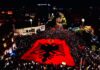
Photos from the event show students and staff inside and around the monastery complex, with the museum encouraging similar initiatives by other schools. Some images also show students displaying the Albanian double-headed eagle symbol within the monastery grounds.
These claims contrast with decades of archaeological research and internationally recognized historical sources, which define the Peja/Peć Patriarchate as one of the most important monuments of Serbian medieval culture.
The complex, consisting of four churches built between the 13th and 14th centuries, is historically linked to Serbian church figures such as Archbishop Arsenije I, Archbishop Nikodim II, and Danilo II, while its architecture reflects the Raška and Byzantine traditions characteristic of the period.
Since 2006, the Peć Patriarchate has been included on UNESCO’s World Heritage List as part of the “Medieval Monuments in Kosovo,” where it is defined as a masterpiece of Serbian-Byzantine architecture.
The text also notes that it was common for medieval churches to be built on the foundations of earlier structures, but that this does not alter the historical identity of the existing buildings.
At the same time, messages of cooperation have come from Peja/Peć.
Peja/Peć Mayor Gazmend Muhaxheri, who has long maintained relations with both the Serbian community and the Serbian Orthodox Church, said that building good relations requires both personal and institutional responsibility.
He recalled that his first contact with the Patriarchate’s sisterhood dates back to 2013, and that he has since maintained regular communication and visits during religious holidays.
Speaking at a conference on interethnic cooperation in Pristina, Muhaxheri said that “goodwill must be demonstrated through concrete actions,” pointing to cooperation with the monastery as well as with Serbian communities such as Gorazdevac.
At the same event, Father Andrej, abbot of the Crna Reka Monastery and a professor at the Prizren Seminary, warned about the dangers of historical revisionism.
He described claims that Serbian Orthodox religious sites are in fact Albanian as a serious issue that could lead to misperceptions and further deepen tensions.
“This is very dangerous for us — from a scientific perspective it may seem almost absurd, if it were not tragic,” he said, adding that such narratives could lead some to perceive Serbs as “occupiers,” despite established historical facts and complex interethnic relations.
Preuzimanje i objavljivanje tekstova sa portala KoSSev nije dozvoljeno bez navođenja izvora. Hvala na poštovanju etike novinarske profesije.