A visit by high school students to the Peć Patriarchate, organized by the Peja City Museum, has triggered controversy after museum officials presented the UNESCO-listed site as an originally “Albanian church” later transformed into Serbian Orthodox religious buildings — claims that critics say amount to historical revisionism.
During the visit, students from the “Rifat Gjota” Technical School in Peja/Peć were told that the complex consisted of “early Romanesque and Byzantine churches” that were “systematically transformed into Raška-Serbian Orthodox churches,” according to a statement published by the museum.
The same statement further claimed that restoration works carried out in the 20th century, as well as between 2006 and 2008, led to the “degradation” and “destruction of earlier layers” allegedly documenting early Christian periods dating from the 4th to the 6th century.
The museum described the plastering work carried out between 2006 and 2008 as “unnecessary,” stating that it had nearly destroyed older layers and complicated the documentation of cultural heritage.
The event also included a lecture on what was described as the “development of the Albanian church in Peja,” delivered by archaeologist Sefer Lajqi of the Peja/Peć Museum.
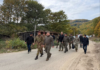
Photographs from the visit show students inside and outside the monastery complex, while the museum thanked teachers Helena Berisha and Merita Arifaj, as well as the students, describing the initiative as a model for other schools to follow.
Images also appear to show several students displaying the Albanian national symbol — the double-headed eagle — within the monastery grounds.
Historical context and established research
The claims contrast with decades of archaeological research and widely accepted historical sources, which identify the Peć Patriarchate as one of the most significant monuments of Serbian medieval culture.
The site became the seat of Serbian archbishops in the mid-13th century and later of Serbian patriarchs. The complex consists of four churches built between the 13th and 14th centuries: the Church of the Holy Apostles, St. Demetrius, the Virgin Hodegetria and St. Nicholas.
Historical records show that the patrons of these churches were Serbian ecclesiastical figures, including Archbishop Arsenije I, Archbishop Nikodim II and Danilo II.
Architecturally, the complex belongs to the Raška and Byzantine traditions characteristic of Serbian medieval art of the period.
Since 2006, the Peć Patriarchate has been included on UNESCO’s World Heritage List as part of the “Medieval Monuments in Kosovo,” where it is defined as a masterpiece of Serbian-Byzantine architecture and a spiritual center of the Serbian Orthodox Church.
While scholars acknowledge that many medieval churches in the Balkans were built on the foundations of earlier early Christian or Byzantine structures, this does not alter the historical identity of the existing buildings, their frescoes, or their role within the Serbian medieval state and church.
Warnings over historical revisionism
Concerns over such interpretations were also raised by Father Andrej, abbot of the Crna Reka Monastery and a professor at the Prizren Seminary.
Speaking at a conference on interethnic cooperation in Pristina yesterday, he warned about what he described as the promotion of “revisionist history,” which claims that Serbian Orthodox religious sites are in fact Albanian.
“This is very dangerous for us. From a scientific perspective it may seem almost absurd — if it were not tragic,” he said.
“People reading such claims may come to believe them, and it is not surprising that in some cases we are perceived as occupiers, despite the well-known historical facts and the complex relationships between communities,” he added.
Calls for cooperation
At the same event, Peja Mayor Gazmend Muhaxheri emphasized the importance of maintaining good relations with both the Serbian community and the Serbian Orthodox Church.
He said that building such relations is both a personal and institutional responsibility, recalling that his first contact with the Patriarchate’s sisterhood dates back to 2013, followed by regular communication and visits during religious holidays.
Muhaxheri stressed that “goodwill must be demonstrated through concrete actions,” pointing to ongoing cooperation with the monastery as well as with Serbian communities such as Goraždevac.
Preuzimanje i objavljivanje tekstova sa portala KoSSev nije dozvoljeno bez navođenja izvora. Hvala na poštovanju etike novinarske profesije.