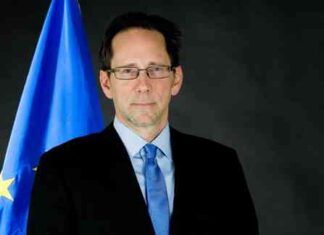
“When the political process collapses, violence, demagogues and the dregs of society take over,” says Enver Hasani, a university professor, former president of the Constitutional Court of Kosovo and former rector of the University of Pristina.
In this written interview for KoSSev, Hasani speaks about the elections, the presidency, relations with the Serbian community, the Ohrid Agreement, the Special Court in The Hague and what he sees as the dismantling of the Ahtisaari framework.
On the Elections: “The Largest Vote-Buying Operation in Post-War Kosovo”
Given the scale of alleged electoral manipulation, accompanied by police and judicial actions, should the elections have been repeated — or was this still a regular process?
These elections were neither free nor fair — not only because of irregularities and vote manipulation, but above all because roughly €400 million was distributed across all segments of the electorate in Kosovo. The authorities did not even attempt to conceal this. Such a volume of money injected into society immediately before elections significantly distorted the political will of voters.
There is no other logical explanation for the stark discrepancy between the February results and those achieved in December 2025. The beneficiaries of these payments were both citizens residing in Kosovo and those living abroad. In that sense, this represents the largest vote-buying operation in Kosovo’s post-war history.
Parliament has also been constituted with MPs whose mandates are, at the very least, questionable. Were the law and the Constitution violated?
Such mandates are, without any doubt, immoral. Those MPs should be ashamed and should not enter the Assembly at all. However, from a legal standpoint, the evidence does not reach the threshold required to annul mandates. That legal standard has nothing to do with the morality of the process or with mandates obtained in an extremely immoral manner. And this applies to all parties, regardless of the scale of the theft.
Do you foresee new elections this year?
No. That would be political suicide for Kurti.
Presidency: “Kurti Needs Absolute Loyalty — And That Is Not Osmani”
What do you expect from the presidential election? Will Vjosa Osmani secure another term? How will the Serb List behave?
I strongly doubt that Mr. Kurti would support someone who represents a lasting challenge to his power and authority. Ms. Osmani has proven to be someone he cannot reliably depend on. He needs a person who is absolutely loyal to him, or someone with strong and deep political and moral credibility — qualities that, in Ms. Osmani’s case, are absent.
On the “Peace Committee” and Gaza What is your view of the Kosovo president aligning with the Peace Committee initiative? Will Kosovo have to pay for participation, and with what funds? Does Kosovo have the capacity to deploy the Kosovo Security Force to Gaza? What is the future of the Committee itself?
Kosovo does not have the luxury of rejecting such an initiative by the U.S. government. There is nothing controversial in this undertaking, and Ms. Osmani acted correctly. I believe the financial resources exist, while the military human capacities are well suited, given that the Kosovo Security Force is very well trained for such missions.
Veton Surroi recently suggested that Kosovo seek the opinion of the Venice Commission regarding the Peace Committee. Does that make sense?
That proposal is meaningless, because constitutional competencies are clear when it comes to the nature and conclusion of international agreements. Everything is perfectly clear, as they say. Politically speaking, such a move would mean confronting the United States and aligning Kosovo with anti-American sentiment in Europe regarding Trump’s policies.
On the Special Court: “There Was No Joint Criminal Enterprise”
The prime minister opened his exposé by glorifying the KLA. On February 17, similar rhetoric was repeated at the joint government-assembly session. He described KLA leaders currently on trial in The Hague as ‘representatives of February 17,’ while the president joined a support march for the KLA. A climate of condemnation of the Specialized Chambers and justification of the KLA and its leaders is being promoted. Without prejudging the verdict, do you see anything problematic in this level of glorification while trials for serious war crimes are ongoing?
“There is nothing controversial or problematic about it, for two reasons. First, as you know, the presumption of innocence applies to everyone, and that is the most sacred postulate of law in Euro-Atlantic civilization. Second, the Special Court has all the self-protective mechanisms that immunize it from any external influence.
What outcome do you expect from the trial?
Much of the material has been redacted, so it is difficult to speculate about individual criminal responsibility for specific acts. However, regarding criminal liability for a joint criminal enterprise, I am fairly certain that this can never be proven, because such an enterprise simply did not exist. That was evident throughout the proceedings.
For a joint criminal enterprise to exist, there could have been no interruption throughout the entire period cited in the indictment, which begins in the mid-1980s. Such continuity did not exist. Testimonies by senior Western military, security and diplomatic officials are decisive on this point, as they had full control over the critical situation during 1998–1999, which is essential to the indictment.
On the Serbian Community: “Kurti Has Driven Serbs Into a State of Panic”
What do you see as the most serious problems in Kosovo today?
The dreams of young people — increasingly bleak — have been affected because the education and economic systems are nearly in collapse compared to the rest of the world, especially now that artificial intelligence has deeply penetrated society, while Kosovo was not even prepared for the digital age.
There is also our relationship with local Serbs and other non-Albanian communities, particularly Roma, Egyptians and Ashkali, and their integration into society, which is a condition for our civilizational orientation toward Europe and the West.
What has been most problematic in the previous government’s approach to the Serbian community? And what about the dominant Serb party?
The most problematic and unforgivable aspect was the unconstitutional and unlawful lynching of Serb political representatives. That was an incredibly low blow. Through populist rhetoric, the Serbian community in Kosovo was homogenized along national lines and driven into a state of panic, which is harmful to Kosovo’s Euro-Atlantic path.
Serb representatives erred in instructing people to withdraw from institutions, because there are always ways to exert pressure within the system to protect the interests of the Serbian community. That step should have been a last resort, not the first.
He adds:
Such actions later encouraged various hooligans within the Serbian community and individuals with criminal pasts to present themselves as legitimate representatives of Serbs, which led to violence and ultimately to the terrorist incursion in Banjska. When the political process collapses, violence, demagogues and the dregs of society take over.
“Kosovo Serbs Should Not Be Spokespersons for Belgrade”
What would be the solution?
The Serbian community in Kosovo, directly and through its representatives, should persevere and fight to the end for its constitutional rights and not accept the role of spokesperson for the interests of the regime in Belgrade.
The Constitution and laws of Kosovo are sufficient to protect the interests of the Serbian community. They should rely on them, rather than relay messages from Belgrade. The dialogue in Brussels is between Kosovo and Serbia — not between local Serbs and Kosovo authorities. What is agreed in the dialogue is implemented through pressure from Brussels and Washington, not over the backs of local Serbs and their interests.
Language and Script: “It Is Shameful to Force Serbs to Write in a Script That Is Not Theirs”
Under the Constitution of Kosovo, Albanian and Serbian are official languages and must be respected at all times and across the entire territory. The Serbian language does not use the Latin alphabet, but Cyrillic. Those who do not know this should learn it. It is shameful to force the Serbian community to write in a script that is not theirs. That would be the same as writing Albanian in Cyrillic. Such unconstitutional and unlawful practices must cease.
On the Association of Serb-Majority Municipalities and Ahtisaari
Is the formation of the body previously known as the Association of Serb-Majority Municipalities inevitable? What is it, in essence?
As I said, Kurti seeks a head of state who is loyal and possesses strong moral-patriotic credentials. This relates to the formation of the Association of Serb Municipalities — that is, political autonomy for Serbs in Kosovo — which he himself accepted in Ohrid in 2023.
Not only is it likely — it is more than certain that he will proceed with it. That is why he will choose as president someone with strong patriotic credentials earned during the war, which Mr. Kurti lacks, although he rhetorically presents himself as a great Albanian patriot.
Do you believe Vetëvendosje is working to dismantle the Ahtisaari package incorporated into Kosovo’s Constitution?
Absolutely — but not in the sense of advancing Kosovo’s interests as a state. Rather, in the direction of creating two Kosovos: one Albanian and one Serbian. Ahtisaari, both in letter and spirit — and this was incorporated into Kosovo’s Constitution — was oriented toward integrating local Serbs into Kosovo’s institutions and society.
What Kurti is doing leads to the disintegration of Ahtisaari’s Kosovo and contradicts the old Serbian saying: ‘Serbs win in war and lose in peace’
All the behavior of Kurti’s government in recent years has fully legitimized and legalized, at the international level, the demands of local Serbs for autonomy and a separate political life in Kosovo, on asymmetrical institutional foundations,” Professor Enver Hasani concluded.
The interview was conducted in writing. Author: Tatjana Lazarević
Preuzimanje i objavljivanje tekstova sa portala KoSSev nije dozvoljeno bez navođenja izvora. Hvala na poštovanju etike novinarske profesije.