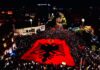
Today, Albanians are commemorating November 28 – Flag Day, marking the 113th anniversary of Albania’s declaration of independence. This date is traditionally celebrated both in Albania and Kosovo and has, over the years, become a broader symbol of national identity.
The date carries multiple layers of significance in Albanian history, particularly in Kosovo. In addition to marking independence, November 28 is also the birthday of Adem Jashari, who, along with many of his family members, was killed by Serbian forces. Jashari is widely regarded in Kosovo as the “legendary commander of the UÇK” and the “father of the nation.” Yesterday, Kosovo also observed Kosovo Security Forces Day (KSF), making November a month rich in ceremonies and commemorations that Albanian institutions treat as key pillars of national identity.
Acting Prime Minister Albin Kurti used the day to emphasize the historical importance of November 28 in the Albanian consciousness. According to Kurti, the date represents a unique point in world history:
“It is unknown whether any other nation in the world has a fate so inextricably linked to a single date as ours is to November 28,” Kurti said, referencing historical milestones from Skenderbegu/Kastrioti raising the flag in 1443, to Albania’s independence in 1912, the birth of Adem Jashari in 1955, and the first public appearance of the UÇK in 1997.
Kurti described this sequence of Novembers as “links in a single chain,” creating what he called a “sacred point in the national calendar.”
Lieu de mémoire
The phenomenon of a “fateful date” is not unique to Albanians. As French historian Pierre Nora explains in his concept of lieux de mémoire (sites of memory), specific dates, monuments, and rituals become symbolic anchors for collective memory. Such dates often arise by chance but, through storytelling, ceremonies, and commemorations, they become central to a community’s sense of identity, connecting past and present.
Historical parallels: Albanians are not the only nation with a “fateful date”
Kurti’s assertion that no other nation shares this connection is not fully supported by historical experience. Many nations attach multiple pivotal events to a single date:
Serbia – June 28 (Vidovdan)
1389 – Battle of Kosovo: symbolic end of Serbia’s medieval state.
1878 – Congress of Berlin: international recognition of Serbia’s status.
1881 – Secret convention with Austria-Hungary: Serbia became politically and economically dependent on Austria-Hungary, in return receiving international recognition to become a kingdom.
1914 – Assassination of Archduke Franz Ferdinand: triggered World War I.
1919 – Signing of the Treaty of Versailles: establishment of the Kingdom of Serbs, Croats, and Slovenes.
1921 – Adoption of the first constitution of the united Yugoslav state.
1948 – Informbiro Resolution: end of Soviet influence, start of Tito’s independent policy.
1989 – Gazimestan rally: beginning of Milošević’s political dominance.
2001 – Extradition of Slobodan Milošević to The Hague: symbolic end of his era.
2013 – European Council approves opening of EU accession talks with Serbia.
France – July 14
1789 – Fall of the Bastille
1790 – Fête de la Fédération, first major republican state holiday
United States – July 4
1776 – Adoption of the Declaration of Independence
1826 – Deaths of John Adams and Thomas Jefferson on the 50th anniversary of the Declaration
1831 – Death of James Monroe, fifth president, also on Independence Day
1863 – Surrender of Vicksburg in the Civil War (symbolically observed on July 4; the Battle of Gettysburg ended July 3)
1884 – Formal handover of the Statue of Liberty from France
1960 – First raising of the 50-star U.S. flag after Hawaii joined the Union
Jewish people – 9 Av (Tisha B’Av)
586 BCE – Destruction of the First Temple
70 CE – Destruction of the Second Temple
Subsequent pogroms and expulsions over centuries
Poland – November 11
1918 – Restoration of independence, coinciding with the end of World War I
Russia – May 9
1945 – Victory over Nazism in World War II
1965 – Declared an official non-working holiday in the USSR
1995 – First post-Soviet grand parade for the 50th anniversary
2008 – Annual military parades reinstated by Putin
Ireland – March 17 (St. Patrick’s Day)
461 – Death of Saint Patrick, Christianization of Ireland
1845 – Beginning of the Great Famine, symbolizing Irish suffering and emigration
1922 – Irish War of Independence; St. Patrick’s Day becomes a global symbol of Irish identity, resistance, and diaspora
Preuzimanje i objavljivanje tekstova sa portala KoSSev nije dozvoljeno bez navođenja izvora. Hvala na poštovanju etike novinarske profesije.