By Veton Surroi (Translation provided by KoSSev)
The actors in today’s clashes on the streets of Serbia are children born or raised in this century. While the world’s attention is focused elsewhere, it has assumed that the wounds of the past would somehow heal with time, that new generations growing up in Serbia would naturally become democrats and liberals like most of their European peers. Serbia did not know, or did not want, to confront its past. Today, its problem has become an inability to confront the present.
1.
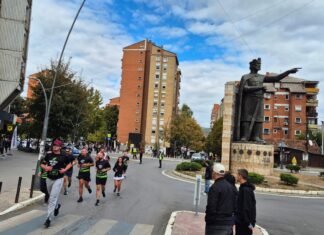
Andrej, the brother of Serbia’s president Vučić, joined a protest against the student demonstrators (they call themselves that, though the movement has long grown into something much broader). His appearance signaled that the authorities too could protest in the streets—indeed, that they could do so from a position of strength, since they enjoy broad popular support, confirmed ritualistically in elections since 2012, when his brother, leader of a populist movement, first took power.
As they approached the anti-government demonstrators, cameras caught Andrej Vučić’s group shouting: “Ustaše, Ustaše…!” That same night, the anti-government crowd coined their own chant for the president—hailed by his supporters as “Aco Srbine” (“Aco the Serb”), a folk affirmation of his patriotic credentials. Their counter-slogan was: “Aco Šiptare!”
The demonstrators then made their view of the government’s ethnic identity even clearer, taunting the riot police with: “Go to Kosovo!” Because, by tradition, if Serbian special units were deployed in Kosovo, they would be expected to beat or kill Albanians—that is their assumed role—not to beat ordinary Serbs.
2.
Serbia has entered a level of tension between two opposing camps that, I believe, did not exist even during the fall of Milošević on October 5, 2000. A quarter of a century later, the conflict is not between “partisans” and “chetniks,” “communists” and “democrats,” or “pro-Europeans” and “pro-Russians.” It has been reduced to the insults of football hooligans. Thus the struggle between Vučić’s supporters and his opponents has become a battle between “Šiptars” and “Ustašas.”
Not everyone on either side of the protests, in favor or against the government, hurled “Šiptars” and “Ustašas” insults at each other. But this one night of shouting seems to me telling—a snapshot of a wider social phenomenon in Serbia. It shows the revival of the word “Šiptar” as an insult. In socialist Yugoslavia, citizens could choose to say “Albanians” in line with linguistic norms, but many preferred “Šiptar.” It was not merely an ethnic designation but a marker of lower social rank, usually tied to manual labor. In Belgrade, “Šiptar” was a synonym for the coal-hauler or woodcutter who stacked logs for winter.
So when demonstrators call President Vučić a “Šiptar,” they mean two things. First, that he is not “Aco the Serb” but the opposite—someone who betrays national interests. Second, that he is socially and civilizationally beneath any Serb.
A similar intent lies behind the use of the term “Ustaša.” This name, which denoted the Croatian quisling formations of World War II, began to be used in Serbia during the breakup of Yugoslavia as an attempt to portray the war of the Serbian armed forces (“a people without weapons”) for the occupation and division of Croatia as a struggle of “antifascists” against “Ustašas.” Since then, anyone opposing Serbian nationalist policy in Croatia was called an “Ustaša,” which encompassed almost everyone in that country. As an extension of this discourse, now the student movement against Vučić has also been declared “Ustašas.”
3.
Both of these labels are part of an old and well-known model of dehumanization. If Vučić is a “Šiptar,” he is not only a foreign body in Serbia, but belongs to a lower social rank – which one day can make violence against him seem justified. Violence of a Serb against a Serb (a brother against a brother) is not acceptable, but violence against a “Šiptar” is not only tolerated but traditionally entirely legitimate. All the more so today, when those “Šiptars” – that lower class – have built from Kosovo an independent state, recognized by much of the world, including its most developed part.
Likewise, violence against “Ustašas” becomes historically justified because that name is connected with the systematic persecution of Serbs in World War II and then extended to all Croats who created their independent state and brought it into NATO and the EU.
In a strange way, Serbia is preparing for a new war. During the 1990s, the dehumanization of opponents in other Yugoslav republics was the prelude to violent campaigns against them. Slovenes were “Vienna’s stable workers,” Croats “Ustašas,” Bosniaks “Turks,” and Albanians simply “Šiptars” – all together part of a great anti-Serb conspiracy of the Vatican, CIA and Iran. Once opponents were labeled in that way, war against them became easier.
Now, after all the wars against other nations, Serbia is entering a discourse that seeks to justify violence against its own political opponents. Thus the “Albanian-Croatian war” becomes Serbia’s last war.
4.
The actors in today’s clashes on the streets of Serbia are children born or raised in this century. While the world’s attention is focused elsewhere, it has assumed that the wounds of the past would somehow heal with time, that new generations growing up in Serbia would naturally become democrats and liberals like most of their European peers. A part of Serbia’s critical intellectuals had warned that Serbia, like the whole space of the former Yugoslavia, must confront its past, as a basic precondition for democracy, in the way Germany did after World War II.
In various resolutions of the European Parliament and in the programs of the Berlin Process it has been repeatedly emphasized that Serbia must confront its past. Not only has it failed to do so, but it has rewritten the past so that every crime against other nations, including genocide, acquires its justification and meaning within the value system of the modern Serbian state.
Serbia did not know, or did not want, to confront its past. Today, its problem has become an inability to confront the present.
Preuzimanje i objavljivanje tekstova sa portala KoSSev nije dozvoljeno bez navođenja izvora. Hvala na poštovanju etike novinarske profesije.