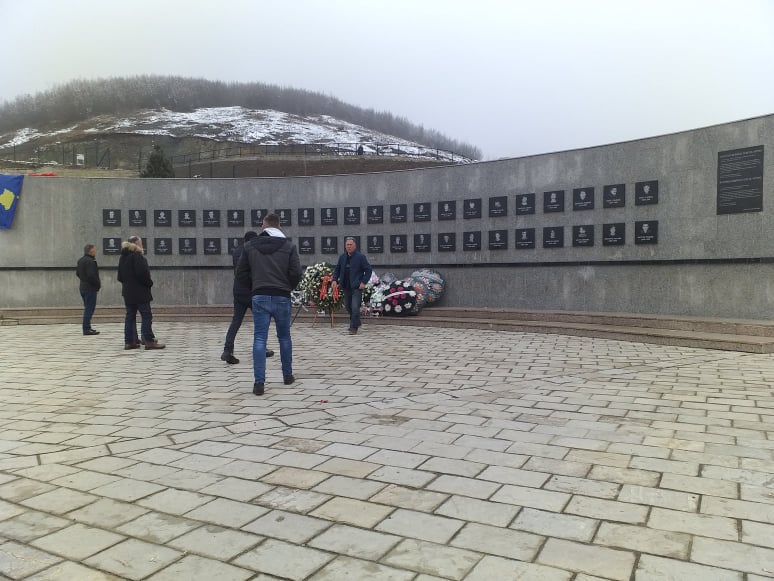
The 21st anniversary of the event in Racak was commemorated in Kosovo today. Several events were organized on the occasion, including yesterday’s conference in Pristina titled „Racak is not a lie,“ and today’s gathering in Racak and Stimlje. Numerous Pristina officials claim that a massacre took place here 21 years ago, with the killing of 45 Albanian civilians by former Yugoslav forces. i.e. Serbian police. They emphasise that a tribunal should be founded for Serb crimes against Albanians, also raising criticism against the EU for lacking reaction to Serbia’s denials of the crimes. Belgrade officials remain largely silent on the issue.
The event that took place on January 15th, 1999 in the central Kosovoan village of Racak, nearby to Stimlje, remains one of the most sensitive topics in both the Serbian and Albanian public even 21 years later. Kosovo Albanians accompanied by the majority of the region and the western governments, claimed it was a massacre of civilians. Serbian officials deny while describing it as an armed conflict between the Serbian police and ethnic Albanian rebels, armed and uniformed – during a police raid. The memory of Racak remains painful to Serbs as its seen as the reason for the 1999 bombing.
Former head of the OSCE Kosovo Verification Mission, William Walker, who is currently one of the most honoured and rewarded foreign diplomats in Kosovo, described Racak as the site of a massacre of innocent civilians executed by Yugoslav and Serb forces, which served as an immediate reason for the 78-day long NATO bombing of the former FR Yugoslavia.
William Walker is currently visiting Kosovo. He once again reiterated that a massacre had taken place there and that it is evidence of all that had happened throughout Kosovo.
„I am pleased that more and more people come here every year to see what happened in this country, because that is what was happening throughout Kosovo,“ Walker said.
„The massacres that took place have led to freedom and an independent Kosovo. But every time I come here, I remember January 15th, 1999 and those are bad memories,“ Walker stressed. On the other hand, he expressed satisfaction with „the way people welcome him.“
Finnish forensic expert Helena Ranta: Because of report on Racak everyone pressured me
„I’d like people to remember everything before and after Racak. Many civilians were killed on both sides during the conflict in Kosovo. I remember that, during his trial at The Hague tribunal, Slobodan Milosevic blamed me, saying that it is more or less because of my investigations in Racak that Serbia was bombed. I have to remind you that in the autumn of 1998, NATO already started preparation for the bombing, which was long before my investigation. I want the people to remember that,” Finnish forensic expert, Helen Ranta spoke to Insajder in an exclusive interview in 2017. Ranta was part of a Finnish forensic team that conducted an investigation in Racak.
Ranta confirmed that the bodies of the 45 victims in Racak were not relocated nor were their clothes changed. She said that all of them were killed from close range. Ranta also confirmed that Walker, as well as other diplomatic circles and representatives of Serbia, tried to influence the report of the team of Finnish forensic experts.
“William Walker wanted me to confirm who committed this in Racak. I could not do that, I am a scientist, not a politician or diplomat or something else. I said that I was not going to draw any conclusions,” said Ranta.
„The victims of Racak are the seal of liberation and the creation of Kosovo,“ LDK leader, Isa Mustafa said on the occasion.
According to Kosovo Assembly chairman, Kadri Veseli, Racak was „the worst massacre committed by the Serbian state“, whose historical responsibility is “tolerated” by the EU. He also underlined that crimes against humanity do not have a statute of limitations.
„Today we remember the massacre in Racak, one of the worst committed by the Serbian state against innocent civilians in Kosovo. On other days of the year, we will also sadly remember our national wounds in Prekaz, Studimlje, Obrije, Meja village, Vrbovac and throughout Kosovo, as a result of other mass crimes that were part of the Serbian state’s project to exterminate the Albanian people,“ he emphasized.
Veseli also reiterated that in order to achieve “lasting peace and stability” in the Balkans, it is “unavoidable and necessary to establish an International Tribunal which would punish Serbs for the atrocities they committed against Albanians.”
Denying the crimes in Racak is „a permanent crime against the people and the state of Kosovo,“ said Self-Determination leader, Albin Kurti, who also attended the rally today.
„The news of the Racak massacre shocked and terrified Kosovo, but it also made it aware and alarmed the democratic world and international diplomacy. The massacre in Racak was crucial for NATO’s bombing of Milosevic’s Yugoslavia,” Kurti said, underlining that „there is still no justice for victims and families“ 21 years later.
„Local institutions and international partners must bring them to justice and put pressure on Serbia so that all the perpetrators who have executed and those who instigated the massacre in Racak are brought before the court and sentenced,“ he noted.
Kosovo President, Hashim Thaci said that Racak and other crimes are „genocide committed by the state of Serbia against the people of Kosovo.“ Thaci also expressed dissatisfaction with, as he saw, lack of international insistence on shedding light on what happened.
Kosovo MFA: Vucic’s denial of Racak worsened Belgrade-Pristina relations
The Kosovo Foreign Ministry also reacted today, urging the international community to pressure Serbia to „bring to justice those who killed and massacred 45 innocent Albanian civilians.“
This ministry described the Racak case as one of „the worst crimes against humanity“ and claimed that Vucic’s recent denial of what happened in Racak has worsened relations between Belgrade and Pristina.
Thaci also joined other Pristina officials in comparing Serbia’s president, Aleksandar Vucic to Slobodan Milosevic due to his Racak denials.
Thaci’s Albanian counterpart, Ilir Meta, who was also present in Racak today, described the events in Racak in 1999 with just three words – „crime against humanity,“ Kosovo media reported.
„It was an act that shocked the whole world but also mobilized the Western world and led to NATO’s intervention in Kosovo,“ he added.
According to Meta, „any attempt to deny the massacre“ creates the risk of „recycling violence.“
On the other side – no reaction arrived from Belgrade so far. The President of Serbia, Aleksandar Vucic briefly commented – on two occasions – Walker’s efforts “to format the Kosovo government,” and the presence of a minor Serbia party’s leader – Nikola Sandulovic at the Racak conference.
„The importance of William Walker is evident by those he keeps in his company. If Nikola Sandulovic, a famous drug dealer, the man who predicted and sought Djindjic’s death keeps him company, then I don’t know. If that is their strength, I congratulate William Walker as well, and when it comes to being truthful, he is one of the biggest liars along with Milovan Brkic and some of the political opponents that I will not mention now,“ Vucic said today in Becej, a town in Vojvodina.
„That expert came to form a government,“ because he thinks that he „created an independent Kosovo, and now he wants to create a Greater Albania,“ Vucic said yesterday, sending the following message to the former head of the OSCE Kosovo Verification Mission: „Lay off the pipe, William. Serbia is no longer a handful of oats you can reap.”
The Racak case caught the public attention once again in 2019 after a member of the seventh convocation of the Kosovo Assembly and a member of Srpska Lista, Ivan Todosijevic described the 1999 event as „fictional“ after which he was dismissed and an indictment was issued against him. He was sentenced to two years’ imprisonment. Srpska Lista and Serbian state top-level officials stepped in to defend Todosijevic and harshly condemned his sentence.
Serbian President, Aleksandar Vucic confirmed at the time that Walker had „fabricated“ Racak, while also recently describing Walker as „a conman, a thief, and a fraud.“
Vucic’s statement was condemned by Pristina officials, while the former lawyer of the victims’ families in the Racak case, Tom Gashi filed criminal charges against Vucic.
Walker himself said that this was not the first time in twenty years that Belgrade officials called him “different names and made up what happened in Racak.”
The Racak case has remained a controversial topic among the Serbian public to this day. In addition to the opposing views of the two sides, the controversy was deepened by the different conclusions from the autopsy of the 45 bodies of the killed Albanians – as was presented through the media. What contributed to the controversy were the political consequences – the bombing followed by the withdrawal of the former YU federal security forces from Kosovo, again followed by the launch of a UN civilian and KFOR military mission within which Kosovo unilaterally declared independence nine years later, but with the support of key Western countries.
As for the western society, however, there is no controversy about what happened back in 1999 in Kosovo.
In a joint press release, the Ambassadors of France, Germany, Italy, the United Kingdom and the United States confirmed once again that a massacre occurred in Racak, which eventually prompted NATO allies to intervene and end a humanitarian catastrophe.
“We honor the memory of those who were lost in Recak and all the other massacres in Kosovo two decades ago by working together to build a future of peace, justice, and prosperity for the next generations. The governments of Kosovo and Serbia need to ensure victims and their families have full access to justice, and to information about the fate of their loved ones,” they wrote in a statement, adding:
“Citizens of all ethnicities should feel at home and free to live and work in peace with their neighbors. As the Declaration of Independence of this country says, Kosovo is a country ‘committed to confronting the painful legacy of the recent past in a spirit of reconciliation and forgiveness. Dedicated to protecting, promoting and honoring the diversity of our people.’ Our shared aim is to continuously support Kosovo on this path.”
The OSCE mission also reacted today with a short statement:
“On 15 January 1999, 45 Kosovo Albanians were massacred in Recak. We join in honoring the memory of innocent lives that were taken in Recak and throughout Kosovo during this period. We extend our deepest condolences to the families of the victims and remain committed to the principles of rule of law, public safety and a peaceful future for all.”
‘Racak’ under investigation by Kosovo’s Special Prosecutor’s Office
Kosovo Special Prosecutor’s Office prosecutor, Drita Hajdari, the head prosecutor in the Racak case, spoke to Kallxo about the ongoing investigation.
„I opened an investigation into the Racak massacre last year after receiving war crimes cases from the EULEX Prosecutor’s Office,“ Hajdari said today. Hajdari is investigating the case in cooperation with the Kosovo Police War Crimes Unit.
„So far, we have collected autopsy reports and questioned witnesses, survivors and other witnesses of the incident,“ she told Kallxo, adding that they are still collecting testimonies, other evidence and information, including Hague tribunal records.
According to Hajdari, command responsibility for this case is also under investigation.
Preuzimanje i objavljivanje tekstova sa portala KoSSev nije dozvoljeno bez navođenja izvora. Hvala na poštovanju etike novinarske profesije.