Following yesterday’s protest by members of the special units of the Kosovo police in front of the Kosovo government building, several opposition leaders shared their support of the police officers. At the same time, while publishing photographs from the protest, they criticized the Pristina government for making the protest necessary in the first place. Late last night, the Prime Minister of Kosovo reacted, confirming that the elite unit (NJSI) will be retroactively paid 1,350 euros each at the end of November. The Kosovo Interior Minister reacted, as did Kurti, who spoke about the investments in the police.
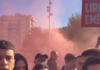
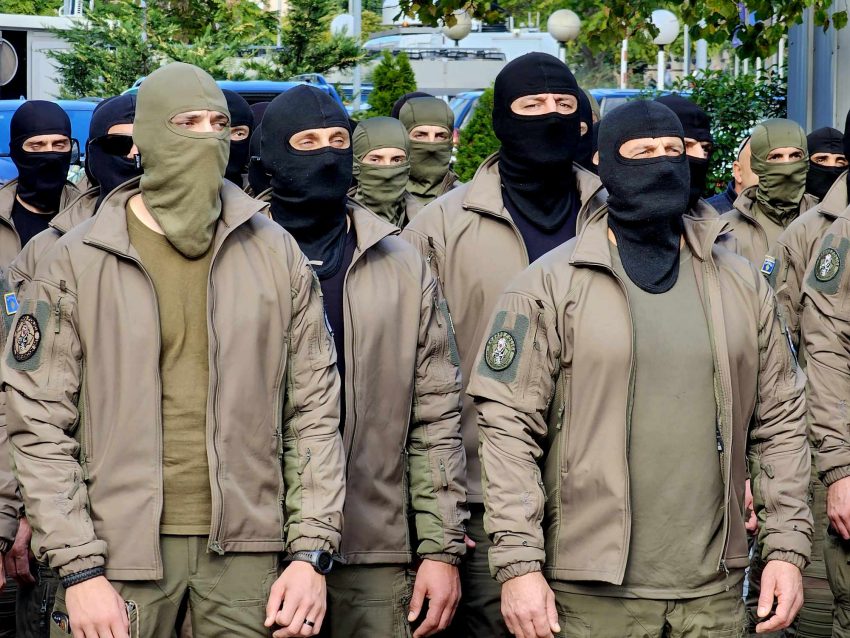
As announced, a protest was held yesterday in Pristina in front of the Kosovo government building. Members of the Special Intervention Unit (NJSI), the most elite unit of the Kosovo Police, as well as the Explosive Ordnance Disposal Unit, participated in the protest.
The vision of these tall uniformed men, hooded and wearing black glasses, although without weapons, is not a common sight in front of the institution that employs them.
These units, on the other hand, are seen much more often in the north. It was their involvement in this area – starting from the arrest of the former head of the Kosovo Office, Marko Djurić in 2018, to the latest intervention in Banjska on September 24, that served the Kosovo opposition, but also part of the media, as one of the key allegations via which they emphasized the reasoning behind their protest.
The two key special units protested in order to express their dissatisfaction with the new wage law, and to press for greater compensation for hazardous work.
The police officers complain that they have been harmed by the new law, as well as the treatment they have been receiving. They claim that they receive less money than was the case before the adoption of the law, that they have a lot of overtime work, and that the government treats them „without dignity.“
As reported by Pristina-based Kallxo, referring to an official document, the base salary of a member of the NJSI is 631.89 euros. Also, these members indicated that they had 380 hours of overtime work in the last month, as a result of the situation in the north.
„It’s not just an issue of not meeting the conditions, but the arrogance with which they ignore us,“ one of the unnamed police officers told the Albanian Post at the protest yesterday.
This media outlet was among the first to report about the dissatisfaction of these special forces, revealing that these units boycotted the dinner with the Kosovo president at their base in South Mitrovica, immediately after the action in Banjska. The Kosovo president’s office tried to present the absence of these policemen as a coincidence.
„Sadness and misery“, „The shameful truth of this incompetent government“
Opposition leaders showed solidarity with police officers at the protest yesterday, criticizing the Kosovo government.
„Prime Minister, what are you waiting for? The police are right, you should respect them“, Ramush Haradinaj said in response to yesterday’s protest, while also sharing photos of uniformed and masked members of the NJSI.
The leader of PDK, Memli Krasniqi, also reacted, saying that the sight of the protest is „the shameful truth of this incompetent government.“
„We never had to see this picture, especially after the recent events in the northern part of the country,“ said Krasniqi.
„A scene that hurts to the core“ – reads the reaction of the vice president of this party, Vlora Çitaku.
„They are forced to protest in order for their most basic demands to be met,“ Çitaku wrote on Facebook.
„Sadness and misery“ – is how LDK leader, Lumir Abdixhiku, described the protest.
„The most elite unit of the state is forced to protest, the heroes of the north, the bravest men, humiliated by the government that does not listen to them when they need it. Kosovo deserves better,“ said Abdixhiku.
Wages increased by the new law, but were lower than before the law was adopted
The decision on compensation for the Kosovo Police was adopted by the Kosovo government on October 27, and the compensation amount was divided into seven categories – from 45 to 150 euros, while the largest increase is planned for the NJSI.
The former director of the Kosovo Police, Rashit Qalaj, however, described the decision as scandalous. Both Qalaj and the policemen themselves emphasized that even such higher wages are still lower compared to the previous compensation given to all units.
Specifically when it comes to special units, the compensation is now lower by as much as 65 euros, he warned.
Several experts also alerted of the same problem for numerous Pristina media in the past few days.
Kurti: At the end of November, a retroactive 1,350 euro payment
At yesterday’s protest in front of the Kosovo government building, about 100 special forces members requested a meeting with Kosovo Prime Minister Albin Kurti.
The Special Intervention Unit (NJSI) has 70 members, while the unit for disposing of explosive devices has a little more than 10 members.
The meeting with Kurti did not happen, but the Kosovo PM reacted late last night after photographs of uniformed and masked special forces marching in protest went viral in the media and social networks.
While recalling that the average salary in the private sector, which employs 340,000 people, is 470 euros, and 700 euros in the public sector, which has about 80,000 employees, Kurti shared details about greater investment in the special police, saying that the NJSI equipment is worth 10,000 euros, and their average salary is over 2,200 euros per month (base salary and additional payments).
„Now, they will also have an increase in the compensation for hazardous work of 150 euros per month as long as this situation in the north of the country lasts, which is the highest level of increase,“ Kurti announced on Facebook.
Moreover, he announced that these police officers will already receive an increase in the net amount of 1,350 euros retroactively at the end of November, and that this amount includes an increase in compensation for hazardous work from February to November.
Although Kurti said that he would retroactively pay these policemen compensation for nine months, in the conclusion of his statement he still emphasized that „needs, not just wishes, are always and many times simpler than solutions“, reminding that in Kosovo GDP per capita is only 460 euros.
He once again emphasized that 203 police officers in Kosovo this year had a higher salary than President Osmani.
Kurti also thanked the special forces for their „service to the country and law enforcement“.
Kurti’s announcement, which he posted on Facebook, was liked by more than 5,600 people in less than 20 minutes. We monitored the rating of the post in the next 15 minutes. The post received around 100 likes per minute.
Svecla: The average income of members of these units is over 2,200 euros
Kosovo Minister of the Interior, Xhelal Sveçla, the first official of the Kosovo government to react after yesterday’s protest, presented claims that these units „had and still have the greatest financial support.“
„After receiving the mandate, we found the members of the Special Units of the Kosovo Police without uniforms, without protective equipment, without working conditions and with insufficient and poor-quality food,“ this minister claims.
He also alleged that since he became the head of the Kosovo MIA, the budget for the police has been increased by over 30%.
„As of 2021, the budget for operational equipment is 21 times higher. In 2021, the budget was less than half a million euros for operational equipment, while this year it amounts to over 9 million euros,“ Sveçla adds.
Presenting the same allegations as the Kosovo Prime Minister, Sveçla claims that the average monthly income of these units during this year amounts to over 2,200 euros.
The head of the Kosovo MIA added that it was this government that implemented compensation for the Kosovo Police.
„For us, it has always been a goal to improve working conditions, to provide equipment that protects the life of police officers, as well as to treat them with dignity and justice, unlike before, when compensation for additional duties was not implemented at all. We made it up to them without delay,“ he claims.
Founded 24 years ago, the Kosovo Police has almost 10,000 members of various ranks. They still have neither health nor life insurance. According to union data, 2,200 members have left this institution since its establishment in 1999.
The Kosovo Police Union has often protested in the past, demanding better conditions for its officers from the Kosovo government, and there have been reports of police officers leaving the institution due to poor conditions, including a lack of uniforms, as well as non-payment of compensation.
Foto pa koment.
A janë këta policë të Kosovës që e ruajnë sovranitetin e shtetit?
E kush është shteti e qeveria sot? pic.twitter.com/Lojpr3nWgh
— Muhamet Hajrullahu (@MetiHajrullahu) November 1, 2023
Preuzimanje i objavljivanje tekstova sa portala KoSSev nije dozvoljeno bez navođenja izvora. Hvala na poštovanju etike novinarske profesije.