A new memorial plaque commemorating Albanian civilians killed during what Albanians call the “Night of Horror” on 3–4 February 2000 has been unveiled on the new pedestrian bridge connecting South Mitrovica and the multiethnic Tri Solitera neighborhood. The plaque, inscribed in Albanian, reads:
„In memory of Albanian civilians killed on the night of horror between 3 and 4 February 2000 by an armed Serbian gang. On the night of 3–4 February, 25 Albanian residents were also wounded, while around 12,000 other (Albanians) were expelled from the northern part of Mitrovica,“ followed by the names of the victims. The installation was reportedly organized by the South Mitrovica municipality.
Today marks 26 years since the February 2000 violence in North Mitrovica, which erupted after the detonation of one of three bombs at the then-popular café Bel Ami, frequented by local Serbian youth. More than ten people, ethnic Serbs, were injured in the blast, several suffering severe injuries, including amputations.
In the immediate aftermath, violence escalated against Albanian civilians in the northern part of the city. Ten Albanians were killed, and many more fled their homes.
Commemoration and Candlelight Vigil
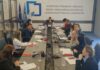
As announced in the days leading up to the anniversary, South Mitrovica Mayor Faton Peci unveiled the plaque alongside a photo exhibition at the nearby Cultural Center and a candlelight vigil.
Peci described the memorial as both an act of remembrance and a warning to future generations:
„Together with deputies of the Assembly of Kosovo and the executive authorities of Mitrovica, we honor the memory of 3 and 4 February 2000, when ten Albanian citizens were killed, 25 were injured, and about 12,000 were expelled from the north by the genocidal regime of Slobodan Milošević and his followers. It is vital that this plaque remains an indelible reminder of the sacrifice and bloodshed of Albanian citizens, even after the liberation of Kosovo and the presence of KFOR in the region. They were killed as innocent civilians, unprotected solely because they were Albanian and returned to their homes and property.“
Peci has consistently described the events as a “Night of Terror,” noting the same figures: ten killed, 25 wounded, and around 12,000 expelled.
Survivors Speak: “My Mother Was Killed; 26 Years Without Justice”
Luan Abrashi, 13 at the time, lost his mother Sebihu during the attacks. Speaking to Albanian media, he described the violence as ethnically motivated, executed in the presence of international forces:
„On 3 and 4 February 2000, ten Albanian civilians were killed in North Mitrovica, including my mother. This happened in the presence of KFOR and UNMIK, six months after the war had ended. It was a night orchestrated by Serbian structures to ethnically cleanse Albanians. People were wounded indiscriminately, using bombs, knives, and any weapons at hand.“
Abrashi emphasized that justice has yet to be served. While officials and families know those responsible—including Dragoljub Delibašić and Oliver Ivanović—no one has been prosecuted.
Families are now considering appeals to the European Court of Human Rights in Strasbourg, reportedly citing crimes committed under the supervision of international forces, when civilians should have been protected.
Many families were forced to abandon the northern part of Mitrovica, living for decades in the south while their properties were seized or sold. Abrashi recalled being forced to sell his northern home in 2008 due to safety concerns.
Kurti: “Kosovo Remembers Every Victim”
Outgoing Prime Minister Albin Kurti directly accused Serbia and paramilitary groups of ethnic cleansing:
„On the night of 3–4 February 2000, the Serbian state, through police and the paramilitary ‘Bridge Guards,’ carried out ethnic cleansing of the local Albanian population. Under threat of death, thousands were forcibly expelled to the southern side of the Ibar River. Ten civilians were killed, 25 injured, and 1,564 families—11,364 people in total—were displaced. The people and the state of Kosovo do not forget.“
Kurti stressed that the attacks occurred only seven months after Kosovo’s liberation, when Mitrovica was one of the last areas not fully liberated, and that justice remains incomplete. He noted that in recent years, over 150 homes have been rebuilt in the four northern municipalities, allowing displaced residents to return.
Today, Kurti asserts, citizens of all ethnicities—Albanians, Serbs, Bosniaks, Roma, and Turks—can live freely in Mitrovica under the rule of law and democratic institutions.
Silence from the Serbian Side
Serbian officials and the government in Belgrade have not commented on the anniversary, despite repeated statements from Pristina and South Mitrovica authorities. North Mitrovica Mayor Milan Radojević did not respond to requests for comment on the memorial unveiling.
Diverging Narratives
Public memory and media coverage remain deeply divided along ethnic lines. In Serbian public discourse, recollections of the February 2000 events have gradually faded over the years, with media and political attention largely diminishing. Serbian outlets continue to highlight the injuries to young Serbs and the deaths of elderly passengers in bombed UNHCR buses, presenting the events primarily from a Serbian perspective.
Meanwhile, Albanian narratives have intensified, particularly during the period of Albin Kurti’s government and the influence of the Vetëvendosje party, with renewed public commemorations and media coverage emphasizing the suffering and displacement of Albanian civilians in the north. Each community continues to focus on its own victims, often presenting only its side of the story, with little acknowledgment of the other’s experiences.
Disputed Numbers
The figure of 12,000 expelled Albanians, first cited by Kurti in 2025, is now widely used by Kosovan officials and media. UNHCR reports from 11 February 2000, however, estimated around 4,500 Albanians lived in northern Mitrovica prior to the escalation, with over 630 registering as displaced in the week following. UNHCR noted that many fled without registering, leaving their properties vulnerable to looting or occupation by Serbs.
Accusations Against Delibašić and Ivanović
Kosovan officials and media continue to cite retired Serbian police Colonel Dragoljub Delibašić and the late politician Oliver Ivanović as responsible for the 2000 violence. Delibašić was fully acquitted of all charges by Kosovan courts in 2016. Ivanović, who had also been cleared of charges related to the 2000 events, was awaiting the outcome of his appeal when he was killed in 2018. Despite these legal outcomes, both still remain central figures in public and political discourse surrounding the incidents.
Preuzimanje i objavljivanje tekstova sa portala KoSSev nije dozvoljeno bez navođenja izvora. Hvala na poštovanju etike novinarske profesije.