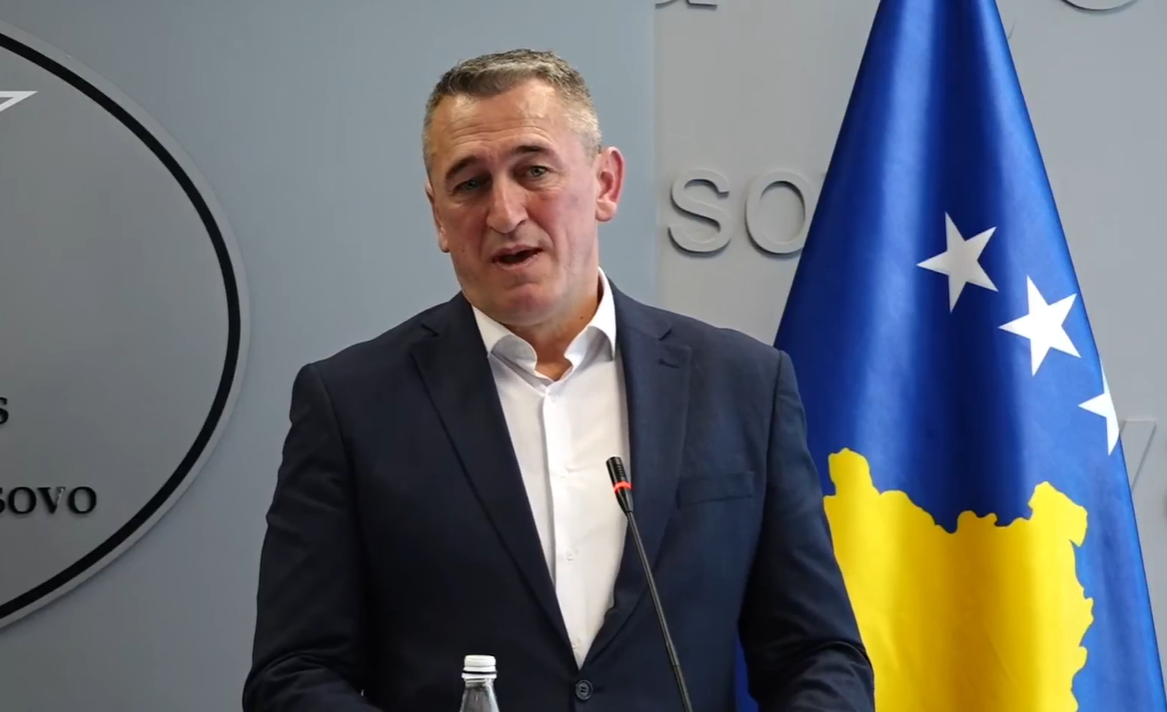
Kosovo’s Assembly on Thursday elected Nenad Rašić, an ethnic Serb MP, as one of its deputy speakers, after all nine candidates of the Belgrade-backed Srpska Lista were rejected in repeated rounds of voting. The decision formally completes the Assembly’s leadership structure after months of stalemate. However, this outcome may not be final: if Srpska Lista appeals to the Constitutional Court and the Court issues temporary measures, the voting process could be repeated once again.
Rašić, leader of the Party for Freedom, Justice and Survival, received the backing of 71 MPs, with nine voting against and 24 abstaining. Following the vote, Speaker Dimal Basha declared that the Assembly is now fully constituted, which triggers the constitutional timeline for forming a new government.
“As of today, the Assembly of the Republic of Kosovo is fully constituted,” Basha said, noting that the step fulfills the Constitutional Court’s ruling from earlier this week, which had given MPs a 12-day deadline to complete the process.
Failed Candidates from Srpska Lista
The outcome followed three rounds of unsuccessful attempts to elect a deputy speaker from Srpska Lista, Kosovo’s dominant Serb political party. None of its nine nominees — starting with Slavko Simić, who stood for three votes but never passed nine votes in favor — managed to win support. Other rejected candidates included Zlatan Elek, Ljiljana Stevanović, Igor Simić and several others.
With Srpska Lista’s slate exhausted, Speaker Basha moved to put Rašić forward, breaking with precedent that the Serb deputy speaker is nominated exclusively by the Srpska Lista.
However, the possibility of Rašić’s election had previously been hinted at by the Serbian President. At the end of August, Aleksandar Vučić commented:
“Kurti is trying to prevent the Serb List from putting forward a candidate, and is attempting to have Rašić elected as deputy speaker, even though the obligation is to elect Slavko Simić, who was nominated by the Serb List. This is something we will have to endure and survive, in order to preserve peace and stability, and it will not be simple or easy at all.”
Constitutional Court as Turning Point
The deadlock shifted on October 8, when Kosovo’s Constitutional Court issued a binding decision stating that parliament could not remain blocked indefinitely due to the absence of a Serb deputy speaker. The ruling introduced what it called a “deblocking mechanism,” allowing the Assembly to appoint another Serb MP if the Srpska Lista nominees repeatedly fail.
The Court’s intervention came after months of tension between Prime Minister Albin Kurti’s Vetëvendosje (Self-Determination) movement and the judiciary. Vetëvendosje has frequently criticized the Court’s rulings, while President Vjosa Osmani has done so more cautiously. The United States suspended its Strategic Dialogue with Kosovo in September, citing unilateral actions by Kurti’s government and political uncertainty over the Assembly’s functioning.
Rašić: “I Accept Responsibility”
Ahead of the vote, Rašić declared he was ready to assume the role if MPs supported him.
“I have always said that I am a politician of responsibility. If MPs choose me, I will take it as a duty, with the same responsibility held by other deputy speakers,” Rašić said.
He added that he believed Albanian-majority parties would back him — which proved correct.
Vetëvendosje: No Support for Belgrade-Backed Candidates
Throughout the stalemate, Vetëvendosje insisted it would not support Srpska Lista candidates.
“It is certain that Rašić will be elected. I cannot vote for people whose heads are in Belgrade while their bodies are in Pristina,” VV lawmaker Agim Bahtiri said earlier in the day.
Divided Opposition
Kosovo’s opposition was split: the Democratic League of Kosovo (LDK) and part of the Democratic Party of Kosovo (PDK) signaled support for Rašić to end the deadlock, while the Alliance for the Future of Kosovo (AAK) refused to back either Serb List or Rašić.
“The institutions are being held hostage by Albin Kurti. He is responsible for this situation,” AAK MP Time Kadrijaj said.
Fatmir Limaj, leader of the Social Democratic Initiative (NISMA), has criticized the election of Nenad Rašić as deputy speaker of the Kosovo Assembly, calling it unconstitutional and a threat to the democratic process.
“The election of Nenad Rašić as deputy speaker is unconstitutional and undermines the democratic process. This continues a pattern of violating the Constitution,” Limaj told Demokracia.
What It Means Going Forward
Rašić’s election ensures that the Assembly’s presidency is complete and opens the way for government formation. However, Srpska Lista still has the right to appeal to the Constitutional Court, as it has done previously. Should the Court issue temporary measures, the process could be repeated — potentially even leading to fresh elections, which some speculate could coincide with presidential elections.
For Vetëvendosje and Prime Minister Kurti, today’s vote is a political victory: Srpska Lista no longer holds a monopoly on representing Kosovo Serbs in high-level institutional posts. For Srpska Lista, it marks an unprecedented setback — the first time since its founding that a Serb was elevated to a senior Assembly role without its nomination or support.
For the Constitutional Court, it represents the first practical enforcement of its ruling that minority communities cannot indefinitely block institutions. For the international community, which has repeatedly urged resolution of the crisis, today’s vote may be seen as restoring a functional Assembly and opening the door to a government.
Whether this marks the definitive end of Kosovo’s longest institutional blockade since UDI in 2008 remains uncertain. If Srpska Lista appeals again, the cycle may repeat.
The session took place just days ahead of Kosovo’s local elections, in which Vetëvendosje aims to consolidate power at the municipal level, while Srpska Lista, after three years of boycotting institutions, seeks to return.
Adding to the political turbulence, Kosovo media on Thursday released an audio recording allegedly involving Fatmir Sheholli, recently arrested on espionage charges, in which he reportedly admits close ties with Milan Radoičić, the fugitive Serb paramilitary leader and former Srpska Lista Vice President.
Preuzimanje i objavljivanje tekstova sa portala KoSSev nije dozvoljeno bez navođenja izvora. Hvala na poštovanju etike novinarske profesije.