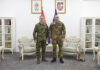
Five members of the Kosovo Prosecutorial Council (KPK) have dismissed as “completely false and unfounded” claims that certain council members faced threats during recent developments within the body, including the session that resulted in the dismissal of acting Chief State Prosecutor, Besim Kelmendi.
In a joint statement, they said that no evidence, facts, or objective elements have been presented to substantiate allegations of threats.
“If there is reasonable suspicion that any threat was made, the legal and institutional obligation is to report the case immediately to the competent security authorities, rather than issuing public statements that may create a false impression and damage the reputation of the KPK as a constitutional institution,” the statement reads.
According to them, the session during which Kelmendi was dismissed was “fully open and transparent,” with media and public present. Four council members, including Kelmendi himself, left the meeting voluntarily, “without any pressure or threat from other members.”
They emphasized that every KPK member enjoys functional independence and immunity in carrying out their duties, making allegations of pressure and threats “unacceptable and baseless.”
The Council announced an extraordinary meeting regarding the situation, stressing that it remains committed to its constitutional and legal mandate.
Sharp reactions and Osmani’s concerns
Kosovo President Vjosa Osmani earlier expressed serious concern over statements by KPK members claiming they feel unsafe and have requested protection from the Kosovo Police and action by the Intelligence Agency.
“It is unacceptable that 26 years after the war we have KPK members, prosecutors or not, who do not feel safe and cite threats as the reason. It is important that they can freely express their views,” Osmani said.
She added that institutions, together with “Quint partners,” are analyzing the situation and that an official position will follow soon.
Disputed dismissal of Kelmendi
Tensions escalated on 20 November, when five KPK members voted to dismiss acting Chief State Prosecutor Besim Kelmendi and appoint prosecutor Agron Çalaj in his place.
The decision was made despite the fact that the quorum for decision-making requires six members. Of the ten present, five left the session — including Kelmendi — leaving only the remaining members to vote.
Kelmendi said he learned about his dismissal through the media, calling the move “arbitrary, unlawful and adopted without quorum,” and announced that he would challenge it in court.
The dismissal came one day after Kelmendi testified before the Special Prosecutor’s Office as a witness in the “Racak massacre” case, further increasing political and public attention.
SPRK rejects allegations of influence
The Special Prosecutor’s Office of Kosovo (SPRK) rejected claims by some KPK members, including Visar Krasniqi, suggesting that Chief Special Prosecutor Blerim Isufaj influenced the dismissal.
The SPRK called such allegations “untrue and unfounded,” stressing that Isufaj does not and cannot influence KPK decisions, which fall exclusively under the Council’s authority.
“Dragging the Special Prosecutor’s Office into internal KPK debates directly harms the integrity of the prosecutorial system and creates unnecessary confusion among the public,” the institution stated.
EU criticism and reform concerns
The EU Office in Kosovo previously described Kelmendi’s dismissal as a move that “obstructs the ongoing and necessary reform of the Kosovo Prosecutorial Council and disregards the rule of law principles.”
It warned that such developments undermine Kosovo’s progress on its EU path.
This followed earlier warnings issued by Ambassador Aivo Orav, who stated that the Council and its members would be considered “direct saboteurs of the reform” if they take actions aimed at blocking new judicial legislation or maintaining what he called an “unbalanced composition” of the Council.
Kosovo Law Institute: Attempt to preserve “corporate structures”
The Kosovo Law Institute (IKD) argued that Kelmendi’s dismissal represents a clear attempt to preserve “corporate structures” within the KPK, describing it as an unlawful move aimed at maintaining power within the Council.
They warned that such actions undermine institutional integrity and the public interest.
Preuzimanje i objavljivanje tekstova sa portala KoSSev nije dozvoljeno bez navođenja izvora. Hvala na poštovanju etike novinarske profesije.