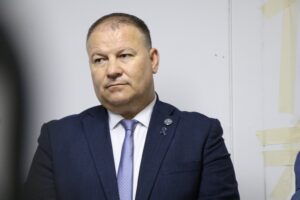
During a conference in North Mitrovica, Kosovo Police Chief Gazmend Hoxha rejected demands for his resignation while addressing sharp criticism over recent security breaches, ethnic representation in the police force, and the deployment of special units in northern Kosovo. The meeting was attended by KFOR, EULEX representatives, and local officials.
Arsenijević Calls for KP Director’s Resignation; Hoxha: “I Take Pride In My Work”
Aleksandar Arsenijević, leader of the Serbian Democracy party, issued a scathing critique of Kosovo’s security apparatus. Referring to the recent incident at the Ibar-Lepenac canal, Arsenijević challenged Kosovo Police Director Gazmend Hoxha to explain the breach:
„How is it possible for someone to bring 20 kilograms of explosives into a region controlled by Pristina, where not even a needle can fall unnoticed?“
He further demanded Hoxha’s resignation, accusing him of negligence and Kosovo police of fostering an environment of ethnonationalism within this institution.
Hoxha refused to step down, asserting his dedication to his role and dismissing the calls for his resignation:
„I take pride in my work. I will resign only if I lose the trust of my superiors and the citizens of Kosovo.“
He argued that similar incidents occur in countries across the globe, such as the United States and Serbia, emphasizing that the challenges faced by Kosovo are not unique.
Ethnic Composition of Police Units
Arsenijević’s criticism extended to the ethnic makeup of police forces in Northern Kosovo. He highlighted the lack of Serbian officers in special police units stationed in the region:
„When will special units with Serbian members be stationed in the North? Are you working on training such units to replace the monoethnic ones in seven police bases?“
He also pointed out that the annual report presented at the conference was only in Albanian, excluding the region’s Serbian-speaking population.
Arsenijević also questioned Hoxha regarding his statement that a new generation of Kosovo Police recruits from various communities would graduate in January, replacing Albanian officers in the North.
„How many years will it take for those recruits from the Serbian community to reach the rank of Mr. Elshani or the director of the Northern region?“ he asked.
He also touched upon the collective resignation of Serbian police officers in November 2022, along with other Kosovo Serbs in various institutions. While understanding that some individuals may not return, Arsenijević believes most should be allowed to.
In response, Hoxha explained that the resignations were due to political pressure from Serbia.
„They cannot return because the procedures do not allow it,“ he said, adding that „most of them were involved in criminal and suspicious activities“ and had signed agreements with „illegal structures in Kosovo.“
Hoxha further clarified that the legal framework does not permit someone to resign and return at will.
Civil Society’s Concerns
Dušan Radaković, director of the Advocacy Center for Democratic Culture (ACDC) – one of the five NGOs from the north who recently published a study titled “The Ethnicization of the Kosovo Police: Undermining the Ahtisaari Foundations of a Civic and Multiethnic Institution“, also attended the conference.
The report highlights what they describe as the promotion of nationalism by monitored members of the Kosovo Police through their social media activity.
The study is based on a database of 140 photos collected from social media, featuring over 300 individuals purported to be police officers. These images showcase symbols such as the Albanian flag, „Greater Albania“ emblems, depictions of Adem Jashari, and UÇK insignias. Some images even reportedly show police officers making gestures symbolizing the Albanian eagle, posing with official vehicles, or displaying flags from police cars.
Radaković told the Kosovo Police Director that it was not difficult to compile the report, as, according to him, all the photos of these officers are public, posted on social media.
„I know that the report has caused a big issue and stirred up a lot of dust, but the point is that the law should be respected for all citizens of Kosovo. Those images and those officers damage your work, any sense of multiculturalism, and the trust that these children should have in the police they need to believe in,“ Radaković said.
In response, Hoxha acknowledged the issue and stated that measures were being taken to regulate police officers’ conduct on social media to prevent similar controversies in the future.
Security Versus Presence
The increased deployment of special police units in Northern Kosovo was another contentious topic. Hoxha clarified that the number of officers had been reduced to fewer than 50 in the region but defended their presence due to recent security incidents, including bomb attacks on police stations:
„We had plans to decrease their presence, but the attacks in Zvecan increased the risk level.“
He added that future adjustments would depend on evolving security conditions.
From NGO Report on Kosovo Police Ethnicization on Social Media to New Police Guidelines?
Preuzimanje i objavljivanje tekstova sa portala KoSSev nije dozvoljeno bez navođenja izvora. Hvala na poštovanju etike novinarske profesije.