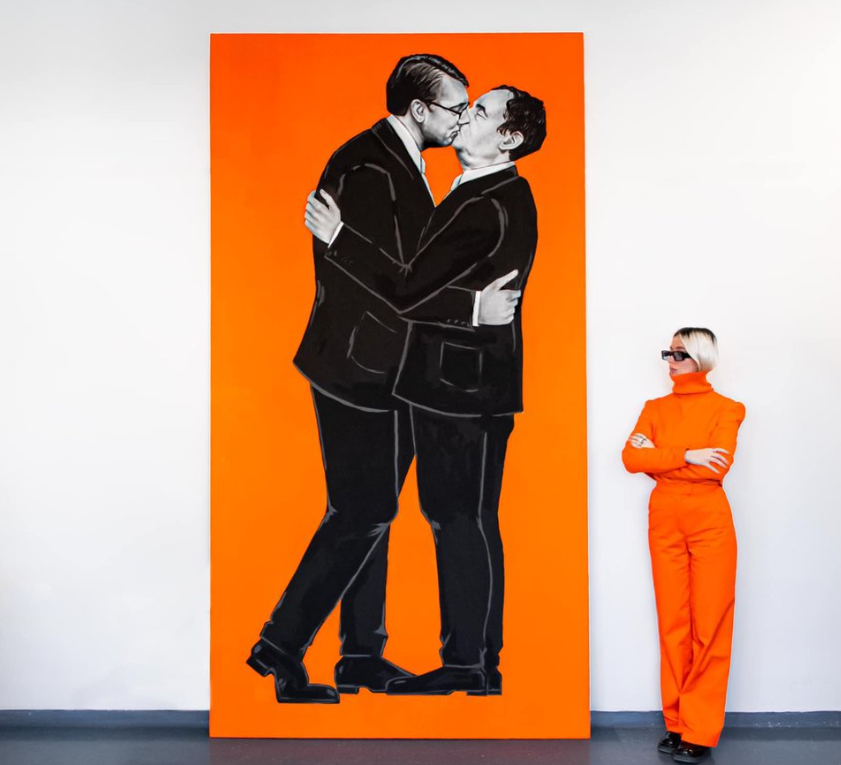
A year ago, Albanian artist Ermira Murati unveiled a provocative painting featuring Kosovo Prime Minister Albin Kurti and Serbian President Aleksandar Vučić exchanging a kiss on the lips. The artwork, shared widely on social media, drew significant attention, particularly from Murati’s followers, where she raised a poignant question: „Will this be a kiss of friendship or betrayal?“
Murati, known online as the „Orange Girl,“ explained that a kiss is never neutral, with its meaning varying based on the context and intention. „From a kiss, both solemnity and humiliation are expected. History records kisses from moments of pain and parting, but also kisses of brotherhood or even betrayal. Will this be one of them?“ she wrote, reflecting on the timing of the piece just before the adoption of the „European Agreement on the Path to Normalization of Relations between Kosovo and Serbia.“
The provocative image sparked a wave of backlash from Murati’s fellow Kosovans, including hate speech and death threats. One such message, reported by Reuters, even read: „You deserve a bullet.“
A Prophetic Kiss?
Kosovan journalist Berat Buzhala recalled the painting during a broadcast, labeling it „quite prophetic.“ Buzhala emphasized that, at a time when President Vučić is facing his most significant challenge to his dictatorial rule—amid mass protests across Serbia—Prime Minister Kurti appears to be playing a role in assisting him.
Buzhala’s comment comes in the wake of widespread protests led by students and high schoolers in Serbia, who, together with their professors, have been blocking state universities and schools. The protests culminated in a historic demonstration with over 100,000 participants in Belgrade on December 22, an event widely covered by international news outlets.
There was this painting by a young artist. Quite a prophetic one. Just at the time when Vucic is facing biggest challenge for his dictatorial rule with big protests, here comes Kurti giving him bit of help. Issue of LS certification is a matter of law and legal standards not… pic.twitter.com/CfxhmFGu5d
— berat buzhala (@buzhala) December 23, 2024
CIK’s Controversial Decision
In a politically charged move, the Central Election Commission (CEC) of Kosovo decided today not to certify the Srpska Lista for the upcoming parliamentary elections. The party, which directly supports President Vučić, was denied certification due to the „nationalist rhetoric“ of Srpska Lista’s leader, Zlatan Elek, during the presentation of their election list.
The CEC’s decision was further reinforced by two members of the Self-Determination Movement (Vetëvendosje) in the CEC, Sami Kurteshi and Alban Krasniqi, who criticized the party for using the term „Kosovo and Metohija“ instead of „Republic of Kosovo“ and for expressing loyalty to Serbia rather than Kosovo.
However, in a surprising turn, the Partija kosovskih Srba was certified despite also using the term „Kosovo and Metohija.“
International Reactions and Diplomatic Concerns
The decision triggered immediate reactions from the international community. The United States, Germany, the European Union, and the OSCE expressed concern about the politicization of the certification process.
The U.S. embassy, in a statement, emphasized that the CEC’s actions should be strictly based on legal standards, not political motivations. They further urged Srpska Lista to use the Electoral Complaints and Appeals Panel (ECAP) to challenge the decision.
German Ambassador Jorn Rohde echoed similar concerns, stressing that the certification process must remain strictly formal and free from political influence. The EU also expressed regret over the CEC’s decision, reinforcing that the certification process should be grounded in legal standards, not political considerations.
Kosovo’s Political Climate and Vučić’s Response
The decision to exclude Srpska Lista has sparked tension within Kosovo’s political landscape. Srpska Lista has announced a press conference for December 24, where Zlatan Elek will address the media, followed by a meeting with the head of the Office for Kosovo and Metohija, Petar Petković.
President Vučić responded swiftly, accusing Kurti of trying to remove Srpska Lista as the only political opposition in Kosovo. Vučić had previously warned of such a scenario, especially following the sabotage incident on the Ibar-Lepenac Canal.
„In the coming days, Kurti’s regime will blame the Serbs for the Ibar-Lepenac diversion, without any serious evidence. The goal is clear—to prevent Srpska Lista from participating in the upcoming elections,“ Vučić said on December 17.
Aligning Political Needs
Journalist Buzhala pointed out the alignment of political needs between Vučić and Kurti at this critical juncture. He noted that, despite the CEC’s initial certification of the Srpska Lista’s candidates, political realities in Kosovo have forced both leaders to align their actions.
The CEC, in collaboration with the Kosovo Judicial Council, Ministry of Internal Affairs, and Ministry of Foreign Affairs, had previously confirmed that none of the 1,280 candidates from 28 political entities had legal issues, including Srpska Lista. This casts doubt on the legitimacy of the CEC’s decision to reject Srpska Lista’s certification.
Preuzimanje i objavljivanje tekstova sa portala KoSSev nije dozvoljeno bez navođenja izvora. Hvala na poštovanju etike novinarske profesije.