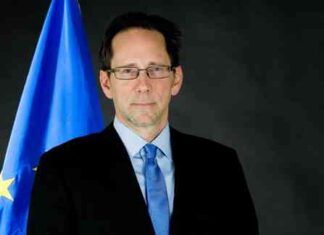
What happened after the release of the Index confirms RSF findings: the Kosovo government is attempting to question the credibility of the media. Instead of questioning the Index’s methodology, the government should propose systemic measures to protect press freedom, said head of the EU/Balkans desk at the Reporters without Borders organization, Pavol Szalai, to KoSSev.
Ahead of World Press Freedom Day on May 3, RSF published its annual report on global media freedom.
After last year’s dramatic 19-spot drop, Kosovo has hit another record low, plummeting 24 places to 99th, making it the worst in the region.
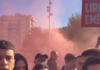
The news triggered a wave of reactions, particularly after the Association of Journalists of Kosovo (AGK) raised the alarm, organizing an emergency press conference outside the Kosovo government building. AGK pointed fingers at the government, specifically Vetëvendosje and its leader Albin Kurti, as the primary culprits behind the decline.
While Prime Minister Kurti has yet to comment on the report, statements did come from the outgoing government and Vetëvendosje, once again criticizing the media for unprofessionalism, spreading misinformation, and allegedly contributing to Kosovo’s poor ranking.
Several officials close to Vetëvendosje called out and attempted to discredit AGK President Xhemail Rexha. One official even criticized Reporters Without Borders, aiming to downplay the significance of the report.
On the other side, condemnations against Vetëvendosje poured in. AGK urged the government to stop slandering journalists and instead address the decline in media freedom. The call was echoed by the Association of Journalists of Serbia (UNS), the Association of Journalists of Kosovo and Metohija (DNKiM), Safe Journalists, and media expert Flutura Kusari.
The European Federation of Journalists also condemned the „disgusting campaign“ by Vetëvendosje members, describing Albin Kurti as an „accomplice” in these actions.
Government Challenges Index Methodology, Promises Clarification with RSF
Amid the backlash, Kosovo government spokesperson Perparim Kryeziu criticized the media further, claiming that the Index’s findings are „hard to reconcile with the reality on the ground.“ He announced plans to send a letter to RSF to „clarify the situation.“
Government Should Propose Measures to Protect Media Freedom, Not Question the Index
What happened after the release of the Index confirms RSF findings, said Pavol Szalai, RSF’s EU-Balkans head, to KoSSev.
„What happened after the release of the Index confirms our findings: government attempts to question the credibility of the media; journalist Genc Godanci of T7 television claims he was prevented from asking the PM about the Index by his security detail; the journalists’ association AGK complains of attacks following their statement about the deterioration of press freedom in Kosovo,“ Szalai noted.
He urged the Kosovo government to view RSF’s analysis as a call to action and to consider AGK’s proposal for creating a working group for press freedom.
„The authorities should propose systemic measures to protect press freedom which is in the interest of citizens’ right to trustworthy information and Kosovo’s EU integration,“ Szalai concluded.
Salai stressed that Kosovo experienced the most significant decline in media freedom in Europe, moving from a „problematic“ to a „difficult“ category.
He also noted that all media freedom indicators are deteriorating, particularly political and socio-cultural ones. Among the concerns are relentless political attacks, accusations of collusion with the enemy, media boycotts during the election period, and political interference in the public broadcaster RTK, which undermines its credibility as one of the country’s most reliable news sources.
As further evidence of the deteriorating situation, he pointed to the polarization of society and the general lack of public trust in the media, exacerbated by “political attacks from both Kosovar and Serbian politicians.“
Szalai also observed a worsening legal environment, exacerbated by the passage of the Independent Media Commission law, which RSF and other press freedom organizations have criticized for undermining the commission’s independence.
Additionally, Kosovo’s Constitutional Court recently deemed the law unconstitutional, citing a lack of guarantees for independence, gender equality, and proper regulation of sanctions.
The deteriorating legal environment is further affected by „the lack of access to public information and discrimination of the Serbian minority media,“ Szalai added.
He noted an increase in so-called „SLAPP“ lawsuits and cited very low economic indicators, which would place Kosovo at 101st out of 180 countries.
Szalai also listed other factors negatively impacting the Index:
„Undue interference of media owners with editorial independence, a lack of sufficient, foreseeable, and independent funding for the public media, low media sustainability of the media on two separate and small markets of Kosovo, issues with transparency of funding (funding from political parties) and of ownership, and precarious conditions of the journalistic profession.“
Comparing Kosovo with Serbia
Szalai compared the situation in Kosovo to Serbia, noting that they both are closely ranked, with a gap of only three places — Kosovo at 99th with 52.7 points and Serbia at 96th with 53.6 points.
He remarked that political pressure on journalism is significantly stronger in Serbia than in Kosovo (31 points compared to 45 points), although Kosovo’s situation has worsened significantly.
„The economic indicator is higher in Kosovo than in Serbia (40 vs. 35 points) which means that the economically journalism can breathe better there.”
However, Szalai stressed that the sense of insecurity is stronger in Kosovo than in Serbia (53 points compared to 80 points):
„A stronger feeling of insecurity in Kosovo than in Serbia, which may be explained by a weaker institutional framework for prosecuting attacks against journalists.”
Preuzimanje i objavljivanje tekstova sa portala KoSSev nije dozvoljeno bez navođenja izvora. Hvala na poštovanju etike novinarske profesije.