Just days after Jared Kushner, the son-in-law of U.S. President Donald Trump, withdrew his company from a controversial luxury hotel and residential project in Belgrade, Kosovo’s First Gentleman, Prindon Sadriu, publicly invited the American businessman to relocate the project to Pristina.
Kushner abandoned plans to build a Trump-branded hotel and residential complex on the site of the former Yugoslav Army General Staff headquarters in Belgrade, citing “respect for the Serbian people.” Eight days later, Sadriu, the husband of Kosovo President Vjosa Osmani, proposed that the same investment be realized in Kosovo’s capital, specifically at the location of the former Grand Hotel.
According to Sadriu, relocating the project to Pristina would carry a unifying message.
“Withdrawing from the Belgrade Trump Hotel project reinforces an important truth: meaningful projects are meant to unite, not divide,” Sadriu wrote on his X account. “Relocating this vision to Pristina—and transforming the Grand Hotel into a Trump Hotel—would revitalize a prime location and unite people.”
Withdrawing from the Belgrade Trump Hotel project reinforces an important truth: meaningful projects are meant to unite, not divide. Relocating this vision to Prishtina—and transforming the Grand Hotel into a Trump Hotel—would revitalize a prime location and unite people. pic.twitter.com/T3Qq5AD3xt
— Prindon Sadriu 🇽🇰 (@PrindonSadriu) December 22, 2025
The Grand Hotel: A Landmark of Pristina
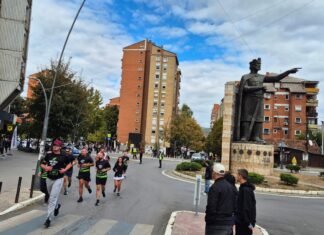
The Grand Hotel is located in the very center of Pristina, on Mother Teresa Boulevard, formerly known as Marshal Tito Boulevard and later Vidovdanska Street following the breakup of the former Yugoslavia.
Before the war in Kosovo, the Grand was a five-star, A-category hotel and a focal point of Pristina’s social and business life. It hosted numerous high-ranking officials, including Yugoslav leader Josip Broz Tito in 1979.
After the 1999 Kosovo war, the property was transferred to the ownership of the Kosovo Trust Agency (KTA), which later became the Kosovo Privatization Agency (KPA).
According to Radio Free Europe/Radio Liberty (RFE/RL), the privatization process began in 2005 using the Special Spin-Off method, under which the buyer was not allowed to change the company’s core activity. In 2006, the winning bidder was Zelqif Berisha (Unio Commerce), who was required to pay more than €8 million, invest approximately €20 million in the hotel, and employ over 400 workers.
However, Berisha failed to implement the planned investments, and in 2012 the KPA revoked his shares. Although Berisha was officially listed as the sole buyer, the companies Mabco Construction, owned by Behgjet Pacolli, and Eurokoha Reisen, owned by Remzi Ejupi, claimed that they had co-financed the purchase of Hotel Grand, based on an agreement to share ownership as follows: Berisha 40 percent, Mabco 40 percent, and Eurokoha 20 percent. The KPA never formally recognized this arrangement.
In 2017, Mabco initiated arbitration proceedings before the International Centre for Settlement of Investment Disputes (ICSID), seeking reimbursement of the €4 million it had paid. In January 2025, ICSID ruled in favor of Mabco; however, ownership of Hotel Grand remained with Kosovo, as confirmed at the time via Facebook by Albulena Haxhiu, Vice President of the Kosovo Assembly.
The “General Staff” Affair in Belgrade
Kushner’s withdrawal from the Belgrade project was announced on December 15, following months of protests, legal disputes, and growing public opposition. His firm, Affinity Partners, had planned to develop a luxury Trump hotel and a residential-business complex on the site of the former General Staff building, heavily damaged during the 1999 NATO bombing and widely regarded as a symbol of Belgrade’s cultural and historical identity.
During 2024 and 2025, Serbian authorities established a joint investment structure with Kushner’s firm, while the Serbian Parliament adopted a special law (lex specialis) in November to facilitate the project, despite strong resistance from the public and professional community.
In defense of the General Staff building, domestic experts were joined by the European heritage organization Europa Nostra.
A major turning point came on December 15, when the Organized Crime Prosecutor’s Office (JTOK) filed an indictment proposal against Serbian Minister of Culture Nikola Selaković and three other officials, accusing them of abuse of office and document falsification related to the removal of the site’s cultural heritage status.
Following the decision to withdraw, a spokesperson for Kushner’s company told The Wall Street Journal that the move was made “out of respect for the people of Serbia and Belgrade.” Serbian President Aleksandar Vučić stated that Serbia had lost an investment worth approximately €750 million and announced criminal complaints against protesters and those involved in the campaign opposing the project.
Preuzimanje i objavljivanje tekstova sa portala KoSSev nije dozvoljeno bez navođenja izvora. Hvala na poštovanju etike novinarske profesije.