Albanians across the region celebrated Flag Day on 28 November, marking the 113th anniversary of Albania’s declaration of independence. The holiday, deeply embedded in Albanian national identity, was commemorated with large gatherings in Prekaz, Kosovo, and in Vlora, Albania, where senior officials invoked themes of unity, sacrifice, and historical continuity.
From Tirana to Bujanovac, Albanian flags lined streets, while border crossings turned into festive checkpoints as thousands of Kosovo citizens traveled to Albania for the holiday. Leaders from Kosovo, Albania, and the Albanian diaspora — including those detained in The Hague — sent congratulatory messages emphasizing national pride.
Prekaz at the Center of Commemorations
As every year, Prekaz — the birthplace of Kosovo Liberation Army (KLA) commander Adem Jashari — was the focal point of celebrations in Kosovo.
The date coincides not only with Albania’s independence day but also with what would have been Jashari’s 70th birthday.
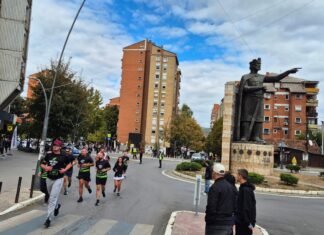
A “November Run,” featuring some 400 participants, opened the commemorations at the Jashari Memorial Complex.
Many runners wore shirts bearing Jashari’s image, and one group unfurled a banner reading “Përjetësisht” (“Forever”). The race began in Prekaz and ended symbolically at the “Adem Jashari” square in Srbica.
Large crowds gathered, including veterans of the KLA’s “111 Adem Jashari Brigade” and “Black Tigers” special unit. Bekim Shiti, one of the veterans present, told local media that the history of such dates must be passed to younger generations to reinforce “the importance of the homeland.”
“We are connected as Albanians from Leposavic to Vlora,” he said. “These dates represent the rise of the KLA and the birthday of Adem Jashari. We must transmit their meaning to all future generations.”
Kosovo Security Force (KSF) officials also paid tribute at the memorial, laying wreaths in honor of the Jashari family members killed in 1998 and all those they described as martyrs for Kosovo’s freedom.
Political Messages: From Prekaz to The Hague
Acting ministers and senior officials, including Dimal Basha, Besnik Bislimi, and Rozeta Hajdari, also visited the memorial.
Basha called 28 November a “sacred day” and described Prekaz as one of the “holiest places in Albanian lands.”
Hysni Gucati, head of the KLA War Veterans Association, said the holiday felt “incomplete” without the presence of former KLA leaders Hashim Thaçi, Kadri Veseli, Jakup Krasniqi, and Rexhep Selimi — currently in The Hague on charges of war crimes and crimes against humanity.
Thaçi, however, issued a holiday message from detention, expressing hope that future Flag Days would be celebrated “together again.”
Lead Ceremony in Vlora
In Vlora — where Albania’s independence was declared in 1912 — Albanian President Bajram Begaj and Prime Minister Edi Rama hosted the central state ceremony.
Kosovo President Vjosa Osmani joined them, laying flowers at the city’s memorial complex and addressing crowds filled with children shouting “Rama, Rama.”
Osmani described the holiday as written “in blood, courage, and faith,” calling Flag Day, Albania’s independence, Jashari’s birth, and the KLA’s first public action the “four pillars of national pride.”
“Two states, one nation, two flags, one heart,” she said in her message.
Rama also commemorated Jashari, writing that the KLA commander “became a flag of sacrifice, freedom, and national pride.”
Border Crossings Turn Festive, Police Presence Tightens in the North
An estimated 18,000 Kosovars traveled to Albania during the day, with border crossings like Morina and Kakavija transformed into “holiday arenas” filled with music and dancing.
In contrast, northern Kosovo — especially Mitrovica — saw increased Kosovo Police and EULEX presence.
Police turned back vehicles displaying Albanian or Kosovo symbols, citing risks of provocation.
Local media reported that images of Vjosa Osmani and Kosovo flags had been placed inside municipal buildings in North Mitrovica in anticipation of political changes.
Some journalists in Kosovo marked the day by posting images of Albanian and KLA flags on their social media profiles, a trend seen in previous years as well.
Commemorations in Southern Serbia
Flag Day was also marked in Albanian-majority municipalities in southern Serbia.
In Bujanovac, the Albanian flag flew from the municipal building and from the National Council of Albanians. This year’s display passed quietly, without the usual political calls for citizens to show the flag.
Shaip Kamberi, an Albanian MP in Serbia’s parliament, stressed the significance of the holiday as a symbol of unity and dignity.
Preševo Mayor Ardita Sinani used the occasion to highlight what she described as ongoing “discrimination” against Albanians in Serbia.
What Did Last Year’s November 28 Look Like?
November 28 of last year was marked with special events in the northern municipality of Zvecan.
In an Albanian café in North Mitrovica, located right on the dividing line between the north and south of the city, Albanian and KLA flags were displayed, as well as in Suvi Do.
The southern part of Mitrovica celebrated with car parades carrying Albanian, Kosovo and KLA flags, including near the main Ibar Bridge.
With increased movement of people from the south to the north — including children — Kosovo Police selectively sent back individuals wearing Albanian symbols, which they said could provoke incidents.
According to Pristina media, senior officials — then–Foreign Minister Donika Gërvalla,
Assembly Speaker Glauk Konjufca, Deputy PM Besnik Bislimi and Interior Minister Xhelal Sveçla — visited the tower of Isa Boletini to lay flowers at the grave of what Albanians consider a national hero.
The official commemoration then shifted to Prekaz, where the full delegation attended a parade involving children, alongside President Vjosa Osmani and acting PM Albin Kurti.
That same day, a mural dedicated to the Košare fighters in central Mitrovica was painted over. Six police officers were suspended for 72 hours after it was determined they had been near the scene but failed to act.
Late in the evening in Gracanica, dozens of cars drove through the town center with men honking, shouting, waving Albanian flags and chanting “Kosova, Kosova.”
Competing Narratives on Adem Jashari
While Jashari is celebrated among Albanians as a national hero, Serbian state sources continue to view him as a terrorist.
Serbian accounts describe the March 1998 operation in Prekaz as a police action against armed KLA fighters who refused to surrender and fired on police, resulting in casualties among officers.
Data from the Humanitarian Law Center (HLC) notes that among the 58 Jashari family members buried after the operation, 18 were women and 10 were children.
Historical Context: What Was Recognized in 1912–1913?
Although Albanians commemorate 1912 as the year of their indepen dence, the international recognition process that followed was complex. While leaders declared independence in Vlora on 28 November 1912, the London Peace Treaty of May 1913 granted only part of the requested territories. Albania emerged as a principality and later as an autonomous constitutional monarchy, largely within the borders that correspond to today’s Albanian state.
Preuzimanje i objavljivanje tekstova sa portala KoSSev nije dozvoljeno bez navođenja izvora. Hvala na poštovanju etike novinarske profesije.