Five months have passed since new Albanian mayors forcibly entered three Serb-majority municipalities in the north. Between the displaced bodies of the Republic of Serbia, which Pristina and the Western countries that recognized Kosovo consider illegal, and the new local governments formed without the participation of Serbs, which Pristina itself agrees are illegitimate, residents are the ones who are suffering. It has become increasingly difficult for them to obtain documents within both systems. We researched how citizens in Leposavic, Zubin Potok, and Zvecan have been tackling this issue for the past five months.
The withdrawal from Kosovo institutions and the boycott of elections resulted in local institutions in the north of Kosovo having virtually no representatives from the Serbian community.
In North Mitrovica, at the local elections held in the second attempt on April 23, Erden Atić won the elections, while Ilir Peca did the same in Zvecan, Izmir Zeqiri in Zubin Potok, and Lulzim Hetemi in Leposavic.
The North Mitrovica municipal building is the only one that is not located on the same premises as the municipal authority operating within the system of the Republic of Serbia, and its mayor took the oath before the other three – peacefully and without incidents. At the same time, Kosovo flags were displayed on this municipal building.
Six days later, the other mayors also took their oaths, but outside the municipal premises, in Cabra – Zubin Potok municipality, Boljetin – Zvecan municipality and Bistrica – Leposavic municipality.
Although warned that the current security situation is fragile, and that the violent occupation of buildings would exacerbate this state, with the help of a strong police presence, Peci, Zeqiri, and Hetemi nevertheless occupied municipal premises.
All of this took place on the same day a massive rally of the SNS was being held in Belgrade, to which Kosovo Serbs, mostly employed or dependent on Serbian state institutions, went en masse and in an organized manner.
The local, Serb-majority, population gathered in front of these municipalities on the same day, in objection to the entry of Albanian mayors. An air raid siren was also heard in three municipalities.
In the ensuing incidents, dozens of citizens were injured, mostly from tear gas, as well as five police officers. Police vehicles were demolished, and one was torched. Stun grenades were used, and shots were fired.
The international community, including KFOR, condemned and described the forcible entry of the new mayors as a provocation. They called on the Prime Minister of Kosovo to cease the violent actions.
Kosovo flags were also displayed on these three municipal buildings that day. Due to increased pressure, the two mayors agreed to leave the buildings. The weekend came and went.
On Monday, citizens gathered in front of these municipalities, where special units of the Kosovo Police have been stationed since Friday, were welcomed by strong forces of KFOR and EULEX.
Negotiations with members of KFOR in Zvecan started in the early hours of the morning.
After Serbs refused several demands of this international mission to withdraw and let the blocked armored police vehicles pass, while issuing their demand that the Kosovo Police leave the municipality, the gathered Serbs and KFOR members clashed.
Dozens of citizens, as well as members of KFOR, were injured in these clashes. There were gunshot injuries on both sides.
On the same day, two Serbs were arrested, and later on, at least six more, in connection with this event.
In the ensuing months, KFOR and NATO announced that 93 soldiers had been injured, which is the highest number since their deployment to Kosovo after the war.
The blame for the additional escalation of the crisis on the ground, the international community once again placed on Pristina, while also condemning the „hooligans“ for the attack, this time aiming at the Serbian side. Through the three-point plan of the EU and the US, they demanded that Pristina call elections in which Serbs would participate as soon as possible, that special units withdraw from municipal buildings, and that Serbia withdraws „radical elements from these areas.“
However, thanks to the Bratislava Agreement agreed in July by Kurti’s deputy Besnik Bislimi and the European mediator, Miroslav Lajčak, the presence of police force in the municipalities has been reduced by 25% on two occasions, i.e. they were transferred to locations where they were “most necessary” in the north.
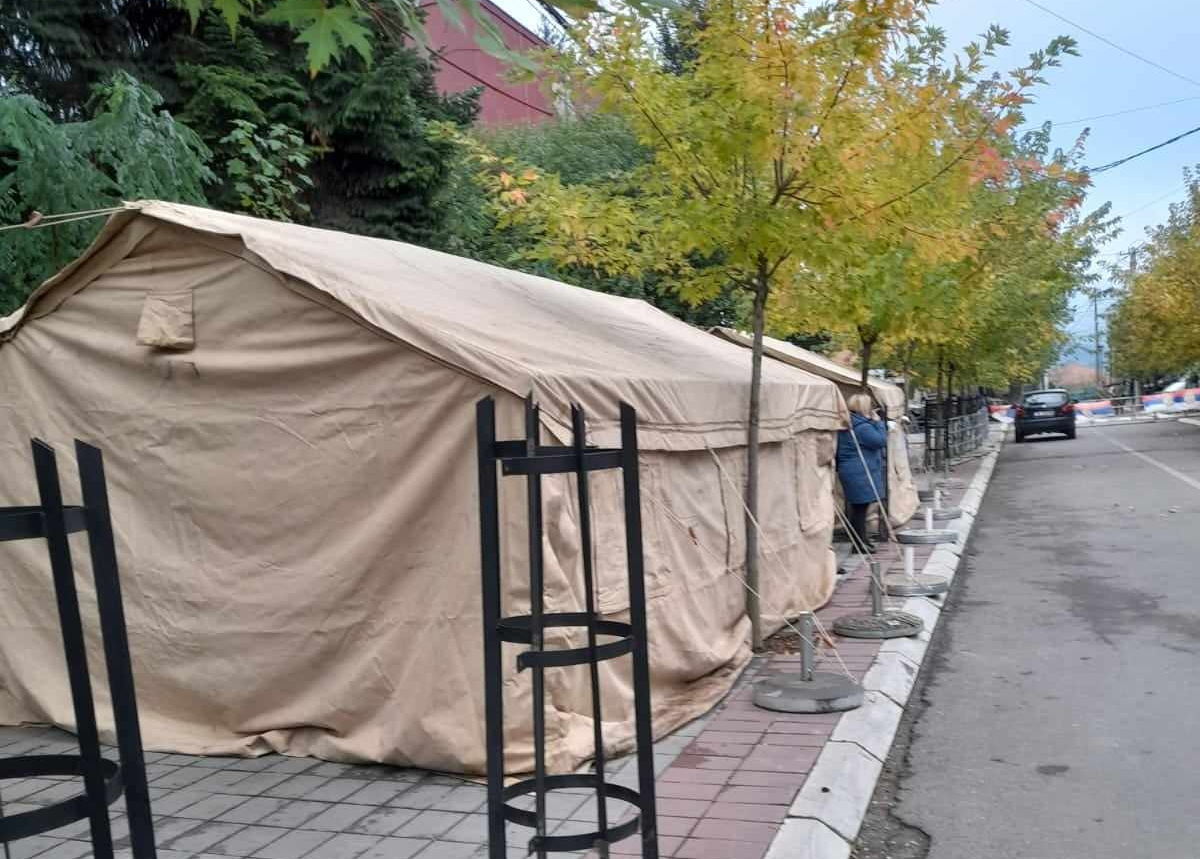
That was also the last significant step taken when it comes to these municipalities, apart from the fact that as the temperatures are dropping, citizens who are protesting in an organized manner have set up tents for the coming winter.
As a result, working space in municipal buildings, in providing services to citizens, especially when it comes to the daily needs of the administration of the Republic of Serbia, was transferred to the streets.
In contrast, a new leadership was being established in Kosovo’s self-government. In the municipal bodies in northern municipalities, Serbs are now in leading positions, in the administration itself and the departments.
They are working at full speed. Decisions are made and implemented, but they are, however, almost completely alienated from the citizens of the north and do not reflect their requests.
The problem that the Serbs have had for 24 years now, when it comes to the intertwining of the jurisdiction of the administration of the two systems, has gotten significantly more complicated in the north in the last six months.
Kosovo’s municipal administrations are not operating at full capacity in providing administrative services to citizens, nor can such services be provided now when it comes to municipal bodies under the Republic of Serbia.
Citizens are forced to strap on patience, additional costs, and figure out how to fulfill their basic civil rights and obligations as quickly and painlessly as possible.
Leposavic: Documents issued at the police station
Several interlocutors confirmed for KoSSev that municipalities are now completely dysfunctional for the basic administrative needs of citizens, both in the Serbian and Kosovo systems.
After the arrival of new mayors and the police, Serbian documentation, seals, and other materials remained in these buildings.
Marko Milenković from the New Social Initiative, a resident of Leposavic, told KoSSev that taking out documents from the municipal building itself is almost impossible.
He specified that the same applies to documents issued by the Provisional Municipal Authority under the system of the Republic of Serbia, but also for those issued by Kosovo.
„The municipality is completely closed to the workers of the Provisional Authority, as well as to the complete services provided by this body. However, in several places around Leposavic, these people work from alternative premises. That is where citizens can sometimes, in rare cases that is, find them and ask them to somehow get things they need to be done,“ he says.
Although an alternative way was found, Milenković emphasizes that it is still difficult to get documents in this way.
„They manage to take care of priority stuff, such as document certification and the like. But some administrative needs, for which people used to come to this municipality every day, are not fulfilled. And therein lies the problem,“ he says.
The municipal building is also inaccessible when it comes to Kosovo documents. Although the heads of several departments have already been established, most of the services are not functional.
An alternative was also found, and citizens are now forwarded to the police station.
„I don’t know of cases where citizens went to the municipality itself to get documents and fulfill their administrative needs. Now, within the police station, Centers for Civil Affairs have been established for this purpose. Citizens are now renewing documents there, submitting requests, registering cars, among other things,“ Milenković told us.
One good thing for the citizens of Leposavic is that in previous years, other services from the Serbian system were not carried out in the municipal building. In other words, the Pension and Insurance Fund, the National Employment Service and others were situated in separate buildings.
Zubin Potok – several institutions blocked in the building.
This is not the case in Zubin Potok. In the municipal building, until May 26, in addition to the Provisional Municipal Authority of the Republic of Serbia and municipalities under the Kosovo system, there were also the National Employment Service, the Town Library, and the Cadaster. Different sectors dealing with agriculture, as well as Health Insurance, also shared the location.
„Citizens now have nowhere to update their health insurance cards, or report to the National Employment Service. The cadastral service is not functioning. All this complicates the everyday life of ordinary citizens. Worst of all, they have no one to turn to. On May 26, all the workers left the building and turned into demonstrators. I heard that they moved to another location, but I don’t think the citizens know about it,“ said Milija Biševac, a former councilor in the municipality of Zubin Potok.
„In the case of the deceased and death registration, citizens cannot do this anywhere in Zubin Potok. As far as I know, in those cases, you can go either to North Mitrovica or to Raska. When it comes to birth, it was not done here before, but also in Mitrovica, because the maternity ward is located there.“
He confirmed that the situation is the same when it comes to Kosovo documents.
„These documents cannot be obtained in the municipality itself. The alternative office is in Cabra, where the mayor is also,“ he explains.
Biševac noted that the cadastral books were left in the municipal building.
Within the Kosovo system, citizens have to go to Pristina for a title deed, as they cannot do it anywhere in the north
„After the incursion of the special units of the Kosovo Police into the municipal buildings of Zubin Potok, Zvecan and Leposavic – they were literally turned into a police base and have no function,“ Biševac emphasized.
Zvecan – The most important services are not located in the building itself
When it comes to the municipality of Zvecan, documents cannot be obtained in the municipal building itself.
However, in a completely opposite situation to the one in Zubin Potok, the mitigating circumstance for citizens in Zvecan is that the Registry Office of the Provisional Municipal Authority of Serbia was moved from the municipal building before May 26.
„Some basic administrative needs can be done there, certificates, document authentication…“ says journalist Ana Marija Ivković, a Zvecan local.
These documents used to be issued in a nearby building that the Kosovo government built, among the first such buildings in this municipality – the Intel building.
Ivković could not confirm whether it is still possible to obtain documents in the same facility, but she states that since the departure of Serbs from Kosovo institutions, there has been a practice among the people of Zvecan to go to North Mitrovica for most documents.
While waiting for all these issues to be resolved by high politics, life goes on for the common citizens. Weddings, births, and funerals are just some of the events that cannot wait for such solutions.
Dragana Vukosavljević
Preuzimanje i objavljivanje tekstova sa portala KoSSev nije dozvoljeno bez navođenja izvora. Hvala na poštovanju etike novinarske profesije.