Kosovo’s religious and political landscape is witnessing the emergence of a controversial figure— Nikolla Xhufka, a self-declared archbishop of an unrecognized „Orthodox Church of Kosovo Albanians“ Over recent months, Xhufka has intensified his public presence through official visits, social media messaging, and repeated unauthorized entries into Serbian Orthodox churches.
Most recently, renowned Kosovo publicist Veton Surroi publicly criticized what he described as a „bandit form of Albanian ethnophyletism“ embodied by Xhufka—juxtaposing it with the longstanding critique of ethnophyletism within the Serbian Orthodox Church (SOC). Writing in his weekly column, Surroi highlighted the irony of this development occurring „in a part of Kosovo where there are almost no Orthodox Albanians.“
Official Meetings, Symbols, and a Campaign for Legitimacy
Xhufka has begun securing official meetings with Kosovo mayors, including those of Peja/Peć, Pristina, and Gjakova/Đakovica. The meetings, often documented with stylized photographs and language of „brotherhood“ and „spiritual unity,“ signal his efforts to cement a role as a religious and civic leader. Of the three, only Djakovica’s mayor, Ardian Gjini, publicly acknowledged the meeting, referring to Xhufka as „archbishop of the Autocephalous Orthodox Church of Kosovo.“


Through social media, Xhufka also recently awarded a „Knight of St. Constantine of Dardania“ title, appeared in television studios, led a commemorative service on what he called the 35th anniversary of Kosovo’s independence, and held a prayer at the grave of KLA commander Adem Jashari.
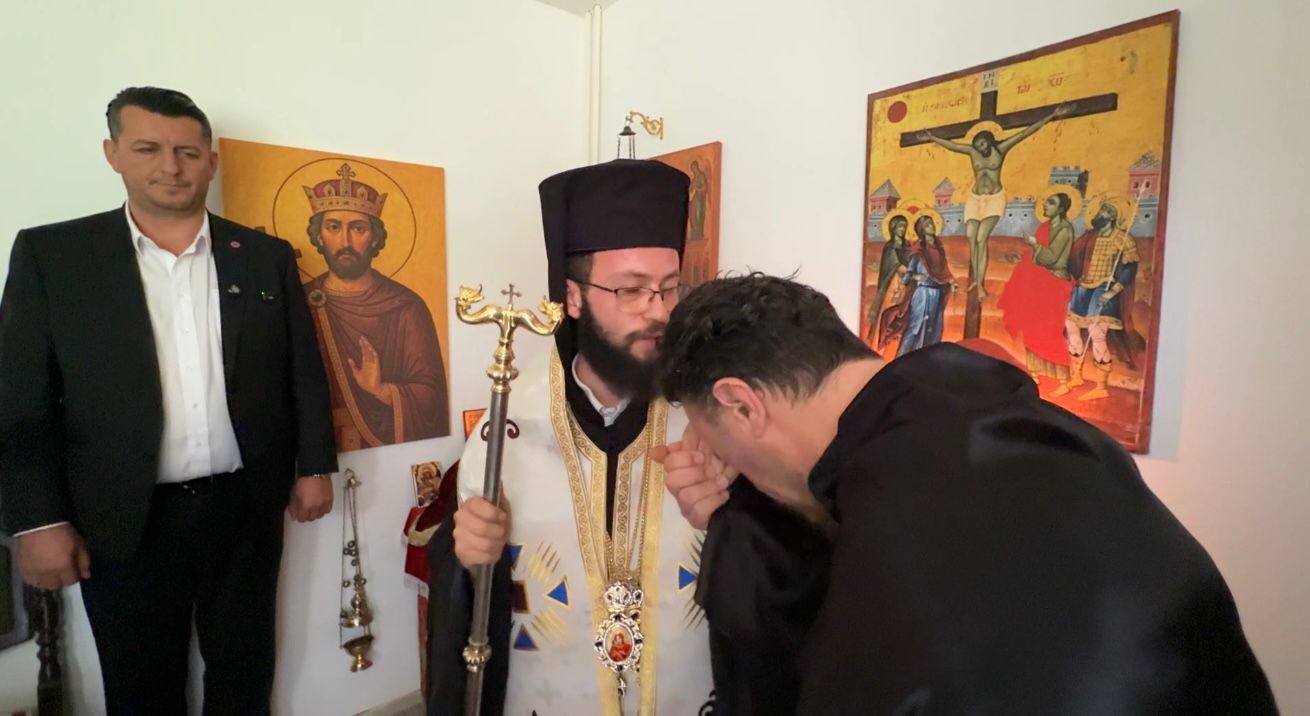
His posts often show him with Albanian flags, KLA symbols, and the so-called Greater Albania map. In several images, he even appears in military attire or posing with firearms.


Church Break-Ins and Legal Battles
Xhufka’s activities have triggered repeated legal responses from the Serbian Orthodox Church Raška-Prizren Diocese. The latest criminal complaint was filed in June after Xhufka once again broke into the 14th-century Church of St. Archangel Michael in Rakitnica near Podujevo—marking the third such incursion.
The Diocese accuses him of unlawfully occupying and attempting to appropriate the property for a „false organization“ while posing as a cleric, despite lacking ordination or recognition from any canonical Orthodox Church. In a previous statement, the Albanian Orthodox Church also disavowed him, describing him as a source of misinformation and religious provocation.
The 28 November 2023 break-in—when Xhufka held an improvised liturgy under the Albanian flag and declared the church the „Church of Fan Noli“—was particularly inflammatory. Though the church was re-sanctified in the presence of police and international representatives, another intrusion followed just a month ago.
Despite multiple attempts by the Serbian Orthodox Church to prompt legal action, Kosovo police have been reportedly slow to respond. Charges were finally filed in May, with the first hearing held in October. Xhufka denied all accusations.
Response from International Community and Xhufka’s Counterclaims
After the latest incident, The OSCE is the only international organization to publicly respond thus far, expressing concern over the unlawful entry into a Serbian Orthodox church and urging an investigation. Xhufka replied by defending his legitimacy, claiming he leads a „canonical“ institution recognized by „international ecclesiastical authorities“ and asserting that he operates in full compliance with Kosovo’s laws.
He dismissed accusations of trespassing, alleging instead that the church in Rakitnica belongs to Kosovo and not the Serbian Orthodox Church. He went further, claiming he is under surveillance by Serbia’s Ministry of Defense—a claim he attempted to support by posting a vehicle insurance document allegedly tied to the ministry.
Surroi’s Critique: False Prophets and Legal Contradictions
The case has now attracted strong criticism from Veton Surroi, who, in an editorial for Koha, described Xhufka (whose real name, he says, is Nikollë Bllazhde) as a „false prophet“ and symbol of a growing ethno-clerical narrative on Kosovo. Surroi argues that Xhufka’s activities violate both canonical law and Kosovo’s legal order, which recognizes the Serbian Orthodox Church as the rightful owner of its historic properties under the Ahtisaari Plan.
According to Surroi, Xhufka’s self-appointment as bishop—without ordination by the Orthodox Church of Albania—constitutes a clear breach of canonical procedure. He warns that this ethno-clerical ideology attempts to frame Orthodox Christian heritage in Kosovo as inherently Albanian, thereby erasing Serbian Orthodox identity in the process.
“Xhufka becomes a prophet of a new ethno-clerical religion, in which Albanian claims over Orthodox churches solve political problems in Kosovo, while denying the identity of Kosovo Serbs and Orthodox believers as part of the Republic of Kosovo,” Surroi wrote.
Agon Maliqi on Xhufka: “A priest about as much as I’m a NASA astronaut”
Kosovan publicist and commentator Agon Maliqi has strongly criticized the recent public appearances of Nikolla Xhufka, denouncing him as a charlatan with a dubious political and religious agenda.
In a statement shared on social media yesterday, Maliqi warned about the consequences of legitimizing Xhufka in public discourse—particularly after some Kosovan officials received him in their offices.
“This charlatan, Nikolla Xhufka from Elbasan, who declared the so-called Orthodox Church of Kosovo, is an Orthodox priest about as much as I’m a NASA astronaut,” Maliqi wrote.
He was especially critical of institutions and media outlets that, according to him, take Xhufka seriously simply because he parades through Orthodox churches carrying the Albanian flag.
“It’s disappointing that public officials welcome him into their offices and media give space to a clown with a suspicious agenda—treating him seriously just because he waves the Albanian flag inside Orthodox churches and fulfills certain folkloric-nationalist fetishes.”
Maliqi also pointed to a broader lack of understanding of Albanian Orthodoxy in Kosovo, highlighting the recurring confusion around the date of Christmas celebrations.
“The level of ignorance in Kosovo regarding Albanian Orthodoxy, which resurfaces every January 7th when public figures congratulate Orthodox Albanians on Christmas (even though they celebrate it on December 25th), is also evident here—in this desire to project a kind of patriotic Fan Nolli onto a clown.”
He warned that Xhufka’s appearances are already being used for political manipulation.
“All of this is happening at a time when the incidents caused by this clown in Kosovo are being cited for months in Serbia’s official reports as examples of alleged attacks by Kosovo on Orthodox churches. Now do the math yourselves—what kind of phenomenon does this clown really represent?” Xhufka, who presents himself as “Father Nikolla,” claims to be the leader of an “Autocephalous Albanian Orthodox Church in Kosovo.”
His appearances, combining religious imagery with Albanian national symbolism, have sparked controversy and concern.
Religious experts and Orthodox institutions across the region have dismissed his legitimacy and warned of the risks posed by religious confusion and nationalist spectacle.
Preuzimanje i objavljivanje tekstova sa portala KoSSev nije dozvoljeno bez navođenja izvora. Hvala na poštovanju etike novinarske profesije.