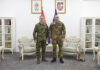
Former Head of the OSCE Mission in Kosovo Michael Davenport has responded after alleged messages by Jelena Djukanović, a former OSCE staff member in Pristina who was recently sentenced to six years in prison for espionage, were made public.
Davenport’s name appeared in messages that Albanian-language media presented as an alleged exchange between Djukanović and Aleksandar Vlaić, previously convicted of espionage and described in those reports as a “resident agent of Serbia’s BIA in Kosovo.” The messages claimed that Davenport had been preparing an OSCE report on Kosovo and was expected to consult with then Serbian Foreign Minister Ivica Dačić before presenting it in Vienna.
Responding to a post by Kaltrina Kamberi, who presents herself as an analyst and described Djukanović as a “spy” while calling for the harshest punishment, Davenport said that the first of the published messages — referring to one of his reports to OSCE participating States — was “strangely ill-informed” if it indeed came from an OSCE Mission member.
He stressed three key points: first, that during his mandate it was not the practice for individual OSCE participating States, including Serbia, to receive draft reports before they were circulated to all participating States; second, that although he met successive Serbian foreign ministers, including Ivica Dačić, he never shared his reports with them in advance; and third, that it is standard procedure for the OSCE Secretariat to circulate final reports to all participating States several days before they are formally presented to the Permanent Council in Vienna.
The first of the messages allegedly sent by Jelena Đukanović & attached to your post refers to one of my reports to OSCE participating States (pS) as Head of the OSCE Mission in Kosovo. However, the message is strangely ill informed if coming from an OSCE Mission Member 1/4 https://t.co/AJZQ5A5R14
— Michael Davenport (@mhdport) April 27, 2026
His reaction followed the publication by Kosovo and Albanian media of alleged communications suggesting that Serbia’s Security and Intelligence Agency (BIA) used Djukanović to influence how events in northern Kosovo were portrayed in OSCE reports.
Kosovo media widely reported materials originally published by Dukagjini just hours before the verdict was delivered. According to these reports, Aleksandar Vlaić allegedly instructed Djukanović on how to shape reports and narratives about events in the north, including framing actions by the Kosovo Police as “attacks” on Serbs.
The same reports mention meetings between US Embassy officials and Kosovo government representatives, alleged dissatisfaction from the American side with Prime Minister Albin Kurti, and information concerning KFOR, including Slovenian and Swiss contingents.
Djukanović was sentenced on Monday to six years in prison. Kosovo’s Special Prosecution stated that, using her position within the OSCE, she collected and passed information to Serbia’s BIA. Prosecutor Bekim Kodraliu said the trial proved “beyond reasonable doubt” that she engaged in unlawful activities that assisted the Serbian intelligence service “to the detriment of Kosovo’s interests.”
Her defense, however, rejects the verdict. Lawyer Predrag Miljković announced an appeal, claiming the ruling “will not stand.” He pointed in particular to contested phone evidence, arguing it was obtained without a court warrant, thus violating the right to privacy, and that other evidence does not support the charges.
Advokat Miljković: Presuda Đukanović neće opstati, žalićemo se
Vulnerability of International Organizations to “Espionage Activities” by Serbia and Russia
The portal Nacionale places the Djukanović case in a broader context, presenting it as part of a pattern of Serbian and Russian actions targeting international organizations in Kosovo and across Europe.
In an article titled “The Djukanović Affair – Russian and Serbian Espionage Targeting International Organizations,” author Col Mehmeti claims that the OSCE Regional Center in northern Mitrovica allegedly served for years as a base for activities conducted under diplomatic cover against Kosovo.
According to Nacionale, “under the cover of the OSCE mission, Serbian agents carried out extensive espionage activities in Kosovo,” while Djukanović allegedly “transmitted sensitive security information to Belgrade and collected data on the Kosovo Police, international staff, and even KFOR.”
The outlet also highlights a reported message — “Thank you. I understand. Great” — allegedly sent by a BIA superior after Djukanović informed him about meetings between US diplomats and Kosovo officials.
In the same report, the OSCE Mission in Kosovo declined to comment on the individual case but emphasized that all staff must adhere to the Code of Conduct, staff regulations, and OSCE rules. The Mission said it respects the court’s decision and will continue cooperation with Kosovo institutions within its mandate.
Nacionale further argues that the case demonstrates the vulnerability of international organizations to what it describes as espionage by Serbia and Russia. It draws parallels with alleged Russian infiltration of the OSCE Special Monitoring Mission in Ukraine, citing media reports about the collection of personal data on staff and links between diplomats and intelligence services.
The outlet also recalls previous incidents involving UNMIK, including the 2019 arrest of Mikhail Krasnoshchenkov and media reports about Russian intelligence officers allegedly operating under the UN mission in Kosovo.
Preuzimanje i objavljivanje tekstova sa portala KoSSev nije dozvoljeno bez navođenja izvora. Hvala na poštovanju etike novinarske profesije.