Translation provided by KoSSev
Journalist: Ivana Milanovic Hrasovec
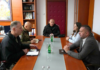
The explanation of the collegium of the „Vreme“ weekly, which awarded the person of the year recognition to the editor of the portal Kossev.info, Tatjana Lazarevic, states, among other things: „She is reporting and testifying from the front where plenty of propaganda, open lies, and political villainy converge. And she is testifying openly. In the year when professional journalism was exposed to contempt and violence, she was one of the bright examples of journalistic honesty.“ It is a precise and elegant explanation, which, after visiting Tanja Lazarevic and the editorial staff of the portal Kossev.info in North Mitrovica, can only be read up close and „from the gut“. The conversation with Tanja was not a classic interview, nor could it be. In the light of the layers of her sincere story of surviving in Kosovo’s reality, all issues became redundant. Perhaps because the longest „chapter“ in her story is the one that speaks of the struggle for media freedom and pressures, while the latter concerns the very life itself.
The starting point at which KoSSev emerged relies heavily on the terrible sense of vulnerability of the community. The crisis has not stopped here for 30 years, and that is my life. My entire childhood, and even later, was spent in the position of vulnerability: how to get to school, to take care of what language you are speaking, to look at what cafe you will go to, and KoSSev emerged from this feeling of vulnerability. And social injustice which I cannot stand. Nobody took care of us here and we lived under media lies and propaganda
Start of (Entering) journalism…
I will say that I have been in journalism since the beginning of KoSSev. However, before that, I worked as a Kosovo correspondent for the Osservatorio Balcani e Caucaso, an Italian political portal, for six or seven years. I worked in the media sector of the UN for ten years. I also had shorter journalistic excursions, although I, frankly, spent my entire life running away from journalism. Despite the fact that I dreamed of being a journalist from early childhood.
My value system, on which my entire work is built, was installed by my father. Admittedly, he comes from the world of medicine, he was a Zagreb student, and then a Belgrade and Novi Sad student. He passed on all the best things from Yugoslavia to me through education: the culture of connecting the Yugoslavs with the rest of the world, identifying with the citizens of the world, the idea of a common good, righteousness, truthfulness. „Politika“ was read in our home, and, most importantly, its foreign column, so as a young child from the province my entire connection with the world passed through journalism and journalistic texts.
Studies…
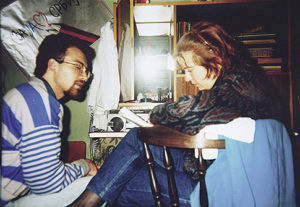
I was getting ready to enroll into journalism at the Faculty of Political Sciences in Belgrade, and that was in 1988, the economic crisis has been running rampant for a while, and the clutches of this environment came to light. I remember quite well when my father said: „I have always encouraged you, but you know that we are not in a position to finance you right now.“ At the time, we have already been growing up, for seven or eight years, under the burden of Serbian-Albanian relations. I remember the sentence he said to me at the time: „You are a girl and it is a question what effect it will have.“ And why did he tell me that? Because I remember that during these few years before starting my studies, after those demonstrations in ’81, female children were specially kept safe. Today I cannot claim whether this fear was justified or not, but if the classes at school were held late in the day, my parents waited for us in front of the school. These were the eighties and I remember those journeys back from school when there were usually a larger group of Albanians waiting for Serbian girls and heckling us. In this atmosphere of fear and, in some way, already distinguished gender issues, journalism fell out of the picture. There was not enough money, and Pristina was much closer. There was already a lot of police and army in Pristina, and for my whole life I wandered between journalism and literature, whether I wanted to be a writer or a journalist, I said: Well, then I will study literature and Serbian language. Interestingly, I brought documents to college to enroll into the Serbian language and literature department, but in a moment I turned, I still do not know why and handed over the documents to the English language department. It seems to me that I subconsciously missed this connection with the world. In any case, I buried the entire story about journalism.
New contacts with journalism…
All my dreams of journalism as a great profession dispersed in the nineties and I was happy to escape from that story because I saw that I could never work in all those editorial offices, starting with RTS to „Politika“, so I wondered if I had changed as I grew up or whether it was because of the degradation of the entire profession. It was especially evident that there was no real journalism here in KiM, as there was propaganda on both sides. During the 1990s, I started working on a local TV channel that opened here and I ran away from there as fast as I could, and the television station itself was shut down even faster. I worked shortly for ZIP, an external policy program, and at the time, a part of the ZIP program was done by TV Pristina. We traveled around the region and it was horrifying for me to go to the field and see the editor, who came with me, writing a text about what did not even happen in the field. And when I realized that everything was just pure propaganda. I ran away from this, because the story of journalism as a struggle for the truth, for informing citizens, was dead to me following the disintegration of that first state. At that time, I ordered “Njuzvik”, which caused small problems for me. The Secretariat of Foreign Affairs used to open my shipments or they would sometimes invite me to some sort of, now I realize, informative conversation. To warn me that they know my family, that it is a good, respectable family, and „what do you need this ‘Njuzvik’ for?“. It is the destiny of a small environment.
Childhood and youth in Mitrovica…
I have a principled life attitude on never returning to the past. And because of that, to be honest, this conversation with you is quite difficult for me. Maybe because the circumstances have made us as such that I cannot function if I do not think in advance, from this moment onwards. Because in the last three decades we have been in a constant state of emergency, I do not have that luxury to go back to the past and remember something. If I ever remember, it is just because I am thinking about solving the problem of a situation in which I am currently in. We have basically been in a state of emergency since ‘81, from ‘88-‘89 surely, and everything is more concentrated, faster, it only seems to me that this extraordinary situation from the past did not have the banality and the frivolity through which we are going through today.
I had a very happy childhood. In the seventies, and that was the period of my early childhood, our neighbors were intellectuals from Mitrovica. As Mitrovica prospered economically in the 1960s and 1970s, many intellectuals flocked there from all over Yugoslavia and I grew up in the area where the houses had „Trepca’s“ engineers, professors, doctors. But, I also remember that in my early childhood one house after the other was sold. I do not remember the sale of the houses themselves, but I saw how my neighbors and friends changed and how my growing up changed. I remember that I suddenly had to make sure whether I left my toys in the backyard or not so that they would not be stolen by those other children. I remember that we planted a hedge all around the house, and when we woke up in the morning, in the middle of the town, there was no single hedge box anywhere in sight. I remember that my father, being a hunter, went with a rifle to the end of the street to a neighbor who had just arrived because he found the hedge at his place. It was the time of the 1974 Constitution, the time when I had not yet started school, the time when these intellectuals started leaving. Serbs and Albanians lived together, they mostly visited each other during some important family events or big holidays. It is interesting that we still live next to the same neighbors. My closest neighbor is an Albanian Catholic family.
At school we were all mixed up – the Serbian and Albanian classes one next to the other, until I was in the fourth grade of elementary school. When we came back from the holidays, my class was no longer there, and it was a very stressful event for me. We were divided into three Serbian classes, and there were around six or seven Albanian classes. Serbian classes, as we called them, were almost a small Yugoslavia, and the Albanian classes were exclusively Albanian. When they divided us, they told us that there were not enough children for all classes, and the fact is that seven children in the class, I think, left overnight. Now I understand that this accelerated emigration of the Yugoslav intellectual core began after the Constitution of 1974.
The eighties in Kosovo…
The first demonstrations occurred in ’81, the institutions were still there, some friendly connections also, but a difference was already noticeable in the cities. We had divided streets here. And even today, you’ll see if we take a walk later, I will walk on „that“ side of the street. Always on the left side of the street, when you go down to the bridge because I spent my whole adolescence walking on the „Serbian“ side. That is what we called it because when the promenade was divided, the Albanians went on one side and we went on the other. The cafes were also divided into Serbian and Albanian. It seemed as if these divisions were completely natural. It was more natural and safe for me if I walked on the Serbian side of the street, less of us passed through, imagine, „less of us passed through.“ The grammar school was at the end of the town. When I went to school, I first walked along that comfort zone, the left side of the street, and I slowly went towards an increasingly risky zone. I went through the Serbian side all the way to the bridge, crossed the bridge, and suddenly I found myself in the middle, in which everything was at a boiling point, as though it was always a market day, most of them were Albanians, everything was dynamic, national tensions already existed, and since they knew that Serbian girls were going to school, they would gather and heckle. We always went in groups, we never went alone, because we felt safer that way.
I remember that once, while I was returning from school, and we had classes in the afternoon, as I passed through that part that was like Mitrovica’s bazaar, some Albanian told me something very misogynous. And I replied defiantly. He approached me and beat me, he slapped me hard several times. It was a terrible humiliation for me. I did not feel any fear, but it was extremely humiliating. I scrubbed my cheeks at home with a brush, I cried all through that night, I stayed in a locked room the entire time and I did not want to go out because I was afraid of telling my father and brother. I was afraid that they will go to the police, and I did not feel protected by the police. The first fear that I felt then was that something would happen to my father or brother because the police, as we believed, were Albanian. And I kept quiet about all this shame and pain.
The beginning of Milosevic’s power…
Imagine Pristina, where approximately 40,000 Serbs lived at the time. Milosevic comes to power, homogenizes Serbs, introduces repression of Albanians, who step out of institutions and then Serbs enter those institutions. I remember that I got my first job without any problems, as a student, because some Albanians stopped working and new job positions opened up. Imagine money pouring into Pristina, when state structures in Kosovo gained strength and when the Serbian community in the capital, Pristina, began to strengthen. With all the privileges that have been made possible, their national feeling of „defending“ Kosovo gained strength. I believe that the Serbian community „lived the best days of their lives“ back then in Pristina. From this perspective now, it appears to be so. As I grew up in a totally different environment, I saw that injustice and I saw that we, within the cities, became enemies. It is not just an interethnic problem now, but I grew up with an awareness that we have an institutional deconstruction of the state, institutions that are collapsing, losing quality, institutions that are no longer citizens’ services, but which rule over them, the corruption that was so visible. A decent, hard-working Serb family is suffering because it’s a minority. Albanians are also suffering, but many things are solved with money among them because that money comes from the diaspora.
The nineties…
I remember that we went to Gazimestan with the best conviction that someone arrived who was bringing back our dignity. But it only lasted a year. The disappointment was present in my house ever since ’91. The unconditional love for Milosevic was ubiquitous, and my closest family and I were in the minority. My extended family remained part of Milosevic’s structure or they just supported him. We even had a family problem, for example, when our closest relatives were not allowed visit our house at certain points because Dad was perceived somewhere as an opposition agent. My father is a great individual if he had acted wiser, if he had built a political career, I’m sure he would have much bigger problems. Since he was, above all, recognized as a professional in his specialty, that is what, I believe, saved us from some of the bigger problems, and the only thing that kept us safe.
Opposition…
The Serbs in Kosovo have been living in terribly difficult circumstances since 1999 and they do not have this luxury, they do not have a developed democratic capacity nor political life to the extent that we can act as the opposition or the position. Our political activity is fundamentally linked to providing the most basic survival conditions. From physical survival, through mere economics, to the provision of basic human rights, and it is difficult for political action to give the potential for a wider range of political profiles in such a crisis situation.
KoSSev…
The starting point at which KoSSev emerged relies heavily on everything I am talking about, on the terrible sense of vulnerability of the community. The crisis has not stopped here for 30 years, and that is my life. My entire childhood, and even later, was spent in the position of vulnerability: how to get to school, to take care of what language you are speaking, to look at what cafe you will go to, and KoSSev emerged from this feeling of vulnerability. And social injustice which I cannot stand. Nobody took care of us here and we lived under media lies and propaganda. Our life changed radically, especially after the continuation of the Brussels process, tectonic disorders were created in the community, and there were no words about it in the public.
KoSSev was created in February 2014. We worked as a non-governmental organization Centre for Communities Development, and we had an opportunity for a media project. When we started, as the only one who had some journalistic experience, I told the director Nevenka Medic and another colleague: „You do not know what you are walking into.“ At a rational level, everything inside me said that we should run away from this, but everything that really makes me me returned me to this, to the fight for decent information.
The price of fighting for decent information…
The last audience we won over was the local audience. That’s what I predicted. However, I did not anticipate the shooting at us, burned cars, I was prepared for the endangerment, but I did not go that far. I did not deal with the Serb-Albanian issue to the extent that I dealt with the current moment: we are in danger and we have to do something. Back in 2000-2001, I was one of the initiators, along with several other journalists, to establish our local news agency. It was never done, all that remained were the plans, and I was especially pleased when we opened KoSSev because it burned in me all this time: Why are there no people who want this to work properly? And when we founded KoSSev, I said: That’s it, yes, it’s 13 years later, but now we can shed light on something. We “aimed” at the international public, although we did not have content in English, we provided, at that time, an alternative view of events, we „aimed“ at diplomatic representatives’ office and the local public, at the same time. And I knew that we would win them over at a local level much later because we were not part of the publicized picture of what media was. This province has received its media education exclusively through RTS, local media that follow the RTS pattern, and this whole environment is actually a similar environment. Mitrovica is a city of similar people. There are individuals, but when we talk about a social pattern, it has always been the environment of similar people. Sometimes it was measured through undisputed loyalty to the KPJ, the SPS, the DSS, and now the SNS. There are individuals here who are inclined to critical thoughts, critics of the authorities, but they realize their maneuvering space with difficulty, they mostly stick out and many decide to leave because of this. A small number of them dares to remain in the province and to act publicly. I could count them on my fingers.
We quickly gained importance. The establishment of municipalities under the Kosovo system, the imprisonment of Oliver Ivanovic, the Brussels dialogue and its results were some of the issues that have, in time, „soared“ us into the local „orbit“ because we showed consistency and gave a different view of reality. We worked on media education of the public, and our survival was dependent on it. We cannot be a media that will „shock“ and then disappear. We have a saying here – „I will not slaughter an ox for a kilogram of meat.“ But tango with the public had to be danced the entire time, so if we take a step or two towards them, let them make at least half a step toward us. I knew that the pressure would eventually follow. That’s why it was important to win over the public space as soon as possible. The most important of our weapons, in addition to truth and honesty, was to win over as much of the public space as soon as possible as it was the third component that could have protected us most when the highest pressures started.
Pressures…
With our own news, we introduced the classic media monitoring of the Kosovo press. We did not repackage the news, but we kept the original narrative in the articles. In those articles from the Koha Ditore, for example, instead of saying „the president of provincial institutions in Pristina“, as Marko Djuric says, and we also published that, we quoted „President of the Republic of Kosovo Hashim Thaci“, in order for it to remain the same as in the original. It was important for us to show the original narrative of the text in the Kosovo newspapers. Of course, we knew that it carried a certain risk, because the Serb community was unused to someone saying the „Kosovo Republic“, even though the Albanians use it. The Serbs do not have such a problem to hear that from them, but they have a problem hearing it in the Serbian language. We additionally disassociated ourselves, and today we remark that the text was originally translated from Albanian. We have prepared people to understand that they do not reject diversity a priori, but that it is this diversity that actually empowers them as people literate in information are, as such, much more willing to better understand the situation. The first attack came from individuals of the pro-right-winger orientation or from the parts of the services to which they belong. They sent threatening messages, comments, and we pointed out immediately who we are, and what we are, and who finances us, we wanted to exclude every kind of ground for speculation. Although they will definitely accuse us of working for the „occupiers“, that we are paid by „Soros’s people“, we pointed out who finances us. The state-owned media here is financed by, for example, the KFOS or the British or the US or some other embassy, but they do not point that out. This is not something we are ashamed of as long as we maintain our independence in editing.
Then soft pressure began: you are great, you are good, we would finance something, we would give you some money, we want to help you. For example, this was offered to us by the president of the Provisional Municipal Authority who does not communicate with us today. I thanked him and said that it is not desirable to have this kind of cooperation with government institutions due to the objectivity of the job itself. After that, an e-mail arrived, saying they were willing to help us. Also, we are maybe the only NGO in Kosovo that has not yet requested or received a single euro from the Kosovo government.
And then, when I least expected it, a shooting on our premises occurred in June 2015. At that moment, we did not have any critical texts. From 2013 onwards, the absence of attacks was visible on the ground. It was a long period of peace that replaced a series of car burnings and the throwing of bombs. In 2013, we had the murder of a candidate for the mayor, election boxes were broken, abduction, as it was speculated, of the elected mayor, then we had Oliver who went to jail, and then they suddenly shot at us. It kept bugging me, why did they shoot? They did not want human victims, they saw that the lights were off while they were shooting. Usually, if intimidation starts, it starts with threats, then car burnings, and it ends with a shooting. But this was frontal, it started directly. According to our records, 11 bullets were fired, and it was done by someone who has a good aim because some of the bullets even went through the same hole. I did an analysis of what we wrote about and I could not find any reason anywhere on why it could have happened. For example, during this period a year earlier, seven days after the shooting, the barricade set up by the Serbs on the bridge in 2011 was removed for the first time. This was a huge event that was consciously presented in the media as irrelevant. And in fact, it was a big and significant event. This barricade on the bridge was „ultra“ visible and recognizable, guarded by civil protection personnel, various state-owned companies took turns to guard it. It was removed at the speed of light, and the Peace Park was created the following day. A whole new chapter was opened and if the shooting took place at that time, I would rightly speculate that this shooting could carry the message „you stopped working“ since we were the only ones that have reported about that event in detail.
Our car was set on fire in November, the only one we used, a private car in very good condition. It is interesting that after the shooting at us, that is, after many years, the car burnings started again. Official information from the police stated that our car self-ignited, the same was said for other cases before ours. And how did it self-ignite? Well, installations were not irregular. All right, it can happen once or twice. However, a pattern is formed in which, in the main street, self-ignition of luxury cars or well-preserved cars occurred. And then our car was also burned in November. In the morning, the police said that it self-ignited, and at that moment we were at the monastery celebration in Visoki Decani, there was no service, and the only message I received was that the police have determined self-ignition. Of course, we denied it. We conducted our private investigation and at the same time knew that it was not self-ignition because the car was serviced a few days earlier.
In June 2017, before the Kosovo extraordinary parliamentary elections, threats to my family arrived. I found out about them from my daughter who was eavesdropping on a conversation between my father and brother. My father would never have told me this. My brother was invited for an interview, we do not know by whom, and they told him, I am paraphrasing: your sister should stop doing what she does, writing what she writes, nothing will happen to her, but her family is here. At that time, I noticed that the institutions were excluding KoSSev from communication. And through several „circles“. We were first excluded by Serbian institutions, they stopped answering their phones, sending out announcements, after that it transferred to Srpska Lista, but what was the most dangerous for me was the fact that Kosovo police, with which we kept the closest possible connection in direct communication, with whose officials we talked to several times during the day, suddenly stopped answering our calls. I already started realizing that the next thing that can happen is an attack on one of us. Frankly, inside I prayed for them to strike at me and thought about what to do. I remember that, in those days, I called the police and the Serbian Deputy of Kosovo Ministry of Interior for the umpteenth time. Nobody answered my calls. I called the mayor and told him what I think, I stopped being a professional, I told him: if something happens to my family, you have not seen my madness yet. After that I called the British ambassador, we know each other well, but I never called him before, it was the first and only time. He was traveling, but he listened to me and said he would also inform the EULEX police, and that his deputy would contact me tomorrow. In the meantime, when the Deputy of the Minister of Interior answered my call, he told me: „What can I tell you, my car was also set on fire, Tanja, you see where we live, I know everything.“
I then established contact with the police commanders, I visited them. They asked me, „What are you doing?“, and I could not take it anymore – I started crying. I said, „I’m trying to save the life of my family.“ Apparently, they did not know anything about it. I told them about the threats and I also said: You have to remember, you cannot do this to me (and I am crying the entire time), now, here shoot a bullet through my head, but you cannot do what you’ve been thinking about doing to my family. They just remained silent. Apart from the deputy commander, an Albanian, the police still do not answer our calls, they do not communicate with us. Officials in most institutions, Kosovo and Serb, from the municipalities in northern Kosovo and Gracanica, the mayor’s cabinet, to the Kosovo ministries run by Srpska Lista, with the exception of Minister Dalibor Jevtic, do not communicate with us anymore. An image that it is „dangerous to be with us“ was intentionally created in the public, and that it is dangerous to talk to us. It technically represents a problem for us in writing news, but, for me, the fact that they are not communicating with us is also information.
Our journalists were physically attacked several times. Last summer, during the visit of Marko Djuric, a local Albanian attacked a colleague who no longer works for KoSSev, and me. The police were sitting and watching, knowing perfectly well who we are, but it did not cross their minds to approach and protect us. A policeman, a Serb, hugged him, patting him on the shoulder, the two of them were „buddies“, he removed him from Djuric to keep him from attacking him, but he came at us for no reason or motive. That evening and the next day, after the news spread, the police asked us to give statements and asked us whether we would sue. I do not want to sue, but you did not do your job, open an investigation, why didn’t you react. I do not want to complain about him, I’m complaining about you.
And again, when someone asks me what the scariest thing for me is, I would say the hacker attacks. Because I know that there must be a bigger structure behind it. We had a very serious attack when we published an interview with the former long-time president of Zvecan municipality, Dragisa Milovic, who disappeared from the political scene after the start of the Brussels process and then returned. The door of the media was closed to him everywhere except for ours, and that interview was on the site for an hour or two, and ten hours after that, due to a strong DDOS attack, we could not get our site to function. We transferred the text to Facebook and it was shared through social networks. Colleagues in Belgrade also picked up the text and that is when they understood for the first time. They did not pay much attention when they shot at us, burned our car, but this hacker attack raised our visibility. An image was created that there are no places in the media for the opposition, so they even cut the optical cable of a village cable TV station when a show with O. Ivanovic, D. Milovic and Jablanovic was broadcast.
One year since the murder of Oliver Ivanovic…
Death brought him back to the top of political life in a very tragic way. That death was not a coincidence. Perhaps most people could not have figured out that a murder would happen, but it was not a surprise when the network of criminals working around the city is taken into account, which basically swallowed the community. But symbolically, his death was that great reflector that lit up and illuminated what the population of northern Mitrovica was going through for several years, especially since the beginning of the Brussels process. In private, many will say that this is a city of the mafia, which leads most people to not even look for the murderer in the Albanian community. Perhaps I will be rude if I say that Oliver’s death suited many because many parties could have a political motive for him to be politically inactive, in the end, including the Kosovo Albanians themselves. The circumstances in which people have been living for several years now here in the north, and this is most visible in northern Mitrovica, have changed after this murder.
Comments by readers…
We had a lot of problems due to the authors of the comments. For example, for about two years, we had a reader who left comments on articles under the pseudonym Kusljo Guster, and on the basis of them, we believed that he was a „whistleblower“ because he constantly provided information on alleged corruption of politicians and police. Kusljo Guster became a favorite figure in the city, seen as a „Robin Hood“ of the community. When I would go to the city, people usually greeted us with „hello, KoSSev“, then they started „aha, Kuslja“, and his comments were regularly awaited, what will Kusljo Guster say? They spent a lot of energy trying to find him, held many meetings, and eventually they probably found him. I have some unconfirmed information that they barged into apartments, took computers, that they had extensive police action. They could not capture him for months, even two years maybe. He disappeared the moment we published news that the police said they would sue us if we did not remove the comments. His account disappeared and all the comments he had been leaving for two years were deleted. I know that people who write comments under their own names and surnames receive calls from someone „good-natured“, neighbors or officials of Srpska Lista, or the director of an institution, who tells them to remove the comment. This happens regularly. It is frightening in what the institutional infrastructure has invested. Many anonymous accounts of commentators also quickly disappear, as soon as they appear, and then new ones are opened. Once I was asked by the police in a „friendly“ manner: „Does such and such write? No more.“
Other media…
In our country, almost all alternative media in the Serbian language are NGO media. On the other hand, there are media that have only been the voice of the authorities for years or decades, so today they are mere de facto offices of the Office for Kosovo. At times, the editors or journalists of these media are not allowed to publish anything themselves, so they come and tell me the information. Electronic media on the Internet is becoming more and more popular among the seniors. I bought a tablet for my father, people have no idea what we are doing, now I see that they are printing texts, and taking them home to read. There are local media, such as TV Mir, Radio Kontakt plus, there is Budimir Nicic, who hosts the „Slobodno Srpski“ talk-show, or small media out of public focus, which are like little islands of freedom. I’d like to get in touch with them. For example, which is completely inexcusable, I only recently learned about Darko Dimitrijevic from Osojane. He is in charge of Radio Gorazdevac, and what he does is fantastic. He is one of the strongest political critics of the actions against the local community by Belgrade and by Pristina and the international community. I can imagine how difficult it is for him because he is alone in the enclave and he leads a Don Quixote-like struggle.
About the award…
The decision of „Vreme“ to choose me as the person of the year is actually a reward for all of us and it gives me the hope that all of us small journalists of editorial staff in Serbia will be more visible. Through this award, Darko Dimitrijevic and everyone else is more visible. However, my impression was how much „Vreme“ is visible here. I did not expect that. I know this by how many people from Mitrovica called me, and how many Mitrovica citizens outside of Mitrovica, even some I did not speak to for 30 years, how many older people called, congratulated, how many of them paid a round of drinks at the café and wrote me messages. Honestly, I wondered how is this possible? So one of my strongest impressions was the visibility of „Vreme“ among Serbs from Kosovo.
Untitled…
Kosovo Serbs are a decimated community in every sense of the word. And I think this battle is won through the media, in an informative way. And if we can not fight with the rifles, because for now, or so far, those times have passed, people here can be more literate regarding information and the media, so they can spread their voices further. We are not an active political factor for either side and the more we talk and write about us, we may have a chance to improve the situation we are in. Now we are at risk of disappearing. Whether overnight, whether it is through the outflow of people that have been going on since the ’70s, it’s certain that we are disappearing. It turned out that it is not worthwhile for the municipality, for example, to be a branch of the SNS headquarters in Belgrade or an outpost of the Kosovo government department. And so it began the making of a municipality in Serb-dominated areas with international support. This is not a policy that keeps the population in the field.
Life…
It seems to me that immediate life threats do not exist as much as before. On the other hand, I do not know what Oliver Ivanovic went through, but immediately before his murder, it seemed like the tension had declined. They killed him almost in the middle of the festive period, while on the side it seemed as if there were no tensions. I remember that we even managed to go on a short holiday for the first time, I remember telling a colleague that the New Year had started well and that I hope it ends well – and then they killed him. So that does not mean anything here.
Preuzimanje i objavljivanje tekstova sa portala KoSSev nije dozvoljeno bez navođenja izvora. Hvala na poštovanju etike novinarske profesije.