Political and social crises, coupled with growing security instability, have come to dominate everyday life in Serbia. The government’s response has included measures reminiscent of a state of emergency and a creeping coup, raising the risk of further escalation.
„President Aleksandar Vučić remains one of the most influential actors in this crisis. He has consolidated control over the media, key budgetary and investment decisions, and the management of the Serbian government, particularly its diplomacy, the military, and the police. The president is using this authority to advance the values and interests of a single segment of society and to build the Movement for the Defense of the State. His conduct violates both the letter and the spirit of the Constitution and the Law on the President, which define the president’s primary duty as safeguarding the unity of the state.”
These passages come from a non-paper titled “Preventing Structural Destabilization of Serbia”, drafted by Dušan Janjić, director of the Forum for Ethnic Relations. Sent at the end of June to a mailing list of public figures, policymakers, experts, and media—including Serbian officials—the non-paper built on an earlier document, “A Proposal for Reflection”, circulated the same day.


The text calls for dialogue between authorities, the opposition, and civil society actors at a “roundtable,” under domestic or, if necessary, international mediation. It proposes a package of measures: curbing police violence and extremism, dismantling alleged para-police structures, strengthening parliamentary oversight, reorganizing the police, and establishing a National Security Agency.
Central to the recommendations is an agreement on free and fair elections—through reform of the voter registry, oversight of the state data center in Kragujevac, changes to the electoral system, and clearer definition of presidential powers.
Protests and Escalation
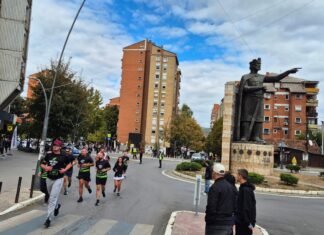
For weeks, Janjić’s appeal drew no reaction. But the situation shifted in August when protests erupted following violent incidents in Vrbas and Bačka Palanka involving police and ruling party supporters. By August 13, demonstrations had spread to more than ten cities under the slogans “Srbijo, probudi se!” (“Serbia, wake up!”) and “Stop the Violence.”
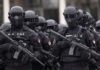
Protesters blocked roads and gathered outside ruling SNS offices and police stations, demanding resignations and snap elections. Some incidents escalated into property damage and clashes with police.
Authorities accused demonstrators of inciting unrest, while the opposition claimed that ruling party “thugs” were deployed to intimidate citizens.
International reactions also intensified. Both the Financial Times and Le Monde published sharply critical pieces on August 18, warning against appeasing Serbia’s “authoritarian president” and denouncing the deployment of “hooligans and enforcers” against protesters.
Brnabić: “Third Phase of a Color Revolution”
Speaker of the Serbian Parliament Ana Brnabić claimed on Tuesday that Serbia is facing the “third stage of a color revolution,” accusing domestic political actors of inviting foreign involvement in the country’s political crisis.
At a press conference in Belgrade, Brnabić said that the central proof of this alleged campaign is the non-paper authored by Dušan Janjić. According to her, the document proposes measures that would effectively transfer control of key Serbian institutions into the hands of international actors.
“When you read this non-paper, signed by Dušan Janjić but not by him alone, you see it is done on behalf of an anonymous ‘expert team’ for stability and security. My question is: who are these experts, by name and surname? The people of Serbia have the right to know,” Brnabić said in parliament.
Pro-government media had earlier reported that Janjić submitted the paper on August 13, describing it as an analytical proposal for a peaceful resolution to the current political crisis.
The coverage has been dominated by headlines accusing Janjić of conspiring with foreigners to remove President Aleksandar Vučić, branding the initiative as “proof of a color revolution.”
Brnabić insisted the recommendations outlined in the document amount to “the removal of all sovereignty,” pointing to its references to international oversight of the presidency, parliament, the National Security Council, and intelligence services.
“Imagine putting under foreign supervision a legitimately elected president who has received the support of our people. This is about taking sovereignty not just from institutions, but from every citizen individually,” she argued.
She singled out one particular proposal—the takeover of the state Data Center in Kragujevac, which houses personal information of Serbian citizens—calling it “scandalous.”
Brnabić also warned that Serbia would not allow scenarios similar to Ukraine’s Maidan protests to unfold in Belgrade.
“Our answer is no. And our message to foreigners is: don’t even think about further discussions on such non-papers. There will be no new Maidan in Serbia,” she declared.
While stressing that Serbia will defend its sovereignty “only through democratic means and institutions,” Brnabić accused the authors of the document of seeking to create the impression of a weakened state in order to justify international interference.
She concluded that the proposals amounted to a fresh attempt to abolish Serbia’s sovereignty, this time in an “even more comprehensive way,” while the omission of certain independent institutions suggested that their authors already consider them to be under their control.
Janjić: Misused for Propaganda
Speaking to KoSSev, Janjić confirmed he authored both documents, though the non-paper was coordinated with three other Serbian security experts. He argued that while his recommendations were framed as an offer for dialogue and reform, authorities seized upon them to propagate the narrative of a “color revolution.”
“This gives Vučić the chance to finally point to a document that ‘proves’ there is an attempt at a color revolution,” Janjić said, calling it a propaganda move. At the same time, he insisted, the paper contains concrete institutional reforms “that any government willing to change would make use of.”
Janjić also emphasized that while domestic mediation was preferable, he mentioned possible involvement of the Quint countries only as a fallback.


Legal Action Announced
Janjić has announced he will take legal action against officials and media outlets that branded him a traitor and a foreign agent. “There will be no settlement,” he said, vowing to pursue both public prosecutors and private lawsuits, with Brnabić at the top of the list.
Despite mounting pressure, he remains adamant that Serbia’s political leadership faces a governance crisis it can no longer conceal. “They know there is a rebellion in society. This is no longer just about students. They are struggling to manage the crisis,” he said.
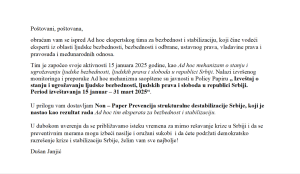
Non-pejper/Propratno pismo
Preuzimanje i objavljivanje tekstova sa portala KoSSev nije dozvoljeno bez navođenja izvora. Hvala na poštovanju etike novinarske profesije.